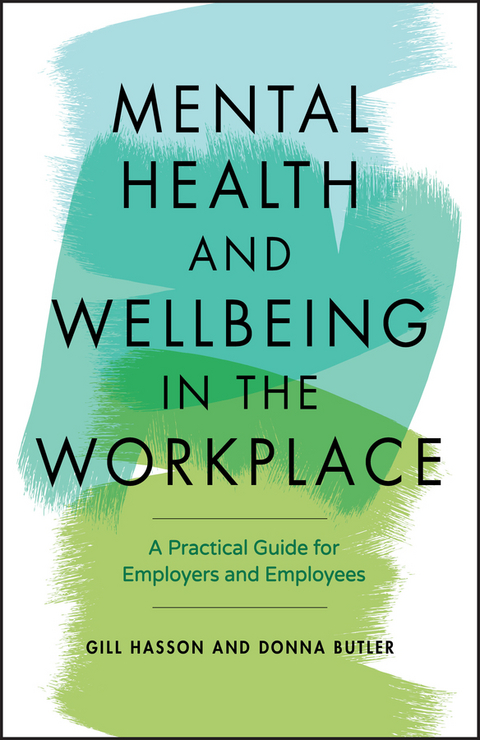
Mental Health and Wellbeing in the Workplace (eBook)
Provides guidance for both employers and staff on promoting positive mental health and supporting those experiencing mental ill health in the workplace
The importance of good mental health and wellbeing in the workplace is a subject of increased public awareness and governmental attention. The Department of Health advises that one in four people will experience a mental health issue at some point in their lives. Although a number of recent developments and initiatives have raised the profile of this crucial issue, employers are experiencing challenges in promoting the mental health and wellbeing of their employees. Mental Health & Wellbeing in the Workplace contains expert guidance for improving mental health and supporting those experiencing mental ill health.
This comprehensive book addresses the range of issues surrounding mental health and wellbeing in work environments - providing all involved with informative and practical assistance. Authors Gill Hasson and Donna Butler examine changing workplace environment for improved wellbeing, shifting employer and employee attitudes on mental health, possible solutions to current and future challenges and more. Detailed, real-world case studies illustrate a variety of associated concerns from both employer and employee perspectives. This important guide:
- Explains why understanding mental health important and its impact on businesses and employees
- Discusses why and how to promote mental health in the workplace and the importance of having an effective 'wellbeing strategy'
- Provides guidance on managing staff experiencing mental ill health
- Addresses dealing with employee stress and anxiety
- Features resources for further support if experiencing mental health issues
Mental Health & Wellbeing in the Workplace is a valuable resource for those in the workplace wanting to look after their physical and mental wellbeing, and those looking for guidance in managing staff with mental health issues.
Gill Hasson is a careers coach, has over 20 years' experience in the areas of personal & career development, and is a freelance tutor / teacher in mental health issues for mental health organisations. She also teaches and delivers training for adult education organizations, voluntary and business organizations and the public sector. Gill is also Capstone's best selling franchise author.
Donna Butler is an Integrative Psychotherapist with a private practice - she sees clients for psychotherapy, including EMDR trauma therapy if required. She conducts individual, couple and group therapy and specialist post incident de briefing is available in the clinic or within the recipient organisation. She is also a Specialist psychotherapist and EMDR trauma therapist.
***HIGHLY COMMENDED - HR & MANAGEMENT - BUSINESS BOOK AWARDS 2021*** Provides guidance for both employers and staff on promoting positive mental health and supporting those experiencing mental ill health in the workplace The importance of good mental health and wellbeing in the workplace is a subject of increased public awareness and governmental attention. The Department of Health advises that one in four people will experience a mental health issue at some point in their lives. Although a number of recent developments and initiatives have raised the profile of this crucial issue, employers are experiencing challenges in promoting the mental health and wellbeing of their employees. Mental Health & Wellbeing in the Workplace contains expert guidance for improving mental health and supporting those experiencing mental ill health. This comprehensive book addresses the range of issues surrounding mental health and wellbeing in work environments providing all involved with informative and practical assistance. Authors Gill Hasson and Donna Butler examine changing workplace environment for improved wellbeing, shifting employer and employee attitudes on mental health, possible solutions to current and future challenges and more. Detailed, real-world case studies illustrate a variety of associated concerns from both employer and employee perspectives. This important guide: Explains why understanding mental health important and its impact on businesses and employees Discusses why and how to promote mental health in the workplace and the importance of having an effective 'wellbeing strategy' Provides guidance on managing staff experiencing mental ill health Addresses dealing with employee stress and anxiety Features resources for further support if experiencing mental health issues Mental Health & Wellbeing in the Workplace is a valuable resource for those in the workplace wanting to look after their physical and mental wellbeing, and those looking for guidance in managing staff with mental health issues.
Gill Hasson is a careers coach, has over 20 years' experience in the areas of personal & career development, and is a freelance tutor / teacher in mental health issues for mental health organisations. She also teaches and delivers training for adult education organizations, voluntary and business organizations and the public sector. Gill is also Capstone's best selling franchise author. Donna Butler is an Integrative Psychotherapist with a private practice - she sees clients for psychotherapy, including EMDR trauma therapy if required. She conducts individual, couple and group therapy and specialist post incident de briefing is available in the clinic or within the recipient organisation. She is also a Specialist psychotherapist and EMDR trauma therapist.
Foreword xi
Introduction xv
1 Understanding Mental Health and Wellbeing 1
2 Is Work Good for Your Mental Health and Wellbeing? 33
3 How to Be a Good Place to Work 47
4 How to Look After Your Wellbeing at Work 87
5 Manage Your Mental Health at Work 131
6 Supporting Staff Experiencing Mental Health Problems 169
Websites, Books, and Resources 203
Find Out About Therapy 209
The Health, Employee, Learning and Psychotherapy Service at Brighton and Sussex University Hospitals NHS Trust 215
About the Authors 223
Index 225
1
Understanding Mental Health and Wellbeing
Defining Mental Health and Wellbeing
The World Health Organization (WHO) defines mental health as: ‘A state of well-being in which every individual realizes his or her own potential, can cope with the normal stresses of life, can work productively and fruitfully and is able to make a contribution to her or his community’.
Our mental health affects the way we experience the world; how we think, feel, and behave towards ourselves and others. WHO defines mental health as a ‘state of well-being’ and just as physical health is intrinsic to wellbeing, so is mental health.
The mental health organization ‘Mind’ suggests that if you have good mental wellbeing you are able to:
- feel relatively confident in yourself and have positive self-esteem
- feel and express a range of emotions
- build and maintain good relationships with others
- feel engaged with the world around you
- live and work productively
- deal with the stresses of daily life
- adapt and manage in times of change and uncertainty.
Both Mind and the World Health Organization's definition of mental health refer to a person's wellbeing. But is wellbeing the same as wellness?
When you think about wellness, think prevention and health. When you think about well-being, think happiness.
Susie Ellis. Chair of the Global Wellbeing Institute
Certainly, happiness is important, but there is more to wellbeing than the positive feelings that come with happiness. Both WHO and Mind recognize that wellbeing involves not just happiness, but crucially, the ability to manage difficulties, problems, and challenges; the ‘normal stresses’.
In 2012, Cardiff Metropolitan University Professors Rachel Dodge and Annette P. Daly et al. published their report The Challenge of Defining Wellbeing. Having reviewed and analyzed past attempts by other researchers to define wellbeing, they concluded that ‘it would be appropriate for a definition of wellbeing to centre on a state of equilibrium or balance that can be affected by life events or challenges’. Consequently they define wellbeing as: ‘the balance point between an individual's resource pool and the challenges faced’.
In other words, wellbeing occurs when a person is able to enjoy life and has the resources to draw on to manage life's ups and downs without feeling overly stressed. Therefore, an important component of wellbeing is resilience; the ability to cope with, as well as bounce back and recover from, difficulties and challenges.
Dimensions of Wellbeing; Social and Spiritual
There is no health without mental health.
World Health Organization
One of the key aspects of mental wellbeing is our social wellbeing; the ability to build and maintain good relationships with others. Social wellbeing is the extent to which you feel a sense of belonging and social inclusion. The UK Faculty of Public Health suggests that social wellbeing is ‘the basis for social equality and the antidote to issues such as racism, stigma, violence and crime’ and that it is dependent on, amongst other things, ‘the norm with regard to interpersonal relationships in a group, community or society, including respect for others and their needs, compassion and empathy, and authentic interaction’.
Another feature of wellbeing – just as important as social, mental, and emotional wellbeing, but not so widely acknowledged – is spiritual wellbeing. Spirituality refers to a sense of being connected to something bigger and more everlasting than yourself.
Spiritual wellbeing means the ability to experience and integrate meaning and purpose in life through a person's connectedness with self, others, art, music, literature, nature, or a power greater than oneself.
Spiritual wellbeing is about our inner life and its relationship with the wider world . . . Spiritual wellbeing does not just reflect religious belief although for people of a religious faith it is obviously a central feature.
Dr Ritika Srivastava
Physical and Mental Health and Wellbeing
Distinctions are often made between mind and body but when it comes to mental health and wellbeing and physical health and wellbeing, we can't think of them as separate entities. Poor physical health can lead to a person developing mental health problems. And poor mental health can have a negative impact on our physical health and wellbeing.
A physical health problem can impact on our cognitive and emotional abilities; adversely affecting our daily lives, our work, and our relationships. Conversely, if our mental health is suffering as a result of, for example, stress, depression, or anxiety, we are less likely to eat and sleep well and may be less physically active which, in turn, can impact our immune system and so our ability to resist infections and illness can be depleted.
Just as when we neglect and ignore our physical health we can become physically unwell, it's also the case that if we ignore or suppress difficult feelings we can become physically unwell.
When we are exposed to stressful experiences or trauma, we can, without realizing it, banish the experience to the unconscious; it's too much to deal with and it's pushed down to the basement of our minds. Eventually – sometimes years later – the stressful/traumatic experience can present as a mental health problem, for example an anxiety disorder. But a stressful or traumatic experience can also manifest itself as a physical disorder.
Case Study
One evening, Catrice was reversing her car into into the garage, when she heard a scream. She had reversed the car over her partner, Julie. Unknown to Catrice, Julie was sitting on the floor at the back of the garage, fixing her bike. Horrified and shocked, Catrice called an ambulance and Julie was taken to hospital. Although she had sustained serious injuries, they were not life threatening and in time, Julie recovered. However, a week after Julie's admission to hospital, Catrice developed a weakness in her lower limbs. Eventually she found that she was unable to stand; each time she tried, her legs gave way from underneath her.
Following weeks of tests, x-rays, physiotherapy assessments, and orthopaedic referral, Catrice's GP, believing that she was experiencing a ‘somatic response’ – a physical response to an emotional trauma – referred her to a psychotherapist.
Catrice had blocked the feelings – the trauma, stress, and guilt – she experienced as a result of Julie's suffering but those blocked feelings had manifested themselves as physical symptoms. With support from a psychotherapist, Catrice recovered; she was able to forgive herself for the pain and suffering Julie had been through as a result of her actions.
People with mental health problems are more likely to develop physical health problems and vice versa. Furthermore, people with mental health problems can present to their GP or employer complaining of physical symptoms that have no physical cause. This can sometimes lead to missed or delayed detection of the underlying mental health problem. The interaction between physical and mental health is complex and it is often difficult to determine the direction of causal relationships.
Professor Dame Carol Black
In the same way that the repression of stressful experiences can become a physical problem, physical health can impact on our mental health.
Psoriasis – an auto-immune condition affecting a person's skin – is an example of a condition which can impact on mental as well as physical wellbeing. A 2010 study published in the journal Archives of Dermatology found that those living with psoriasis are a third more likely than people without the disease to be depressed or anxious. The physical and psychological impacts can be cyclically linked: the condition can cause emotional distress which can trigger a psoriasis flare and, as a result, cause further distress.
Wellbeing is Subjective
A myriad of factors influence health and well-being, though many are familiar only to those who experience them.
Professor Dame Carol Black
Although there are key aspects to wellbeing – physical, mental and emotional, social and spiritual – wellbeing is subjective; each and every one of us has our own individual thoughts and beliefs about what makes for wellbeing. Our thoughts, ideas, beliefs, and experiences are framed in a narrative – we each have our own story – our own explanation or account of our wellbeing and what may or may not influence it.
For example, one person's account of their experience of depression and anxiety – how they feel, how they manage, and the extent of the impact on their wellbeing – will be different from someone else's experience and account. In another example, a person who is physically unwell or has a physical disability may feel that they have good levels of wellbeing despite illness or disability. Conversely, someone who is perceived as being well and ‘able bodied’ may believe and feel that they are not experiencing wellbeing to any great extent.
And, when it comes to traumatic experiences, professor of psychiatry at the University of North...
| Erscheint lt. Verlag | 9.4.2020 |
|---|---|
| Sprache | englisch |
| Themenwelt | Sachbuch/Ratgeber |
| Medizin / Pharmazie ► Gesundheitsfachberufe | |
| Medizin / Pharmazie ► Medizinische Fachgebiete ► Psychiatrie / Psychotherapie | |
| Schlagworte | Gesundheits- u. Sozialwesen • Health & Social Care • <p>workplace wellbeing • Mental Health • Psychische Gesundheit • Ratgeber • Self-Help • Self-Help Special Topics • Spezialthemen Ratgeber • workplace mental health • workplace mental health guide • workplace mental health help • workplace mental health resources</p> • workplace mental illness • workplace mental ill support • workplace wellbeing guide • workplace wellbeing help |
| ISBN-13 | 9780857088291 / 9780857088291 |
| Informationen gemäß Produktsicherheitsverordnung (GPSR) | |
| Haben Sie eine Frage zum Produkt? |
 EPUB (Adobe DRM)
Kopierschutz: Adobe-DRM
Adobe-DRM ist ein Kopierschutz, der das eBook vor Mißbrauch schützen soll. Dabei wird das eBook bereits beim Download auf Ihre persönliche Adobe-ID autorisiert. Lesen können Sie das eBook dann nur auf den Geräten, welche ebenfalls auf Ihre Adobe-ID registriert sind.
Details zum Adobe-DRM
Dateiformat: EPUB (Electronic Publication)
EPUB ist ein offener Standard für eBooks und eignet sich besonders zur Darstellung von Belletristik und Sachbüchern. Der Fließtext wird dynamisch an die Display- und Schriftgröße angepasst. Auch für mobile Lesegeräte ist EPUB daher gut geeignet.
Systemvoraussetzungen:
PC/Mac: Mit einem PC oder Mac können Sie dieses eBook lesen. Sie benötigen eine
eReader: Dieses eBook kann mit (fast) allen eBook-Readern gelesen werden. Mit dem amazon-Kindle ist es aber nicht kompatibel.
Smartphone/Tablet: Egal ob Apple oder Android, dieses eBook können Sie lesen. Sie benötigen eine
Geräteliste und zusätzliche Hinweise
Buying eBooks from abroad
For tax law reasons we can sell eBooks just within Germany and Switzerland. Regrettably we cannot fulfill eBook-orders from other countries.
aus dem Bereich