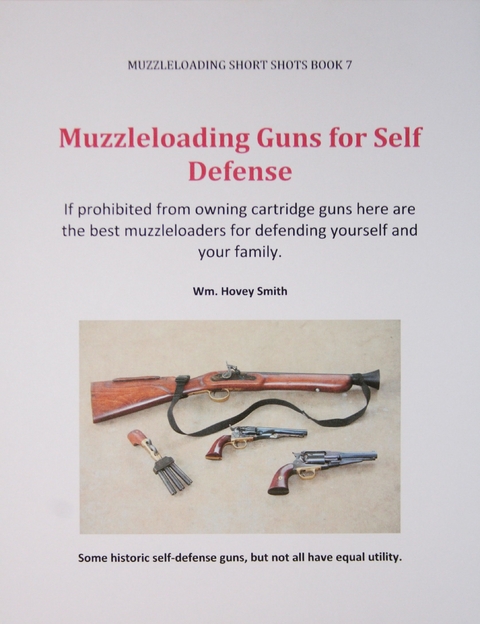
Muzzleloading Guns for Self Defense (eBook)
58 Seiten
Whitehall Press - Budget Publications (Verlag)
978-0-9855965-8-3 (ISBN)
The common, uncommon, and sometimes strange world of muzzleloading guns is investigated by author Wm. Hovey Smith from the point of view of critically examining their practical self-defense applications. For a decade Smith wrote the black-powder section of The Gun Digest Annual and had the opportunity to use and hunt with many historic replica firearms as well as occasionally refurbish and use some original guns. These experiences included dispatching wood rats with North American Arms' .22 percussion revolver to taking Cape Buffalo with a .50-caliber muzzleloading double rifle. Rather than slavishly sticking to historical precedents, he modified many of his guns to make them more effective hunting tools. This included things such as rebuilding a Colt Walker revolver to make it functionally reliable and more nearly capable of precise shooting, using nitride finishes to weather proof a variety of guns, and doing serious work with a .54-caliber blunderbuss to determine its actual capabilities. While muzzleloading guns are in no way magical, when employed by a skilled shooter they can be effective in self-defense applications. Keeping in mind their deficiencies, Smith describes tactics where they best employed and stresses the importance of making that first shot count, because that shot may be your only shot.
Chapter 1.
Is Some Gun Better Than No Gun?
North American Arms’ stainless steel .22-caliber revolvers have the power of a standard velocity .22 short.
When faced with a home intrusion or going into a deserted parking garage at night after a public event, is having any gun on your person better that not having one? Most people would answer this question positively; but with reservations about the portability, reliability, legality, and effectiveness of muzzleloading guns.
Although there are shadings of this in different jurisdictions, the most common standard is that deadly force may be used only when the person being assaulted reasonably assumes that he is defending his or someone else’s life. If the other person is armed and issues verbal threats or makes aggressive moves, you may make the assumption that the potential assailant intends to do you bodily injury. Nonetheless, you must be prepared to defend your action in court that there was some demonstrably aggressive act or perceived threat, and that using deadly force was your only option.
With sworn police officers facing increasingly exacting examinations every time they shoot with deadly results, you can reasonably expect that civilian activity would get no less attention.
Individual states may have “Stand Your Ground” laws, as was most recently publicized by the Travon Martin case in Florida. A neighborhood watch volunteer reportedly followed and shot a teenager who was returning home at night from a grocery store. There was a scuffle, one of the two shouted for help, and during the fight George Zimmerman pulled his gun and fatally shot Martin.
The “Stand Your Ground” defense would have not been particularly effective in this case if, in fact, Zimmerman ran after Martin and apparently challenged him, despite having received a warning from a police dispatcher that he should wait for the police, as was popularly believed at the time. Zimmerman claimed that he followed the dispatcher’s instructions and that Martin confronted him and demanded to know why he was being followed. That is when the fight broke out that was recorded on an open phone. It was during that fight that Martin was shot. Evidence indicated that the fatal shot was fired at very close range, and Zimmerman was acquitted.
The popular interpretation of the intent of this kind of legislation is that if you are challenged, you have the right to defend yourself if you have a fear for your life, without having to prove that there were no other available options. These other options might include your making the statement, “I am armed, and I will shoot if you come any closer.”
In addition to being knowledgeable about and reasonably proficient with the gun that you are carrying, you must also be assured that you have the proper permit and carry license for your firearm. These may be very restrictive indeed with some states having long waiting lists, arbitrary refusals, and mandated training programs. Just because yours is a black-powder firearm of an antique pattern does not necessarily exclude your gun from these requirements – particularly if you carry it concealed. Should you be traveling from state to state, some may recognize your carry permit while others will not. Other states may issue concealed carry permits, but prevent open carry of firearms, while others take the opposite approach.
Portability
As will be seen in Chapter 8 which discusses handguns, muzzleloading pistols come in all sizes from single-shot Derringers to those with barrels over a foot long. The smallest of these were designed to be eminently portable, although not necessarily carried in a holster or pocket. It was assumed during the 1700s that a gentleman in a carriage would have his pistols in a pistol box and be able to retrieve them if needed. This requirement was particularly true of flintlocks and extended into the 1860s when Henry Derringer’s pistols were sold as cased pairs of guns.
Carrying boxed sets of guns was not very practical for military units fighting on foot or horse. Pistol clips were used for sticking handguns in belts, pairs of holsters might be slung over a horse’s saddle, or American Civil War revolvers were commonly carried in belt holsters. The progressive design from matchlocks to flintlocks, to percussion, to cartridge guns resulted in more compact firearms that were safer to carry and could be reloaded more rapidly.
Percussion revolvers were advances in self-defense technology in that pre-loaded cylinders could be used (like magazines today) to more rapidly reload a gun, although this required removing the barrel of Colt-pattern revolvers and the cylinder pin on Remington-style pistols. Having pre-loaded cylinders is still an option, but they are one more thing to carry around or lose and are a source of danger should the cylinder fall or be struck in such a manner as to hit a percussion cap and fire the charge in one of the chambers.
Reliability
Are flintlock and percussion guns reliable? The correct answer to this question is yes and no. It depends on the quality of the gun,how it was loaded, weather conditions, and how it was handled. Flintlocks can lose their flints, have the flints crack, have the priming powder get wet or dribble out of the pan, and percussion guns have their own set of problems associated with the copper percussion caps.
Unless the guns are dropped into water or soaked by prolonged rain, properly loaded percussion guns are very reliable and flintlocks somewhat less so. It follows that these guns are most likely to function when stored in a dry environment, as in a home, rather than when used as an every-day carry gun exposed to the weather. Loads in muzzleloading guns can be shot centuries later if correctly loaded and kept dry, and the most common problems are with the ignition systems.
Compared to percussion ignition systems where there is only a hammer, percussion cap, and nipple; the added parts of the flintlock ignition system must all work properly for the gun to fire.
While percussion caps were great advances over flint ignition, the caps can lose their priming pellets or the priming compound can be dampened to the point of not firing when struck. In addition, fragments from a fired copper cap can jam between the cylinder and the frame so that a revolver’s cylinder cannot rotate or be stuck on the hammer’s nose cushioning the fall of the hammer to the extent that the next shot will not fire. Any long-term user of percussion revolvers will experience these problems.
Legality
Although laws vary from nation to nation, state to state, and city to city, generally it is less restrictive to own and purchase firing components for replica black-powder guns that for cartridge arms. These laws can also change depending on the whims of elected officials who generally know nearlyh nothing about guns and even less about muzzleloading firearms. Most people only see muzzleloading guns during reenactments of historic battles, in the movies, and they may be vaguely aware that there are brief primitive weapon hunting seasons where muzzleloaders are used.
Perhaps the most practical test is to attempt to purchase a gun, powder, and components at some large nearly gun or outdoor store. The clerks behind the counter would likely produce any paperwork necessary or explain what steps you need to do to buy your gun. Even as a foreign citizen visiting France, for example, you may be able to purchase antique muzzleloading guns and bring them into the U.S.; whereas this would be very difficult if it were a cartridge gun.
The United States with its Second Amendment to the U.S. Constitution guarantees, promotes, or permits, depending on your interpretation, the rights of U.S. citizens to own firearms. This has the result that in most of the 50 states, muzzleloading guns and the components needed to make them shoot may be freely purchased across the counter. Buying black powder is more difficult because of mandated storage requirements and its classification as an explosive. Because of these restrictions, relatively few sporting goods stores in the U.S. sell black powder, although many more sell Pyrodex, Triple7even, and other black-powder-substitute propellants.
Nonetheless, muzzleloading guns may still be purchased by mail in most U.S. states which increases the availability of replicas and new muzzleloading designs. Generally, all muzzleloaders in the U.S. are classified as the same category of arms even if they are not replicas of any particular gun or are new designs that use 209 primers, pelletized powders, and are scope sighted.
In some other countries the only muzzleloaders that may be owned or possessed without a license are replicas of historic arms with matchlock (a few), wheellock (almost none), flintlock (common) or percussion (common) ignition systems.
Effectiveness
As far as power is concerned, a single shot from a muzzleloading pistol can be as powerful as a modern cartridge revolver at close range, but is less efficient caliber for caliber. For example, to achieve the ballistic equivalency of the .38 Special revolver cartridge, a similar-sized muzzleloading revolver needs to be .44-caliber. The 60-grain charge of black powder and a round ball fired from the huge Colt Walker exceeds the power of the .45 ACP and .45 LC, but the Walker is over a foot...
| Erscheint lt. Verlag | 20.3.2020 |
|---|---|
| Sprache | englisch |
| Themenwelt | Sachbuch/Ratgeber ► Sport |
| ISBN-10 | 0-9855965-8-9 / 0985596589 |
| ISBN-13 | 978-0-9855965-8-3 / 9780985596583 |
| Informationen gemäß Produktsicherheitsverordnung (GPSR) | |
| Haben Sie eine Frage zum Produkt? |
 EPUB (Ohne DRM)
Größe: 10,8 MB
Digital Rights Management: ohne DRM
Dieses eBook enthält kein DRM oder Kopierschutz. Eine Weitergabe an Dritte ist jedoch rechtlich nicht zulässig, weil Sie beim Kauf nur die Rechte an der persönlichen Nutzung erwerben.
Dateiformat: EPUB (Electronic Publication)
EPUB ist ein offener Standard für eBooks und eignet sich besonders zur Darstellung von Belletristik und Sachbüchern. Der Fließtext wird dynamisch an die Display- und Schriftgröße angepasst. Auch für mobile Lesegeräte ist EPUB daher gut geeignet.
Systemvoraussetzungen:
PC/Mac: Mit einem PC oder Mac können Sie dieses eBook lesen. Sie benötigen dafür die kostenlose Software Adobe Digital Editions.
eReader: Dieses eBook kann mit (fast) allen eBook-Readern gelesen werden. Mit dem amazon-Kindle ist es aber nicht kompatibel.
Smartphone/Tablet: Egal ob Apple oder Android, dieses eBook können Sie lesen. Sie benötigen dafür eine kostenlose App.
Geräteliste und zusätzliche Hinweise
Buying eBooks from abroad
For tax law reasons we can sell eBooks just within Germany and Switzerland. Regrettably we cannot fulfill eBook-orders from other countries.
aus dem Bereich