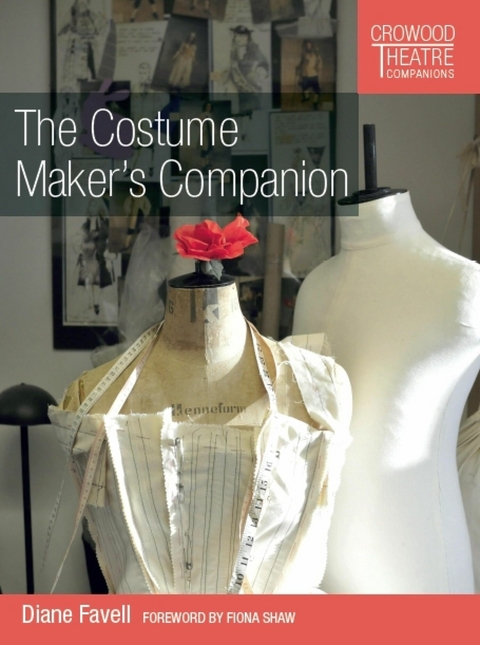
The Costume Maker's Companion (eBook)
272 Seiten
Crowood (Verlag)
978-1-78500-720-0 (ISBN)
Diane Favell has worked at the Royal Academy of Dramatic Art for nearly twenty-five years, teaching costume and running the Wardrobe department since 2001. Before this she both made for and supervised performances in theatre and film. Diane also teaches short courses at Central St Martins, University of Arts, London.
Diane Favell has worked at the Royal Academy of Dramatic Art for nearly twenty-five years, teaching costume and running the Wardrobe department since 2001. Before this she both made for and supervised performances in theatre and film. Diane also teaches short courses at Central St Martins, University of Arts, London.
1
MEDIEVAL
In this chapter we look at costumes from the late medieval era spanning 1200 to 1485, this being the period in Britain following a succession of invasions from other countries.
The Romans, Saxons (Scandinavia and northern Germany), Vikings, Normans (Normandy) and Danes (Denmark) all brought fashions from their own countries to Britain, and the effect had been significant.
This era also sees the start of the Renaissance period, widely accepted to be from 1300 to 1600, when fashion became a very significant influence on why we wore the clothes we did.
This period embraces Shakespeare’s historical plays about Edward III, Richard II, Henry IV, Henry V, Henry VI and Richard III, plays that are often visited by theatre, film and television. The monarchy very much influenced fashions, and so they will often be referred to.
In this section of the book men’s and ladies’ clothes are discussed together, as they at least start in a similar way, and many of the names of garments refer to both genders.
UNDERWEAR
Both men and women would wear loin cloths, although there is evidence that draw-string briefs were also worn, in the shape of shorts and small ‘tanga’ briefs (with no legs and only a short side seam). They would have been made of linen or wool. The loin cloth was either a triangle shape or a T shape, shown in red and blue in Figure 2, and was worn not unlike a nappy, with the sides brought round and tucked in and then the flap brought under the crotch and tucked in at the front. The cote, described below, was also worn as underwear, though made in a lighter fabric. Later, if fancy sleeves were needed, they could be attached to the underwear, usually tied at the shoulder.
Fig. 2: The loin cloth.
Ladies’ corsets didn’t really exist in these times, though there is some evidence of iron forms likely to be used as a form of chastity belt, to be locked on when the husband was away. It is very possible, however, that ‘body binding’ existed, and dresses became quite figure hugging – it is likely that ladies of the higher classes wrapped their bodies tightly to smooth out any ‘unsightly’ bulges.
THE COTE
The cote was a very basic garment, which existed before any invasions. Celtic men wore it as a basic garment, and it was then used under armour. There were influences from many countries, mainly in the way it was decorated, but the development of the shape, and therefore the pattern shapes, were the same. There were garments called a cote for both men and ladies, the ladies wearing them from the middle of the thirteenth century until the fourteenth century, when a more tailored garment came into play.
Fig. 3: The classic man’s cote, worn throughout the medieval period.
The original cote was a T shape, made from one piece of fabric, as shown in Figure 3. More affluent men wore long cotes, while workers would have shorter ones (just past the knee), which was more practical; they would wear trousers, or braies, under the cote. The cote would have a faced or bound opening at the neck, and sometimes splits from the waist to the hem. This developed into a more tailored garment that flared out at the sides and had set-in sleeves.
Blues, reds and greens were the usual colours of the day, with the poorer community managing to dye greys and ‘russet’ colours. All cotes would have been woollen at this time, unless used as an undergarment, in which case they might have been linen.
Fig. 4: A cote made from tweed – from the RADA costume store.
Fig. 5: Wool was the most probable fabric to use for this period, though linen might be worn by the rich.
A: The lady’s cote, worn throughout the medieval period and as an undergarment in later periods.
B: The gown, with long, wide sleeves. Fashionable circa 1200.
C: The lady’s kirtle, also fashionable circa 1200.
Ladies’ cotes were always long, and developed quickly to have gores in the sides, and tailored sleeves. The cote would usually be drawn in at the waist with a girtle (belt), and this gave it the shape that later developed to become a gown. By the 1200s the cote had already developed wide-bottomed sleeves, as shown in Figure 5B, and was either fastened at the neck in a similar way to the man’s cote, or was laced down the back, which allowed for further shaping. This developed into the kirtle, which was a close-fitting garment, often worn under a cotehardy.
In the 1200s it is likely that the looseness of the weave of the woollen fabric allowed for the fabric to be shaped merely by the lacing at the back; it is also possible that felt was used, which would mould to the body well. The kirtle did use seams, first a princess but then a waist seam, which we are much more likely to use when making one of these garments.
Fig. 6: A lady’s gown – from the RADA costume store.
THE SUPERTUNIC
The supertunic is a garment we’re more likely to call a ‘tabard’ now. It was a long piece of fabric that would almost reach the front and the back hem of the cote, as can be seen in Figure 7 in the middle drawing, with a hole for the head; it was attached together at the waist, or kept in place by a belt. Both men and women had these. The women who wore a supertunic were mainly the working class, and it was the forerunner of what we know now as the apron. It was also used by nuns, and still remains part of the traditional habit (called a scapula). Higher classes did wear a form of the supertunic as a fashion item, when it was usually lined with fur and called a pelisson.
Fig. 7: Gold and silver were also worn by the rich. A: The bliaut worn by both men and women.
B: The male supertunic.
C: The lady’s surcote, showing the progression from the supertunic to the surcote.
Another form of the supertunic was the surcote, which was more shaped, with deep armholes: it is shown as C in Figure 7.
THE BLIAUT
The bliaut was fashionable from the eleventh to the thirteenth centuries; it could be one or two layers, and was worn by both men and women. It was cut on the cross of the fabric so it had some give, and was made tightly to the body, wrinkling up over the torso. It was often belted by a wide cummerbund over the belly, shown as A in Figure 7.
The supertunic and surcote were rarely worn in the fifteenth century, the main forms of dress being the houppelande and the cotehardie or gown.
THE COTEHARDIE
The cotehardie appeared during the fourteenth century and was a much more tailored garment. The main difference between the lady’s and the man’s garment was the length: the man’s reached to just below the knee, and the woman’s to the ground. It was worn over a gypon (later referred to as a doublet).
Fig. 8: The cotehardie, worn with a hood with a cape attached, also showing a tippet, worn as a separate garment.
The garment had buttons to the waist, and was shaped into the body. It didn’t usually have darts or any other shaping other than that in the seams. The buttons were on the edge of the centre front, so the opening was almost edge to edge. The drawing in Figure 8 shows a later cotehardie, which was short and often worn with a hood with a cape attached.
The man’s cotehardie often had dagging on the hem (the one in Figure 8 has some on the cape): this was either in the shape of scallops, or squares cut into the edge of the garment. The sleeves were usually short, revealing the sleeves of the gypon underneath, and had hangings from the back of the sleeve. These hangings later became a separate item, comprising a band around the arm with a long piece of fabric called a tippet attached; this is shown separately in Figure 8.
The lady’s kirtle took the name of cotehardie. During the fifteenth century the cotehardie developed a collar similar to the houppelande, high with a turnover or padded top to it. The garment itself was slightly padded and had pleats stitched in place down the front; later in the century these became longer.
The lady’s cotehardie still had the close-fitting sleeves of the fourteenth century but developed an oversleeve, which hung open with long tippets to the ground. During Henry V’s reign (1413) the lady’s cotehardie came to be called a gown.
NOTE: In the fifteenth century silk was broadly used in fabrics. The silk industry was growing in Europe, especially in Italy and Spain, and this brought an abundance of taffetas and brocades in strong, rich colours, which influenced fashion from this time onwards.
THE HOUPPELANDE
Introduced late in the fourteenth century, the houppelande was the main garment in the fifteenth century: it was a long, very full-skirted gown that fell in folds. It had a high neck, which either turned over at the top, or had a padded top to the collar. The skirt was split at the front or sides, and often had dagging along the hem. The sleeves were full at the wrist, and often had dagging here, as well as that shown in Figure 9.
Fig. 9: The houppelande, from the late fourteenth century onwards, made with silk, frieze (a thick woollen cloth), fustian (a fine woollen cloth), and brocade with taffeta linings.
Fig. 10: A houppelande with the pleats sewn down – from the RADA costume store, originally donated by the Regent’s Park Theatre.
Fig. 11: A development of the...
| Erscheint lt. Verlag | 23.3.2020 |
|---|---|
| Reihe/Serie | Crowood Theatre Companions | Crowood Theatre Companions |
| Verlagsort | London |
| Sprache | englisch |
| Themenwelt | Kunst / Musik / Theater ► Theater / Ballett |
| Sachbuch/Ratgeber ► Freizeit / Hobby ► Handarbeit / Textiles | |
| Sachbuch/Ratgeber ► Freizeit / Hobby ► Heimwerken / Do it yourself | |
| Sachbuch/Ratgeber ► Sport ► Tanzen / Tanzsport | |
| Schlagworte | applique • bagpipe sleeve • bag wig • balance points • Barbette • betsy dress • bliaut • bloomers • bodice • body binding • Boning • bound buttonholes • bound buttons • braises • Brazier • Breeches • bustle • butterfly veil • calash • canions • cartwheel farthingale • Chaperon • chemise • cod piece • copitain • Corset • Costume • costume construction • costume design • costume maker • Cote • cotehardie • cravate • crin • crinoline • crispinette • Dagging • doublet • English dress • epaulettes • fall front breeches • farthingale • fontage • french hood • frockcoat • gable hood • goldwork • gown • gypon • hennin • herringbone stitch • Hoes • homburg hate • houppelande • jerkin • jigger • kirtle • knee knots • leghorn hat • liripipe • macaronies • moccasins • Norfolk jacket • over gown • parlet • partlet • pattern cutting • Pattern Matching • peasecod • pelisse • pelisson • pinking • Piping • poke bonnet • Polonaise • Pressing • queen's gown • quiliting • ramillie • robarti • Robe Anglais • roundel • Ruff • saque dress • Scapula • spencer coat • Stockings • stomacher • stumpwork • supertunic • Tailoring • underproper • waistcoat • Watteau pleats • wimple |
| ISBN-10 | 1-78500-720-3 / 1785007203 |
| ISBN-13 | 978-1-78500-720-0 / 9781785007200 |
| Informationen gemäß Produktsicherheitsverordnung (GPSR) | |
| Haben Sie eine Frage zum Produkt? |
 EPUB (Wasserzeichen)
DRM: Digitales Wasserzeichen
Dieses eBook enthält ein digitales Wasserzeichen und ist damit für Sie personalisiert. Bei einer missbräuchlichen Weitergabe des eBooks an Dritte ist eine Rückverfolgung an die Quelle möglich.
Dateiformat: EPUB (Electronic Publication)
EPUB ist ein offener Standard für eBooks und eignet sich besonders zur Darstellung von Belletristik und Sachbüchern. Der Fließtext wird dynamisch an die Display- und Schriftgröße angepasst. Auch für mobile Lesegeräte ist EPUB daher gut geeignet.
Systemvoraussetzungen:
PC/Mac: Mit einem PC oder Mac können Sie dieses eBook lesen. Sie benötigen dafür die kostenlose Software Adobe Digital Editions.
eReader: Dieses eBook kann mit (fast) allen eBook-Readern gelesen werden. Mit dem amazon-Kindle ist es aber nicht kompatibel.
Smartphone/Tablet: Egal ob Apple oder Android, dieses eBook können Sie lesen. Sie benötigen dafür eine kostenlose App.
Geräteliste und zusätzliche Hinweise
Buying eBooks from abroad
For tax law reasons we can sell eBooks just within Germany and Switzerland. Regrettably we cannot fulfill eBook-orders from other countries.
aus dem Bereich