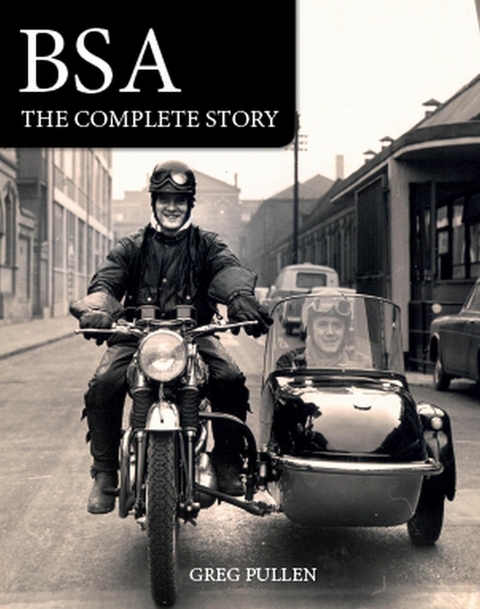
BSA (eBook)
406 Seiten
Crowood (Verlag)
978-1-78500-740-8 (ISBN)
Greg Pullen trained and enjoyed a career as a chartered surveyor, finally retiring as a Fellow in 2009 to pursue his interest in motorcycles and writing. His lifelong love affair with two wheels began in the era of the sports moped and Barry Sheene, growing up in rural Wiltshire during the long, hot summers of the 1970s. Greg has written for many magazines including Classic Bike, Classic Bike Guide and Bike, alongside his own publication, Benzina. He is also author of five other books for Crowood on Classic TT Racers, Ducati Desmodue, Moto Guzzi, The A-Z of Italian Motorcycles and Honda V4s, as well as his self-published Ducati and the TT.
BSA was once the world's most successful motorcycle company, manufacturing more machines than any other in the world by the mid-1950s. And yet, after winning the Queens Award to Industry for exports in 1967 and 1968, it collapsed into bankruptcy in 1973. This is an epic story of rise and fall, even by the precarious standards of the British motorcycle industry. With over 170 illustrations, this book recalls the founding of the company and its foray into bicycle and then motorcycle production. It describes the evolution of the various models of motorcycles including specification tables and discusses the diversification into cars, commercial vehicles and guns for Spitfires. It recounts the successes - two Maudes Trophies and numerous racing victories, and documents the fall from grace to bankruptcy and beyond.
Greg Pullen trained and enjoyed a career as a chartered surveyor, finally retiring as a Fellow in 2009 to pursue his interest in motorcycles and writing. His lifelong love affair with two wheels began in the era of the sports moped and Barry Sheene, growing up in rural Wiltshire during the long, hot summers of the 1970s. Greg has written for many magazines including Classic Bike, Classic Bike Guide and Bike, alongside his own publication, Benzina. He is also author of five other books for Crowood on Classic TT Racers, Ducati Desmodue, Moto Guzzi, The A-Z of Italian Motorcycles and Honda V4s, as well as his self-published Ducati and the TT.
CHAPTER ONE
BEGINNINGS
There was only one place I could start this story, and try to understand the feelings of those involved in BSA’s heyday: Birmingham’s Bullring is now a huge temple to those who prefer to worship in a shopping centre, but it was once where Birmingham’s motorcyclists congregated. The name comes from the iron hoop to which a bull’s nose ring was joined by a length of rope, ready for the auctioneers’ gavel. I feel a measure of trepidation when asking about the factory’s whereabouts at the Bullring’s taxi rank, but needn’t have – the driver knows exactly the location of what is left of the BSA factory. Almost £10 later I’m standing in front of what was once the biggest motorcycle factory on earth, a surprising stillness around me after the traffic jams of the journey here.
Armoury Road in 2017.
All roads lead to Birmingham. SIMISI1
The buildings are still easily recognized, if unloved. One is a car workshop, rammed with discarded bumper panels. At the far end a single-storey building, in red brick like the other original edifices, has bright, polished letters along one side set into blinded windows – BSA: Birmingham Small Arms, advertised as the ‘long-established air-rifle manufacturer and retailer, also selling scopes, pellets and silencers’. This is all that’s left of a proud history that gave the Armoury Road I’m standing in its name. No blue plaque, no tourist information board, nothing. The canal that runs from the end of the road has recently been refurbished in a multi-million pound investment that failed to find a few pounds to remember what was perhaps Birmingham’s finest hour.
Overlooking the canal is another sad and unloved building, gradually decaying, a metaphor for the decline of British industry through the 1960s and 1970s. A sense of entitlement grasped a nation that had been the world leader in innovation, enterprise, and the belief that to be born British was the greatest gift any child could wish for. On the other side of the world the Japanese embraced the post-war possibilities, while Britain – bankrupt and stripped of empire by World War II – was bereft of ambition. Those in the boardroom felt they could return to their unquestioned old world authority, while others, who had seen those men fight, decided it should be the working man who held the levers of power.
‘People would come into work with their fishing rods, expecting a walk-out,’ remembers Pat Slinn, who, like his father, worked in the experimental department. ‘I’d ride my Bantam in round the back to avoid the pickets, but most people just fancied a day off.’ Perhaps they should have been more careful of what they wished for. I walk back to the city centre along the beautifully restored – but completely deserted – Grand Union Canal, the smart gravel towpath pleasingly litter free.
Back in the hotel room I email a photo to Chris Smith, daughter of BSA’s world champion Jeff. The family lives in Wisconsin close to the great lakes, running Motorsport Publications which distributes UK magazines and books to US readers. Chris and Jeff are unequivocal: they never want to see the factory again – it would be just too heart-breaking. I’d met Pat Slinn earlier in the nearby National Motorcycle Museum. After falling silent in the middle of the first hall he stops and raises his hands in the air: ‘What happened to it? Where did it all go?’ he asks. This is an attempt to find out.
These innovative part-reinforced concrete BSA buildings were some of the first of their type in the world. Sadly today they are unloved and used for car repairs.
IN THE BEGINNING
Birmingham (originally Bermingehame) means the home of the Beorma, some long-forgotten Anglo-Saxons. By the early twelfth century it had grown into a town, and in 1166, King Henry II gave the Lord of the Manor, Peter De Birmingham, the right to hold a market, which was soon drawing merchants and craftsmen to the area. By the late fourteenth century Birmingham was known for its metalworking, helped by the proximity of iron ore, coal and surrounding streams turning watermills that powered the bellows of the many forges.
In 1570 a writer observed that Birmingham was ‘full of inhabitants and echoing with forges’, the metalworking industry fast taking over the area. Tudor Birmingham gained a reputation as a place where cutlers made knives, nailers made nails, and blacksmiths worked at their forges. Inevitably this work included making swords and, in turn, an evolution to gunpowder weapons. But each tradesman tended to work alone, and even by the time rifles were being made, there would be specialists for barrels, stocks or even trigger guards. Mass production it was not, and a few men with foresight realized that there needed to be a coming together of like-minded – but variously skilled – smiths.
The Birmingham Small Arms Trade Association gave the city’s master gunsmiths a chance to join forces in 1854, with John Dent Goodman elected as chairman the following year. This was a group of men (perhaps as few as fourteen, perhaps as many as twenty-four) intending to supply munitions (particularly handmade muzzle-loading rifles) for the Crimean War.
Presumably the union was successful because, meeting together on the Friday evening of 7 June 1861, the association decided to form a public company, the Birmingham Small Arms Company Limited, in the Gun Quarter of England’s second city, with Goodman remaining chairman. The War Office promised the BSA gunsmiths free access to technical drawings and to the War Office’s Board of Ordnance’s Royal Small Arms factory at Enfield – as in Royal Enfield. New machinery developed in the United States (US) had been installed at Enfield, and greatly increased output without needing more skilled craftsmen.
The great and the good of Birmingham viewed the expansion of Enfield with suspicion, knowing that the dedicated factory’s proximity to London and its long history of producing firearms gave it an advantage over the loose-knit gunsmiths of Birmingham. Throughout the evolution of the British rifle the name ‘Enfield’ is prevalent, meaning the Royal Small Arms Factory in the town – now suburb – of Enfield – hence its eventual renaming as ‘Royal Enfield’. This factory, north of London, was where the British government had produced muskets since 1804.
Birmingham’s canals are used for leisure today, but were essential to the city’s prosperity. WONJONG OH
The first British repeating rifle was developed in 1879, and adopted as the Magazine Rifle Mark I in 1888, commonly referred to as the Lee-Metford. ‘Lee’ was James Paris Lee, a Scottish-born Canadian-American inventor who designed an easy-to-operate turn bolt and magazine to work with it. ‘Metford’ was William Ellis Metford, an Englishman instrumental in perfecting the smaller .303 calibre – the calibre of the Spitfire’s Brownings. These developments led to the Lee-Enfield repeating rifle, which served as the British Empire and Commonwealth’s main firearm during the first half of the twentieth century. It was also the British Army’s standard rifle from its adoption in 1895 until 1957, so if Birmingham couldn’t persuade the government to allow them to be part of the project, its firearms industry was doomed.
Lee-Metford Mk II .303. ARMÉMUSEUM / SWEDISH ARMY MUSEUM
The BSA’s stated purpose on establishment in 1861 was to make guns by machinery and, although no mention is made of it, the only significant conflict by this time was the American Civil War, the Crimean War having ended in 1856. This would prove the fallibility of building a city’s future around weaponry: there are times in history when wars are thankfully rare, and they are often unpredictable. BSA, like Royal Enfield, would have to find an alternative revenue stream, and they would both fall upon the same idea: the motorcycle.
BSA settled on a 25-acre (10-hectare) site at Small Heath on the condition that the Great Western Railway would build a station nearby. By 1863 the factory was complete, standing alone in open countryside, a square, red-brick fortress with towers at each corner, apparently mainly employing women, judging by photographs of the era. It was set south of the Coventry road and what is now the A45, to the south-west of the city centre and squeezed between the new Small Heath train station and one of the final sections of the Grand Union Canal, which absorbed the older Warwick and Birmingham Junction Canal. This ensured swift loading and excellent links to Manchester and London, as well as to the ports of Liverpool and Bristol.
When you visit Birmingham it’s never long before a proud local will tell you that ‘Birmingham has more miles of canal than Venice’. Is this true? The exact numbers depend on where you draw the city boundaries, but the system adds up to around 100 miles (160km) of canals. It was certainly one of the most intricate canal networks in the world, the life-blood of Victorian Birmingham and the Black Country. At their height, the canals were so busy that gas lighting was installed beside the locks to permit round-the-clock operation. Boats were built without cabins for maximum carrying capacity, and a near-tidal effect arose from swarms of narrowboats converging on the Black Country collieries at the same time each day.
In 1866 BSA acquired a munitions factory in Adderley Park, about two miles (3km) north of the Small Heath site and again between a train...
| Erscheint lt. Verlag | 30.9.2020 |
|---|---|
| Verlagsort | London |
| Sprache | englisch |
| Themenwelt | Natur / Technik ► Fahrzeuge / Flugzeuge / Schiffe ► Allgemeines / Lexika |
| Natur / Technik ► Fahrzeuge / Flugzeuge / Schiffe ► Auto / Motorrad | |
| Schlagworte | 10HP Roadster • 250 Round Tank • A28 • ARIEL • Armoury Road • Bankruptcy • bantam • barracuda • Bicycle • Birmingham Small Arms Company • British motorcycle • Catalina • Daimler • Dandy • daytona • Fieldmaster • Firearms • Firebird • Fury • Golden Flash • gold star • Guns • Hurricane • Lightning • M23 Empire Star • mahindra • Maudes Trophies • Minerva • Model B • Model E • Model G • Model H • Model K • Model L • motorbikes • motorcycle books • motoring • OHV • Pat Slinn • Queens Award to Industry • Rocket • Royal Star • Scout • Scrambler • Shooting Star • Side-valve single • Sloper 500 • Spitfire • Sport Star • Starfire • Super Flash • Tracker • Trident • Victor Roadster • Victor Special • V-Twin • W32-6 • Winged Wheelby |
| ISBN-10 | 1-78500-740-8 / 1785007408 |
| ISBN-13 | 978-1-78500-740-8 / 9781785007408 |
| Informationen gemäß Produktsicherheitsverordnung (GPSR) | |
| Haben Sie eine Frage zum Produkt? |
 EPUB (Adobe DRM)
Kopierschutz: Adobe-DRM
Adobe-DRM ist ein Kopierschutz, der das eBook vor Mißbrauch schützen soll. Dabei wird das eBook bereits beim Download auf Ihre persönliche Adobe-ID autorisiert. Lesen können Sie das eBook dann nur auf den Geräten, welche ebenfalls auf Ihre Adobe-ID registriert sind.
Details zum Adobe-DRM
Dateiformat: EPUB (Electronic Publication)
EPUB ist ein offener Standard für eBooks und eignet sich besonders zur Darstellung von Belletristik und Sachbüchern. Der Fließtext wird dynamisch an die Display- und Schriftgröße angepasst. Auch für mobile Lesegeräte ist EPUB daher gut geeignet.
Systemvoraussetzungen:
PC/Mac: Mit einem PC oder Mac können Sie dieses eBook lesen. Sie benötigen eine
eReader: Dieses eBook kann mit (fast) allen eBook-Readern gelesen werden. Mit dem amazon-Kindle ist es aber nicht kompatibel.
Smartphone/Tablet: Egal ob Apple oder Android, dieses eBook können Sie lesen. Sie benötigen eine
Geräteliste und zusätzliche Hinweise
Buying eBooks from abroad
For tax law reasons we can sell eBooks just within Germany and Switzerland. Regrettably we cannot fulfill eBook-orders from other countries.
aus dem Bereich