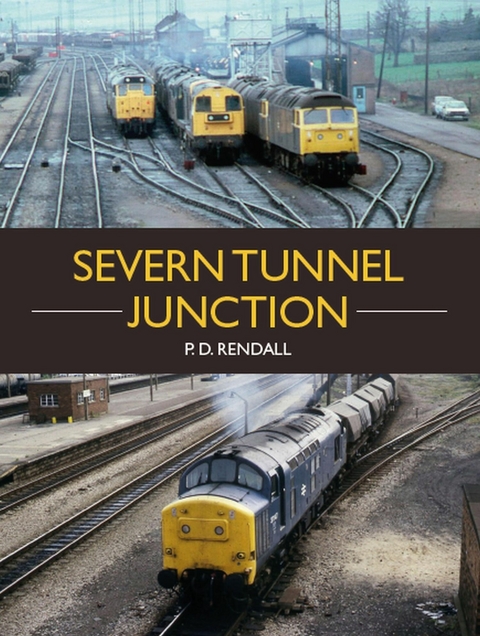
Severn Tunnel Junction (eBook)
329 Seiten
Crowood (Verlag)
978-1-78500-738-5 (ISBN)
P D Rendall became a Mechanical Engineering apprentice for British Rail Engineering's Swindon works at the age of sixteen. After nine years in engineering he worked as a Signalman, rising to become Superrvisor of the Bristol Panel signal box. He has an Honours degree in Social and Community History, and divides his time between work as a social historian and in the mental health sector. He is a published author on many subjects, from the 1970 Bristol resignalling to the North Somerset coalfield, and has appeared on local TV and radio. This is his third book for Crowood.
The Severn Tunnel Junction was the largest freight marshalling yard on the Western Region of British Railways, once stretching for over two miles along the Welsh bank of the River Severn. At its height it was a goods yard, junction, station and loco depot, but it was an important railway community and small town as well. With over 150 photographs this book describes the beginnings of the yard within the wider historical context and discusses the expansion of the site and the impact of the two World Wars. It documents the methods of working at the junction and recalls the locos, freight and passenger trains that travelled the lines. Finally, it remembers the people who worked and lived here.
P D Rendall became a Mechanical Engineering apprentice for British Rail Engineering's Swindon works at the age of sixteen. After nine years in engineering he worked as a Signalman, rising to become Superrvisor of the Bristol Panel signal box. He has an Honours degree in Social and Community History, and divides his time between work as a social historian and in the mental health sector. He is a published author on many subjects, from the 1970 Bristol resignalling to the North Somerset coalfield, and has appeared on local TV and radio. This is his third book for Crowood.
CHAPTER 1
The Beginnings
The year 1870 had begun with mixed prospects. In Europe, the Prussian prime minister, Otto von Bismarck, was whipping up nationalistic fervour in order to unite the independent German states with Prussia. The French were against such ideas and this led to the Franco-Prussian War, which started in July 1870. In the United Kingdom, Queen Victoria was continuing to rule alone; her consort, Prince Albert, had been dead for nine years and Victoria was still in mourning. It was not all gloom though. Joseph Lister had invented the sterilization process for surgical instruments and the Education Act had been passed.
In Britain, the railway age was in full swing. Whilst many railway lines and companies were making their presence felt in the country, in the southwest of the UK the Great Western Railway was finding things difficult. Brunel, its iconic engineer, had been dead for eleven years. Brunel’s engineer Daniel Gooch still held the flag for the GW ‘old guard’ but his age was telling on him. The company may have boasted the longest main line in the country, but there was the ongoing ‘Battle of the Gauges’: Brunel’s ‘out on a limb’ broad gauge versus Stephenson’s almost universally adopted narrow (4ft 8.5in) gauge. The broad gauge was losing and large parts of the GW network were already ‘mixed gauge’.
Elsewhere on the GWR system, capacity was challenged by the fast-growing coal industry. Economics dictated where many of the new lines went and this was especially so in South Wales, where the economic mainstay was coal. South Wales, having outstripped the north of England for coal production (at the expense of the men and boys working in the mines), was on its way to becoming the biggest exporter of coal in the world. Railways not only moved the stuff but railway locomotives would become one of the largest users along with domestic markets.
The South Wales Railway
The GWR began moving coal by rail out of South Wales. It had its line out of South Wales, the South Wales railway (now the main line from Gloucester to Swansea via Chepstow), which had opened between Chepstow and Swansea in 1850. This was initially a main line of two parts, with another section of the South Wales Railway running from Gloucester to, at first, Grange Court, along the western bank of the Severn and then to a temporary station on the Gloucester side of Chepstow. The ‘missing link’ was a bridge over the River Wye. The poor old passengers had to detrain and cross the river by means of a road bridge until Brunel successfully bridged the Wye with his unique suspension bridge, and the railway, now owned by the Great Western, opened throughout on 19 July 1852.
An old print showing Brunel’s unique bridge at Chepstow, which completed the missing link in the South Wales Railway. It was replaced in the 1950s.
From picturesque Chepstow the line took a sharp turn to the southeast and followed the River Wye before turning southwest and following the coast for a couple of miles and turning slightly inland towards Newport just after the village of Portskewett, where a small station was built. This line was, for a time, adequate for goods traffic, but not for passengers. It could take a couple of days to travel from Cardiff or Newport to Gloucester and from Gloucester to the rest of the GW system or to a port, for example Southampton. Not for nothing had the GWR been given the nickname of ‘Great Way Round’.
Crossing the Severn
The GWR sought to alleviate the delays and to speed up the movement of coal traffic and passengers into and (mainly) out of South Wales. But there was a snag: the River Severn. Not the widest or deepest river in the country, the Severn was, perhaps, the most unpredictable. There was the problem of the tides, for example: the Severn had the second highest rise and fall of tides in the world: 14ft (4m) on average, up to 50ft (15m) on those occasions when the famous tidal wave known as the Severn Bore rushes up the river. Then there were numerous underground springs, mudbanks and deep freshwater pools. Crossing the river was not an easy challenge to overcome. Engineers wrung their hands in despair at the thought of building a bridge.
The River Severn. It has the second highest rise and fall of tides in the world. The fishermen are on the old Beachley–Aust ferry landing stage.
Whilst this industrial wringing of hands was going on, the Bristol and South Wales Union Railway was built from Bristol to New Passage on the English banks of the Severn, opening in 1863. A pier was built and from here passengers could detrain and embark on a ship to cross the river. This was fine as long as the weather and the tides played ball, and the new Passage Hotel built nearby was in much demand on such occasions when they didn’t. This service could also only carry passengers, not goods.
Those engineers, meanwhile, had stopped wringing their hands long enough to produce plans for bridges over the Severn. They needed to be high bridges, because ships (which in those days had high masts carrying sails) needed to be able to pass underneath on their way upriver to Sharpness and Gloucester docks. One engineer, Sir John Fowler, planned such a bridge: 100ft (30m) above high water and 2.75 miles (4.4km) long, it would stride across the Severn. Possibly out of a sense of desperation, the GWR board of directors approved this bridge in 1865.
Bridge or Tunnel?
Like all such schemes, it took time to draw plans and survey ground, and by 1870, whilst the world – and other railway companies – was moving on, the GWR found themselves treading water. The South Wales coalfields, having been tapped, were now gushing and if the GWR didn’t get their act in order, they could well lose out to rivals. The LNWR had already made inroads into the South Wales coalfields. The bridge was still the preferred option but all the time another voice was advocating a plan that could reduce the travelling distance between South Wales and Southampton by 61 miles (98km). It could knock an hour off the journey time between Cardiff and London and wouldn’t need to be at the mercy of high tides and tall ships. It all came about because of an idea to speed up railway services between South Wales and the rest of the United Kingdom, and the idea was a tunnel: a tunnel under the mighty River Severn.
The Welsh side of the Severn Tunnel was approached via a deep rocky cutting. This illustration is from an old commemorative cigarette card.
Whilst many engineers had balked at the idea of tunnelling under the Severn, one man, Charles Richardson, surveyed the route and planned his tunnel. The route would run from Pilning (where it would leave the course of the Bristol and South Wales Union line) and descend through a deepening cutting until plunging into a tunnel under the River Severn at a falling gradient of 1 in 100, changing to a rising gradient of 1 in 100 halfway through, and rising up to emerge into another deep cutting near Caldicot. This line would meet the line from Gloucester at a place called Rogiet on the Monmouthshire side of the river. The new line would be almost 8 miles (13km) long, of which 4 miles 624 yards (7km) were to be in tunnel, 2.25 miles (3.6km) of which would be underneath the River Severn.
Daniel Gooch and the GW board listened to Richardson and liked what they heard. The bridge plans were dropped. Richardson’s plans were deposited in 1871 and the tunnel got its Act of Parliament in 1872. Work commenced in 1873 and, thirteen years later, Daniel Gooch was one of the people who rode on the first train to pass through the tunnel from west to east on 5 September 1885, after completion of the works. The tunnel opened for goods traffic in 1886. On 9 January 1886, an experimental coal train ran from Aberdare to Southampton through the tunnel, with the result that coal was delivered at the port in the evening of the same day. The opening for traffic was delayed pending completion of the new pumping station arrangements at Sudbrook, to contain the underground river known as the ‘Great Spring’, which had broken into and flooded the workings during construction. The Sudbrook pumps moved approximately 30 million gallons (136 million litres) of water a day (see Chapter 9).
On 1 September 1886, the line was opened for goods traffic and passenger trains began to run between Bristol and Cardiff three months later. The new line and tunnel cut 60 miles (97km) off the journey between London and Cardiff. This was shortened further in 1904 by the opening of the South Wales Direct line between Wootton Bassett and Patchway.
The junction of the Gloucester–Newport lines with those of the new lines from Bristol was near Rogiet. At the time the South Wales Railway Gloucester–Newport line arrived in the area in 1850, Rogiet was merely a tiny hamlet on the ‘Caldicot Levels’ – the flat lands just inland of the River Severn. Rogiet was at that time a village and community in Gwent (now Monmouthshire), southeast Wales, between Caldicot and Magor. It is 8 miles (13km) west of Chepstow and 11 miles (18km) east of Newport. The area also encompasses the hamlet and separate parish of Llanfihangel Rogiet (located immediately west of Rogiet and which derives its name from the Welsh name for the church of St Michael) and the land immediately east of Rogiet, which once formed the separate small parish of Ifton. The origin of the name Rogiet is not known and it has been spelt ‘Roggiatt’, ‘Roggiett’ or ‘Roggiet’ in its time, the latter two variations being used within living memory. The church of St...
| Erscheint lt. Verlag | 30.9.2020 |
|---|---|
| Verlagsort | London |
| Sprache | englisch |
| Themenwelt | Natur / Technik ► Fahrzeuge / Flugzeuge / Schiffe ► Allgemeines / Lexika |
| Natur / Technik ► Fahrzeuge / Flugzeuge / Schiffe ► Schienenfahrzeuge | |
| Schlagworte | Bishton level crossing • Bishton signal box • Bradbury Co. Wagon works • Bristol • British • British Railways • brunel • Caldicot Halt • Cambrian Wagon Works • Cardiff • Churchward steam shed • Cynheidre Pit • Ferrywagons • first-hand • Glucester • GWR • Hump yard • Ifton Sidings • Jersey Marine • loco depot • Locomotive • Magor Station • mechanical engineer • Milford Haven • Newport • Oakdale Colliery • personal accounts • Pilning • Rail • railway enthusiasts • River Severn • Rogiet • signalman • South Wales Railway • Tower colliery • Trains • trainspotters • Transport • Undy Crossing • Undy Halt • Welsh • Westinghouse Brake & Signal Co. • William Winter • World War II • WWII • Wye Valley Bay • Yard |
| ISBN-10 | 1-78500-738-6 / 1785007386 |
| ISBN-13 | 978-1-78500-738-5 / 9781785007385 |
| Informationen gemäß Produktsicherheitsverordnung (GPSR) | |
| Haben Sie eine Frage zum Produkt? |
 EPUB (Adobe DRM)
Kopierschutz: Adobe-DRM
Adobe-DRM ist ein Kopierschutz, der das eBook vor Mißbrauch schützen soll. Dabei wird das eBook bereits beim Download auf Ihre persönliche Adobe-ID autorisiert. Lesen können Sie das eBook dann nur auf den Geräten, welche ebenfalls auf Ihre Adobe-ID registriert sind.
Details zum Adobe-DRM
Dateiformat: EPUB (Electronic Publication)
EPUB ist ein offener Standard für eBooks und eignet sich besonders zur Darstellung von Belletristik und Sachbüchern. Der Fließtext wird dynamisch an die Display- und Schriftgröße angepasst. Auch für mobile Lesegeräte ist EPUB daher gut geeignet.
Systemvoraussetzungen:
PC/Mac: Mit einem PC oder Mac können Sie dieses eBook lesen. Sie benötigen eine
eReader: Dieses eBook kann mit (fast) allen eBook-Readern gelesen werden. Mit dem amazon-Kindle ist es aber nicht kompatibel.
Smartphone/Tablet: Egal ob Apple oder Android, dieses eBook können Sie lesen. Sie benötigen eine
Geräteliste und zusätzliche Hinweise
Buying eBooks from abroad
For tax law reasons we can sell eBooks just within Germany and Switzerland. Regrettably we cannot fulfill eBook-orders from other countries.
aus dem Bereich