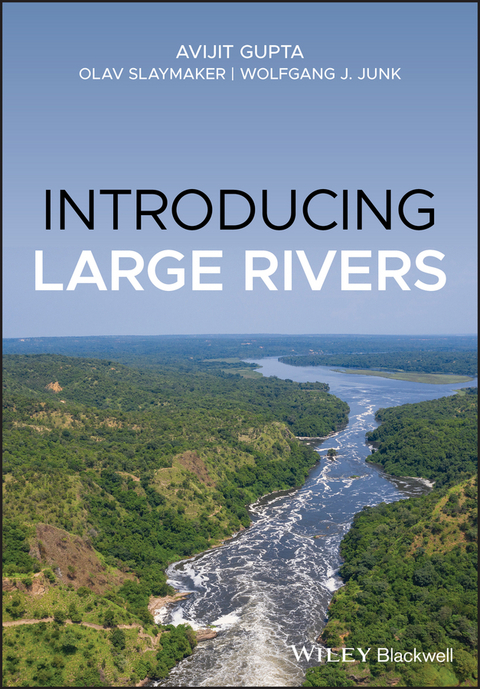
Introducing Large Rivers (eBook)
John Wiley & Sons (Verlag)
978-1-118-45142-7 (ISBN)
An accessible introduction to large rivers, including coverage of the geomorphology, hydrology, ecology, and environments of large river systems
This indispensible book takes a structured and global approach to the subject of large rivers, covering geomorphology, hydrology, ecology, and anthropogenic environment. It offers a thorough foundation for readers who are new to the field and presents enlightening discussions about issues of management at the worldwide scale. The book also examines possible future adaptations that may come about due to climate change. The book has benefitted from contributions by Professor W.J. Junk on the ecology of floodplains and Professor Olav Slaymaker on the large arctic rivers.
Introducing Large Rivers is presented in three parts. Part 1 provides an introduction to the world's large rivers and their basins. It covers source, transfer, and storage of their water and sediment; Pleistocene inheritance; the ecology of channels and floodplains; deltas; and more. Several large rivers are discussed in the next part. These include the Amazon Mississippi, Nile, Ganga-Brahmaputra System, Mekong, and Yangtze. The last part examines changes in large rivers and our management of river systems. It studies anthropogenic alterations such as land use and deforestation in large river basins; structural control systems like dams and reservoirs on channels; and ecological changes. It finishes with chapters on the management of large rivers, covering both technical and political aspects, and the future of the world's big river systems.
Introducing Large Rivers is ideal as an introductory textbook on large rivers for future earth and environmental scientists and river managers. It will also benefit advanced undergraduate and graduate students studying geography, geology, ecology, and river management.
AVIJIT GUPTA, PHD, is Honorary Principal Fellow at the School of Earth, Atmospheric and Life Sciences at University of Wollongong, Australia.
An accessible introduction to large rivers, including coverage of the geomorphology, hydrology, ecology, and environments of large river systems This indispensible book takes a structured and global approach to the subject of large rivers, covering geomorphology, hydrology, ecology, and anthropogenic environment. It offers a thorough foundation for readers who are new to the field and presents enlightening discussions about issues of management at the worldwide scale. The book also examines possible future adaptations that may come about due to climate change. The book has benefitted from contributions by Professor W.J. Junk on the ecology of floodplains and Professor Olav Slaymaker on the large arctic rivers. Introducing Large Rivers is presented in three parts. Part 1 provides an introduction to the world s large rivers and their basins. It covers source, transfer, and storage of their water and sediment; Pleistocene inheritance; the ecology of channels and floodplains; deltas; and more. Several large rivers are discussed in the next part. These include the Amazon Mississippi, Nile, Ganga-Brahmaputra System, Mekong, and Yangtze. The last part examines changes in large rivers and our management of river systems. It studies anthropogenic alterations such as land use and deforestation in large river basins; structural control systems like dams and reservoirs on channels; and ecological changes. It finishes with chapters on the management of large rivers, covering both technical and political aspects, and the future of the world s big river systems. Introducing Large Rivers is ideal as an introductory textbook on large rivers for future earth and environmental scientists and river managers. It will also benefit advanced undergraduate and graduate students studying geography, geology, ecology, and river management.
AVIJIT GUPTA, PHD, is Honorary Principal Fellow at the School of Earth, Atmospheric and Life Sciences at University of Wollongong, Australia.
Cover 1
Title Page 5
Copyright 6
Contents 9
Preface 15
Chapter 1 Introduction 17
1.1 Large Rivers 17
1.2 A Book on Large Rivers 19
References 22
Chapter 2 Geological Framework of Large Rivers 23
2.1 Introduction 23
2.2 The Geological Framework: Elevated Land and a Large Catchment 24
2.3 Smaller Tectonic Movements 25
2.4 The Subsurface Alluvial Fill of Large Rivers 26
2.5 Geological History of Large Rivers 28
2.6 Conclusion 30
Questions 30
References 30
Chapter 3 Water and Sediment in Large Rivers 33
3.1 Introduction 33
3.2 Discharge of large Rivers 33
3.3 Global Pattern of Precipitation 34
3.4 Large River Discharge: Annual Pattern and Long?Term Variability 37
3.5 Sediment in Large Rivers 42
3.6 Conclusion 48
Questions 48
References 49
Chapter 4 Morphology of Large Rivers 51
4.1 Introduction 51
4.2 Large Rivers from Source to Sink 51
4.3 The Amazon River 54
4.3.1 The Setting 55
4.3.2 Hydrology 55
4.3.3 Sediment Load 55
4.3.4 Morphology 58
4.4 The Ganga River 60
4.4.1 The Setting 60
4.4.2 Hydrology 62
4.4.3 Sediment Load 62
4.4.4 Morphology 63
4.5 Morphology of Large Rivers: Commonality and Variations 64
4.6 Conclusion 68
Questions 68
References 68
Chapter 5 Large Rivers and their Floodplains: Structures, Functions, Evolutionary Traits and Management with Special Reference to the Brazilian Rivers 71
5.1 Introduction 71
5.2 Origin and Age of Rivers and Floodplains 73
5.3 Scientific Concepts and their Implications for Rivers and Floodplains 75
5.4 Water Chemistry and Hydrology of Major Brazilian Rivers and their Floodplains 76
5.5 Ecological Characterisation of Floodplains and their Macrohabitats 78
5.6 Ecological Responses of Organisms to Flood?Pulsing Conditions 80
5.6.1 Trees 81
5.6.2 Herbaceous Plants 82
5.6.3 Invertebrates 82
5.6.4 Fish 83
5.6.5 Other Vertebrates 84
5.7 Biodiversity 84
5.7.1 Higher Vegetation 85
5.7.2 Animal Biodiversity 87
5.8 The Role of Rivers and their Floodplains for Speciation and Species Distribution of Trees 87
5.9 Biogeochemical Cycles in Floodplains 89
5.9.1 Biomass and Net Primary Production 89
5.9.1.1 Algae 89
5.9.1.2 Herbaceous Plants 90
5.9.1.3 Trees of the Flooded Forest 91
5.9.2 Decomposition 92
5.9.3 The Nitrogen Cycle 93
5.9.4 Nutrient Transfer Between the Terrestrial and Aquatic Phases 94
5.9.5 Food Webs 95
5.10 Management of Amazonian River Floodplains 96
5.10.1 Amazonian River Floodplains 96
5.10.2 Savanna Floodplains 98
5.11 Policies in Brazilian Wetlands 98
5.12 Discussion and Conclusion 100
Acknowledgements 105
References 105
Chapter 6 Large River Deltas 119
6.1 Introduction 119
6.2 Large River Deltas: The Distribution 120
6.3 Formation of Deltas 120
6.4 Delta Morphology and Sediment 126
6.5 The Ganga?Brahmaputra Delta: An Example of a Major Deltaic Accumulation 128
6.5.1 The Background 128
6.5.2 Morphology of the Delta 129
6.5.3 Late Glacial and Holocene Evolution of the Delta 130
6.6 Conclusion 131
Questions 131
References 132
Chapter 7 Geological History of Large River Systems 135
7.1 The Age of Large Rivers 135
7.2 Rivers in the Quaternary 137
7.2.1 The Time Period 137
7.2.2 The Nature of Geomorphic Changes 139
7.2.3 The Pleistocene and Large Rivers 140
7.2.3.1 The Glacial Stage 140
7.2.3.2 The Transition 141
7.2.3.3 The Interglacial Stage 143
7.3 Changes During the Holocene 143
7.4 Evolution and Development of the Mississippi River 144
7.5 The Ganga?Brahmaputra System 149
7.6 Evolution of the Current Amazon 153
7.7 Evolutionary Adjustment of Large Rivers 157
Questions 158
References 158
Chapter 8 Anthropogenic Alterations of Large Rivers and Drainage Basins 163
8.1 Introduction 163
8.2 Early History of Anthropogenic Alterations 164
8.3 The Mississippi River: Modifications before Big Dams 165
8.4 The Arrival of Large Dams 167
8.5 Evaluating the Impact of Anthropogenic Changes 172
8.5.1 Land Use and Land Cover Changes 173
8.5.2 Channel Impoundments 175
8.6 Effect of Impoundments on Alluvial Rivers 177
8.7 Effect of Impoundments on Rivers in Rock 179
8.8 Large?scale Transfer of River Water 182
8.9 Conclusion 183
Questions 184
References 185
Chapter 9 Management of Large Rivers 189
9.1 Introduction 189
9.2 Biophysical Management 193
9.3 Social and Political Management 194
9.3.1 Values and Objectives in River Management 195
9.3.2 International Basin Arrangements 196
9.4 The Importance of the Channel, Floodplain, and Drainage Basin 196
9.5 Integrated Water Resources Management 198
9.6 Techniques for Managing Large River Basins 199
9.7 Administering the Nile 200
9.8 Conclusion 204
Questions 205
References 206
Chapter 10 The Mekong: A Case Study on Morphology and Management 209
10.1 Introduction 209
10.2 Physical Characteristics of the Mekong Basin 210
10.2.1 Geology and Landforms 210
10.2.2 Hydrology 212
10.2.3 Land Use 213
10.3 The Mekong: Source to Sea 215
10.3.1 The Upper Mekong in China 215
10.3.2 The Lower Mekong South of China 215
10.4 Erosion, Sediment Storage and Sediment Transfer in the Mekong 218
10.5 Management of the Mekong and its Basin 220
10.5.1 Impoundments on the Mekong 220
10.5.2 Anthropogenic Modification of Erosion and Sedimentation on Slopes 222
10.5.3 Degradation of the Aquatic Life 223
10.6 Conclusion 224
Questions 224
References 225
Chapter 11 Large Arctic Rivers 227
11.1 Introduction 227
11.1.1 The Five Largest Arctic River Basins 229
11.1.2 Climate Change in the Five Large Arctic Basins 229
11.1.3 River Basin Zones 230
11.2 Physiography and Quaternary Legacy 232
11.2.1 Physiographic Regions 232
11.2.1.1 Active Mountain Belts and Major Mountain Belts with Accreted Terranes (Zone 1) 232
11.2.1.2 Interior Plains, Lowlands, and Plateaux (Zone 2) 233
11.2.1.3 Arctic Lowlands (Zone 3) 234
11.2.2 Ice Sheets and Their Influence on Drainage Rearrangement 234
11.2.3 Intense Mass Movement on Glacially Over?steepened Slopes 234
11.3 Hydroclimate and Biomes 236
11.3.1 Climate Regions 236
11.3.2 Biomes 236
11.3.3 Wetlands 240
11.4 Permafrost 240
11.4.1 Permafrost Distribution 240
11.4.2 Permafrost and Surficial Materials 242
11.4.3 Contemporary Warming 242
11.5 Anthropogenic Effects 244
11.5.1 Development and Population 244
11.5.2 Agriculture and Extractive Industry 244
11.5.3 Urbanisation: The Case of Siberia 244
11.6 Discharge of Large Arctic Rivers 245
11.6.1 Problems in Discharge Measurement 245
11.6.2 Water Fluxes 245
11.6.3 Water Budget 247
11.6.4 Nival River Regime 248
11.6.5 Lakes and Glaciers 250
11.6.6 River Ice: Freeze and Break Up 252
11.6.7 Scale Effects 253
11.6.8 Effects of River Regulation 254
11.6.9 Historical Changes 254
11.7 Sediment Fluxes 255
11.7.1 Complications in Determining Sediment Fluxes Both Within Arctic Basins and to the Arctic Ocean 255
11.7.2 Flux of Suspended Sediment and Dissolved Solids 256
11.7.3 Historical Changes in Water and Sediment Discharge in the Siberian Rivers 256
11.7.4 Suspended Sediment Sources and Sinks in the Mackenzie Basin 258
11.7.4.1 Sediment Yield in the Mackenzie Basin 258
11.7.4.2 West Bank Tributary Sources 259
11.7.4.3 Bed and Bank Sources 261
11.8 Nutrients and Contaminants 265
11.8.1 Supply of Nutrients 265
11.8.2 Transport of Contaminants 266
11.9 Mackenzie, Yukon and Lena Deltas 269
11.9.1 Mackenzie Delta 269
11.9.2 Lena Delta 269
11.9.3 Yukon–Kuskokwim Delta 272
11.10 Significance of Large Arctic Rivers 272
Acknowledgment 274
Questions 275
References 275
Chapter 12 Climate Change and Large Rivers 281
12.1 Introduction 281
12.2 Global Warming: Basic Concept 282
12.3 A Summary of Future Changes in Climate 286
12.4 Impact of Climate Change on Large Rivers 287
12.5 Climate Change and a Typical Large River of the Future 289
12.6 Conclusion 293
Questions 293
References 294
Index 297
EULA 305
| Erscheint lt. Verlag | 28.1.2020 |
|---|---|
| Co-Autor | Olav Slaymaker, Wolfgang J. Junk |
| Sprache | englisch |
| Themenwelt | Sachbuch/Ratgeber ► Natur / Technik ► Natur / Ökologie |
| Sachbuch/Ratgeber ► Natur / Technik ► Naturführer | |
| Naturwissenschaften ► Geowissenschaften ► Geologie | |
| Naturwissenschaften ► Geowissenschaften ► Hydrologie / Ozeanografie | |
| Technik | |
| Schlagworte | basins • climate change • Deltas • earth sciences • Ecology • Environmental Management • Environmental Science • floodplain ecology • fluvial geomorphology</p> • geomorphology • Geowissenschaften • Global Ecology • Groundwater & Hydrogeology • Grundwasser u. Hydrogeologie • Hydrological Sciences • Hydrologie • Hydrology • <p>large rivers • Management von Wasservorräten • River Management • rivers • The Environment • Water Management • Water resource management |
| ISBN-10 | 1-118-45142-2 / 1118451422 |
| ISBN-13 | 978-1-118-45142-7 / 9781118451427 |
| Informationen gemäß Produktsicherheitsverordnung (GPSR) | |
| Haben Sie eine Frage zum Produkt? |
 PDF (Adobe DRM)
Kopierschutz: Adobe-DRM
Adobe-DRM ist ein Kopierschutz, der das eBook vor Mißbrauch schützen soll. Dabei wird das eBook bereits beim Download auf Ihre persönliche Adobe-ID autorisiert. Lesen können Sie das eBook dann nur auf den Geräten, welche ebenfalls auf Ihre Adobe-ID registriert sind.
Details zum Adobe-DRM
Dateiformat: PDF (Portable Document Format)
Mit einem festen Seitenlayout eignet sich die PDF besonders für Fachbücher mit Spalten, Tabellen und Abbildungen. Eine PDF kann auf fast allen Geräten angezeigt werden, ist aber für kleine Displays (Smartphone, eReader) nur eingeschränkt geeignet.
Systemvoraussetzungen:
PC/Mac: Mit einem PC oder Mac können Sie dieses eBook lesen. Sie benötigen eine
eReader: Dieses eBook kann mit (fast) allen eBook-Readern gelesen werden. Mit dem amazon-Kindle ist es aber nicht kompatibel.
Smartphone/Tablet: Egal ob Apple oder Android, dieses eBook können Sie lesen. Sie benötigen eine
Geräteliste und zusätzliche Hinweise
Buying eBooks from abroad
For tax law reasons we can sell eBooks just within Germany and Switzerland. Regrettably we cannot fulfill eBook-orders from other countries.
aus dem Bereich