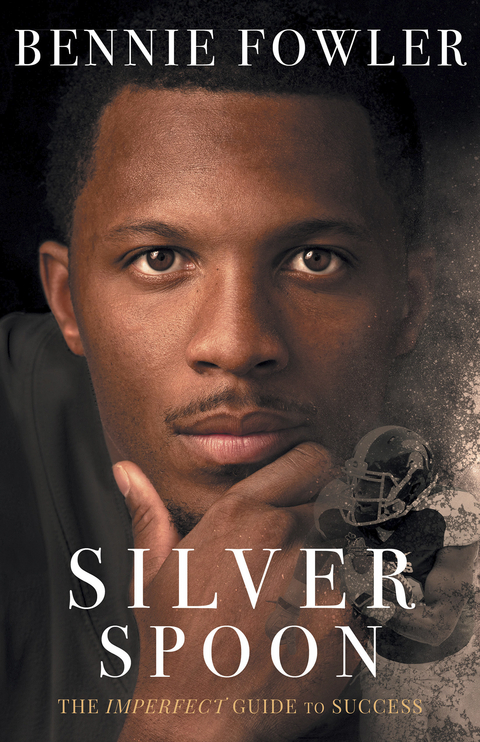
Silver Spoon (eBook)
200 Seiten
Lioncrest Publishing (Verlag)
978-1-5445-0478-0 (ISBN)
Have you ever watched a dog, out for a morning walk, who's just spotted a squirrel? The dog immediately springs forward to pursue his catch. He is restricted, not by his own instincts, but by a force he didn't know existed; his harness, his owner's restraint. When our dreams become real to us, fear, doubt, and adversity often collar our ambitions. Like the dog, we want to keep after that squirrel until we catch it, but how can we break free from the restraint of mediocrity, and endure the anxieties and insecurities that come with the chase?In Silver Spoon: The Imperfect Guide to Success, Bennie Fowler shares stories that will help you overcome what's holding you back. You'll hear from Bennie and other professional athletes like Draymond Green, Julius Thomas, Darqueze Dennard, and Demarcus Ware, as well as entrepreneurs and employees, on how they rose to the occasion when adversity struck. You'll gain a better understanding of yourself and be motivated to implement the daily practices you learn from these top performers.
Introduction
Peyton’s Last Pass
Super Bowl 50.
The third most-watched program in American television history.
Over 110 million people were tuned in when my team, the Denver Broncos, squared off against the Carolina Panthers in Levi’s Stadium in Santa Clara, California. The sidelines were thick with former NFL stars on hand to mark the fiftieth anniversary of this championship game, and the stands were packed with more than seventy thousand fans.
Can you say pressure?
Carolina was a tough team. They’d gone 15–1 and their quarterback, Cam Newton, was the league’s MVP. Newton, in the eyes of some, looked invincible.
My team, on the other hand, was led by the oldest quarterback to start a Super Bowl—thirty-nine-year-old Peyton Manning. Peyton missed several games during the regular season with a foot injury. He led the league in interceptions and was having his worst season since his rookie year in 1998. Peyton, for the first time in his illustrious career, had been benched earlier in the year but had worked his way back into the lineup toward the end of the regular season.
Still, thanks in large part to our defense, we were leading 16–10 when Carolina got the ball near their own twenty-yard line with four minutes left. Anyone who’s watched an NFL game knows that this did not make us feel overconfident. Newton had plenty of time and talent to mount a drive that would allow Carolina to take the lead.
Then, on third and nine, Newton dropped back to pass, and our great linebacker, Von Miller, swept in and stripped the ball as Newton was beginning his throw. The ball bobbled around before our safety, T.J. Ward, fell on it a few yards from the Carolina end zone. A few plays later, running back C.J. Anderson plunged in from two yards out for the touchdown, and we were up 22–10.
While most of us celebrated, our coaches were urgently talking into their headsets. Kick the extra point? Or go for the two-point conversion?
If we kicked the extra point, we’d be up by thirteen points. But there was still time left for Carolina to storm back. If the Panthers could get a quick score and get the ball back on an onside kick or a turnover, they could still win the game 24–23 with a second touchdown.
Head Coach Gary Kubiak elected to go for the two-point conversion, which would put us ahead 24–10 and keep us in the game even if Carolina came back in the final minutes.
Here comes Bennie Fowler.
Why I’m Writing This Book
As I trotted out onto the field with Peyton and the rest of the offensive unit amid the stadium roar, I felt one dominant sensation:
Joy.
I knew the play because I’d practiced it over and over. I knew where the ball would arrive because I’d visualized this moment over and over. I could picture the spinning laces as Peyton’s spiral cut through the air. I could see it sailing into my hands, and I could feel it slamming into my gut as I came out of my break. My mind was quiet and focused because I had learned to fill it with positive thoughts and flush out any feelings of self-doubt or fear.
People think of NFL players and other professional athletes as great physical specimens—and they are. Look at my former teammate Demaryius Thomas—he’s tall, muscled, runs like a deer, and has fluid moves that leave most defenders flailing.
But what people often don’t realize is how much mental work goes into being a professional athlete. The best ones—the Peyton Mannings, the Kobe Bryants, the Von Millers, the Draymond Greens (well, there really is only one Draymond Green)—are towers of mental strength too. They have the powers of perseverance, patience, and discipline, and they have trained their minds as finely as they have honed their physical skills.
They train their minds by following simple principles and practices. They close out negative thoughts while cultivating rich, prosperous ideas. They focus on the things they can control, and as they gain mastery over those factors, any sense of anxiety fades away. Their heart rate goes down, their breathing is relaxed, their muscles are loose, and their thoughts are clear and precise.
These are skills I’ve learned in my five years in the NFL, but they are skills anyone can master. When you focus on what my mentor and friend Dr. Rick Perea calls “the process,” your performance improves. Who among us wouldn’t benefit from becoming healthier, calmer, more confident, and successful?
Focusing on the process allowed me to smile to myself as I prepared to receive the biggest pass of my career from a future Hall of Famer throwing the last pass of his career.
The Last Pass—and the Beginning of Something Big
The play is called scat and vertigo. It’s not always designed to go to me, but on this occasion, I knew it was. In the huddle, Peyton looked me in the eye.
“Just give me a little time to find the laces,” he said in that now-all-too-familiar Southern drawl of his. Since his retirement, Peyton has come to be known through his commercials as a sort of goofy optimist who thinks he can write country songs better than Brad Paisley. But make no mistake—Peyton Manning is smart, intense, competitive, and anything but a hayseed.
I approached the line of scrimmage and spread out wide to Peyton’s right. As he barked out the signals, he looked to his left and then to his right, locking his eyes on mine for a split second. I raised my hand slightly, letting him know that the coverage was what we expected and that I was ready. Suddenly, the field exploded with twenty-two men bolting upright and slamming into each other in a wild flurry of grunts and shouts.
It was a beautiful ballet of violence, inch-perfect in its choreography. I was joyous.
Peyton dropped back two steps as I raced for the end zone. The ball arrived as I came out of my break, smacking into my gut as my arms folded around it. I tumbled, rolled twice, and then popped back to my feet, holding the ball aloft. My teammates bunched around me, slapping my helmet.
I danced like everybody was watching, holding the ball tight.
Something Different
I didn’t write this book to speak only to athletes. Therefore, don’t put this book down just because there’s an athlete on the cover. I wrote this book to share universal human experiences, aspects of life everyone can see themselves in. No matter who you are, every part of what you do well, every part of what you’re passionate about, requires the will, determination, and mental fortitude honed by great athletes in moments of immense pressure.
Now, if you happen to be a football fan, this book might be a revelation to you; it’s definitely different than most books by professional athletes.
This won’t be a blow-by-blow account of playing with Peyton (or later with his brother, Eli).
Still, you’ll hear from plenty of athletes. Rick Perea was an NFL linebacker before he became a sports psychologist. Julius Thomas was a Denver tight end and is now working on his doctorate in psychology. Seth Minter, aka “The Foot Doctor,” made a name for himself as a genius-level footwork trainer for some of the best running backs and wide receivers in the NFL.
You’ll also hear from others—my good friend Draymond; Desyree Thomas, a former women’s basketball star who now owns her own menswear brand; and Marell Evans, a great football player who is now a venture capitalist in the San Francisco Bay Area. You’ll hear from my brother, who endured seven knee surgeries but never wavered in his commitment to basketball. You’ll hear from my dad, one of the best coaches I ever had, and from my mother, whose instincts helped lead me to football.
Each of these people has a mind like tempered steel and has helped me forge my own resilience. They helped me realize that habits and attitudes contribute as much to a person’s success as weight training and drills.
This book won’t teach you to bench 250 pounds or run a 4.4 in the forty-yard dash. Instead, it will share insights I’ve developed for overcoming adversity, staying focused, and persevering to achieve dreams and goals. I’ll explore the mental and personal characteristics that successful athletes embrace but which can also help you clear your own path to success.
Athletes are not superhuman, but many do have profound ideas and approaches to mental strength. The best players work to get better every day, regardless of the obstacles they encounter. What sets them apart is their determination and resilience—their ability to bounce back and see past the day-to-day setbacks we all encounter.
I want my story, and the stories my friends will tell in this book, to inspire you to say:
I’m going to do what I want to do. I’m going to achieve what I want to achieve.
Sports is a business—no one knows this better than an NFL player—but it’s also a game. We play sports for fun, right? That’s the way it should be. Fun should be your life, my mom always said.
But my mother also had other things to say about fun and games.
“Work before you play and all your life you...
| Erscheint lt. Verlag | 28.1.2020 |
|---|---|
| Sprache | englisch |
| Themenwelt | Sachbuch/Ratgeber ► Gesundheit / Leben / Psychologie ► Lebenshilfe / Lebensführung |
| ISBN-10 | 1-5445-0478-0 / 1544504780 |
| ISBN-13 | 978-1-5445-0478-0 / 9781544504780 |
| Informationen gemäß Produktsicherheitsverordnung (GPSR) | |
| Haben Sie eine Frage zum Produkt? |
 EPUB (Ohne DRM)
Größe: 3,4 MB
Digital Rights Management: ohne DRM
Dieses eBook enthält kein DRM oder Kopierschutz. Eine Weitergabe an Dritte ist jedoch rechtlich nicht zulässig, weil Sie beim Kauf nur die Rechte an der persönlichen Nutzung erwerben.
Dateiformat: EPUB (Electronic Publication)
EPUB ist ein offener Standard für eBooks und eignet sich besonders zur Darstellung von Belletristik und Sachbüchern. Der Fließtext wird dynamisch an die Display- und Schriftgröße angepasst. Auch für mobile Lesegeräte ist EPUB daher gut geeignet.
Systemvoraussetzungen:
PC/Mac: Mit einem PC oder Mac können Sie dieses eBook lesen. Sie benötigen dafür die kostenlose Software Adobe Digital Editions.
eReader: Dieses eBook kann mit (fast) allen eBook-Readern gelesen werden. Mit dem amazon-Kindle ist es aber nicht kompatibel.
Smartphone/Tablet: Egal ob Apple oder Android, dieses eBook können Sie lesen. Sie benötigen dafür eine kostenlose App.
Geräteliste und zusätzliche Hinweise
Buying eBooks from abroad
For tax law reasons we can sell eBooks just within Germany and Switzerland. Regrettably we cannot fulfill eBook-orders from other countries.
aus dem Bereich