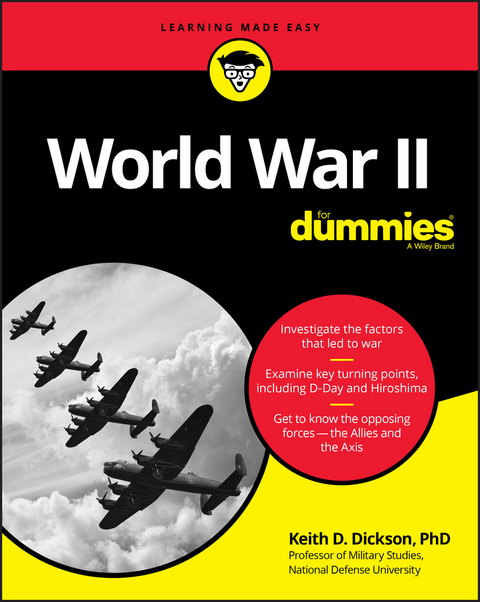
World War II For Dummies (eBook)
452 Seiten
John Wiley & Sons (Verlag)
978-1-119-67557-0 (ISBN)
- Investigate the factors that led to war
- Examine key turning points, including D-Day and Hiroshima
- Get to know the opposing forces - the Allies and the Axis
Explore the greatest war in history
World War II was the most destructive conflict of the 20th century. How did it happen - and why? Packed with fascinating anecdotes, interesting sidebars, and top ten lists, this friendly reference contains everything you need to know about World War II, from the issues that caused the war to its most crucial confrontations and what happened in the aftermath. Read about important figures on both sides, study Hitler's war against the Jews, and find out how the Allies finally achieved victory. Whatever your interest, World War II For Dummies is your go-to guide.
Inside ...
- The significance of World War II
- Hitler's rise to power
- The invasion of Eastern Europe
- Pearl Harbor and U.S. neutrality
- Life and labor on the home front
- The Holocaust
- Liberation and what came next
Keith D. Dickson, PhD, is a Professor of Military Studies at the Joint Forces Staff College, National Defense University. He is a retired Colonel, U.S. Army Special Forces.
Looking to ally yourself with World War II knowledge? More than 75 years after its end, World War II remains one of the most devastating and impactful events in human history. It was a global war, and the nations that fought it employed every available resource, harnessing both technology and people to one purpose. Today, we remember WWII for its battles, tragedies, and horrors, but also for its outcome: a greater good that triumphed over evil. The breadth of World War II facts and history can be overwhelming, which is why World War II For Dummies is the perfect book for any reader, from history buffs to WWII novices. Full of accurate and easy-to-understand information (so you don t have to speak military to comprehend), this book will help you explore a war that defined and shaped the world we live in today. You ll discover all the players individuals as well as nations who participated in the war and the politics that drove them. Battle by battle, you ll find out how the Axis powers initially took control of the war and how the Allies fought back to win the day. World War II for Dummies also covers: The origins and causes of World War II The rise of Adolf Hitler and the Third Reich How the war was handled at home Germany s invasion of Poland, France, Denmark, Norway, Belgium, and Luxembourg Great Britain s refusal to surrender after 42 days of German aerial attack The United States entrance into the war after Japan bombed Pearl Harbor The Allied invasion of Normandy (D-Day) Germany s last-ditch effort to stop the Allies at the Battle of the Bulge The use of the atomic bomb on Hiroshima and Nagasaki Become an expert on this historical catalyst with World War II For Dummies grab your copy today. P.S. If you think this book seems familiar, you re probably right. The Dummies team updated the cover and design to give the book a fresh feel, but the content is the same as the previous release of World War II For Dummies (9780764553523). The book you see here shouldn t be considered a new or updated product. But if you re in the mood to learn something new, check out some of our other books. We re always writing about new topics!
Keith D. Dickson, PhD, is a Professor of Military Studies at the Joint Forces Staff College, National Defense University. He is a retired Colonel, U.S. Army Special Forces.
Introduction
The Most Destructive War
The Second World War (1939–1945) was the most destructive event in history. It was total war covering the entire globe, and the nations that fought it employed every available resource, harnessing both technology and people to one purpose. The farmer and factory worker became just as important to the war effort as the soldier in the field. Aerial attack allowed cities and civilians to become legitimate targets of war. Because of its destructiveness and global scale, the human and material costs of the war were almost immeasurable. The war ended with the development of two new technologies that heavily influenced the course of the postwar world: atomic power and the ballistic missile.
Mass murder of noncombatants and prisoners of war occurred — tens of thousands of defenseless Russians, Poles, and Chinese died at the hands of their enemies. A state-run genocide killed 12 million people, including 6 million Jews. The war also cost millions of lives, resulting from battle as well as non-battle deaths. The Soviet Union lost 28 million people; Germany, nearly 5 million people. Japan lost about 5 million people; China, about 10 million. Great Britain and the Commonwealth lost nearly a half million people. France and Italy both lost over 400,000 combat deaths. The United States, Czechoslovakia, and Yugoslavia each suffered 290,000 combat deaths. Poland, Hungary, Belgium, the Netherlands, Norway, Bulgaria, Romania, and the Philippines suffered significant military and civilian losses as well. The physical destruction of most of the continent of Europe and several Asian nations left an indelible mark.
Undoubtedly, the war has cast a long shadow over recent history. The way that nations form strategy, wage war, make peace, and negotiate treaties is still shaped by the memories and lessons of the Second World War. For better or worse, a new world emerged from the ashes of the old, and we live in the shadow of this most terrible and destructive war. The world has been sensitized to the dangers of ethnic hatred and its accompanying acts of organized killing. The ever changing nature of United States–Chinese relations has its roots in the conditions in China after the war. The creation of Israel by the world community was a direct result of the Jewish Holocaust. The need for collective defense in the form of alliances like the North Atlantic Treaty Organization (NATO) became the primary guarantor of peace in Europe. The United Nations was created to correct the failure of the League of Nations to oversee international norms of behavior. Traditional enemies became partners against a greater threat, and the role of government expanded to meet the burden of greater defense requirements. Nations were willing to take action to guarantee their interests to prevent another catastrophe like World War II.
But the memories of World War II are rapidly fading. Those who lived during this momentous period in twentieth century history will no longer be among us to provide witness to the past. The national World War II monument and local memorials, along with such films as Saving Private Ryan, will preserve some understanding of the virtue and sacrifice of the soldiers and civilians who ensured the survival of freedom in the world. The preservation of freedom in World War II became the ultimate weapon in the victory over tyranny in the Cold War. The end of the Cold War itself may be considered the final act in the drama initiated in the Second World War. The people of the Allied nations, through great sacrifice, guaranteed that freedom would be preserved in the face of forces that threatened the existence of civilization. This protection is undoubtedly their greatest bequest to the modern world.
Like all great stories, World War II has its unforgettable villains and heroes. Things are clearly drawn in terms of good and evil. And though often tragic, the story of World War II is nevertheless dynamic, colorful, and exciting. The dedication and courage of the soldier, sailor, marine, or airman in battle and the resilience and sacrifice of those on the home front still stirs the blood. Military professionals all over the world still study the tactics, strategy, and campaigns of the war.
World War II is a universal story, one that may leave you believing that these people were exceptionally heroic because they underwent such a traumatic experience and somehow managed to get on with their lives. For the most part, these people were quite ordinary, but because they were able to rise to extraordinary efforts, they have earned a measure of immortality. If you compare yourself to those who experienced the Second World War, you may find out a bit about who you are.
About This Book
The literature of World War II is large and continues to grow every year. World War II For Dummies meets the needs of the reader who wants to be informed without being overwhelmed with details. This book is directed toward several types of readers. First, the person who desires accurate, easily accessible information about the major events and issues of World War II without encountering intimidating historical narrative or ponderous military interpretation. Second, the person who may want a refresher on the major events of the war, but does not want to struggle through the tomes of scholars or the arcane minutiae of military buffs. Third, the person who is looking for a different way to approach history and find out more about the war to enhance his or her appreciation and understanding of an event that has directly or indirectly shaped his or her life. To most people, the past appears remote and inaccessible. The main message of this book is that history is neither remote nor inaccessible! Politics, passions, and conflict (both armed and ideological) have always made up the good stuff of history. Thus, history in the proper context can connect you to the past and allow you to discover similarities to events in your own era.
Conventions Used in This Book
History doesn’t have to be boring or intimidating. Everyone who hates history books says that they are nothing more than dry lists of names, places, dates, and jargon. That’s true enough, in most cases, if you only look that far. Although this is a different kind of history book, it does follow certain conventions found in most history books. For example, this book is arranged chronologically, and it tells a story. There’s a beginning, a middle, and an end. What is different about this book is that you can start wherever you want. You don’t need to slog through the whole thing from beginning to end to figure out what is going on. You have maximum flexibility to pick and choose what you want to know. You can jump in at any point and still keep up with the story, or you can select a topic to read in a chapter that interests you.
As you move through this book, you encounter key terms. Wherever necessary, I define italicized terms for you, or I reference terms elsewhere with a detailed explanation. I also provide maps that can help you figure out the whys and hows of this global war.
Not surprisingly, World War II has many dimensions and complexities and therefore, many interesting topics and trivia that are part and parcel of discussions about the war. I include some of these facts in gray boxes called sidebars. If you want to dig into the weeds, these boxes are for you. If you are not interested in such detail, these boxes can be easily passed by with no effect on your overall understanding.
How This Book Is Organized
This book covers a span of about 26 years, from 1919 to 1945. This period seems short, but these years defined and shaped the future. To help you break down the years of the war, I’ve organized this book into seven parts, each dealing with a major period of the war. And the chapters within the parts take you through the major events of World War II, highlighting important facts and points of interest. Each chapter acquaints you with words and ideas that are important to the entire picture.
Every year, someone discovers another cause of the Second World War. Interpretations abound and continue to grow in breadth and imagination. However creative these interpretations may be, almost everyone agrees on several salient points related to the causes of the war. This book focuses on these basic causes.
Part 1: Origins and Causes of the War, 1919–1939
This part takes you from the peace settlement that ended World War I to the opening of the war in Europe — Germany’s invasion of Poland. You can examine the time between the wars to get an overview of world events that led to the rise of totalitarian dictators who threatened peace in Europe and in Asia. You also examine the role the United States and the Soviet Union played during this period. This part tells you about the series of tensions, crises, and decisions that eventually led the to the outbreak of the Second World War.
The chapters introduce you to the leaders and the various political systems that existed at this time, as well as the foreign policies of the major states. You get acquainted with the interests and ambitions (and mistakes) that drove the key events that finally led nations to war. You can take a look at the strategies and military preparedness of the nations involved to help understand why and where the war began.
Part 2: Starting the War: The Axis Invades and Conquers, 1939–1942
This part looks at the stunning victories of the Axis powers — Germany, Japan, and Italy — and how they...
| Erscheint lt. Verlag | 7.1.2020 |
|---|---|
| Sprache | englisch |
| Themenwelt | Sachbuch/Ratgeber ► Geschichte / Politik ► Allgemeines / Lexika |
| Geschichte ► Allgemeine Geschichte ► 1918 bis 1945 | |
| Geschichte ► Teilgebiete der Geschichte ► Militärgeschichte | |
| Schlagworte | America • Axis • Axis and Allies • Dictatorship • Discover • Genocide • Germany • Geschichte • global war • Government • Great Britain • History • history book • Holocaust • Japan • Militärgeschichte • Military • military history • Military Strategy • nationswho • Nazi Germany • participated • playersindividuals • Politics • soldiers • united states wars • U.S. History • war • Weltkrieg • Weltkrieg II • World • World History • World War II • World War II book • World Wars • WWII • Zweiter Weltkrieg |
| ISBN-10 | 1-119-67557-X / 111967557X |
| ISBN-13 | 978-1-119-67557-0 / 9781119675570 |
| Informationen gemäß Produktsicherheitsverordnung (GPSR) | |
| Haben Sie eine Frage zum Produkt? |
 EPUB (Adobe DRM)
Kopierschutz: Adobe-DRM
Adobe-DRM ist ein Kopierschutz, der das eBook vor Mißbrauch schützen soll. Dabei wird das eBook bereits beim Download auf Ihre persönliche Adobe-ID autorisiert. Lesen können Sie das eBook dann nur auf den Geräten, welche ebenfalls auf Ihre Adobe-ID registriert sind.
Details zum Adobe-DRM
Dateiformat: EPUB (Electronic Publication)
EPUB ist ein offener Standard für eBooks und eignet sich besonders zur Darstellung von Belletristik und Sachbüchern. Der Fließtext wird dynamisch an die Display- und Schriftgröße angepasst. Auch für mobile Lesegeräte ist EPUB daher gut geeignet.
Systemvoraussetzungen:
PC/Mac: Mit einem PC oder Mac können Sie dieses eBook lesen. Sie benötigen eine
eReader: Dieses eBook kann mit (fast) allen eBook-Readern gelesen werden. Mit dem amazon-Kindle ist es aber nicht kompatibel.
Smartphone/Tablet: Egal ob Apple oder Android, dieses eBook können Sie lesen. Sie benötigen eine
Geräteliste und zusätzliche Hinweise
Buying eBooks from abroad
For tax law reasons we can sell eBooks just within Germany and Switzerland. Regrettably we cannot fulfill eBook-orders from other countries.
aus dem Bereich