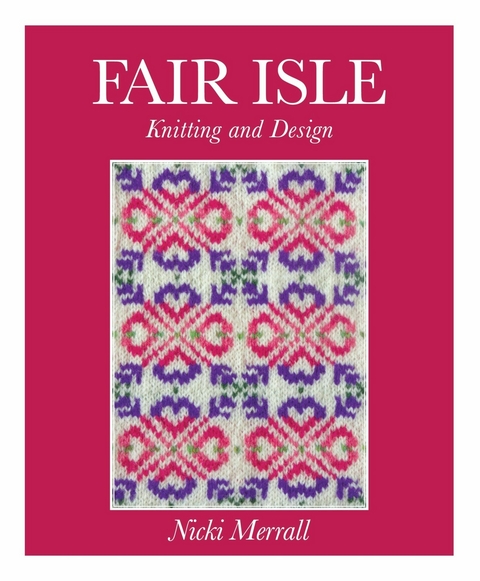
Fair Isle Knitting and Design (eBook)
356 Seiten
Crowood (Verlag)
978-1-78500-698-2 (ISBN)
Nicki Merrall is a knitwear designer and tutor. She has designed for Knit Now, The Knitter and other publications, as well s producing her own range of knitting and crochet patterns and kits (www.beingknitterly.com). Nicki runs both knitting and crochet classes, as well as therapeutic stitching sessions, and is inspired by traditional techniques and textiles, art and nature.
Traditional Fair Isle knitting and design skills were originally handed down from one Shetland generation to the next, with each new generation of knitters experimenting, adapting and extending the repertoire of patterns to develop the Fair Isle knitting we see today. Fair Isle knitting is fascinating - only two colours are used in any single row - yet the patterns and colours chosen combine to create something that is more than the sum of its parts. The distinctive combination of colours and patterns, ranging from the simple to the highly intricate, continues to inspire knitters worldwide. This beautifully illustrated book includes the development of Fair Isle knitting; a collection of Fair Isle patterns and motifs; exercises to develop a sense of colour and apply colour theory to Fair Isle knitting and a detailed step-by-step guide for the techniques used in Fair Isle knitting. Five original designs, with further ideas for their modification and development are included too as well as guidance on adapting and designing Fair Isle projects of your own.
Nicki Merrall is a knitwear designer and tutor. She has designed for Knit Now, The Knitter and other publications, as well s producing her own range of knitting and crochet patterns and kits (www.beingknitterly.com). Nicki runs both knitting and crochet classes, as well as therapeutic stitching sessions, and is inspired by traditional techniques and textiles, art and nature.
CHAPTER 1
THE HISTORY OF SHETLAND
AND FAIR ISLE KNITTING
Shetland (also commonly known as the Shetland Islands) is an archipelago of more than one hundred islands in the North Sea. Just fifteen of these islands are inhabited. The capital of Shetland is the town of Lerwick, and it is found on the largest island, called Mainland. The island of Fair Isle is about 25 miles (40 kilometres) southwest of the most southerly point of Mainland. Fair Isle is one of the most remote of the islands in Shetland. Shetland itself is about 100 miles (160 kilometres) north of mainland Scotland. It is nearer to Bergen in Norway (about 230 miles [370 kilometres] away) than it is to London (about 600 miles [965 kilometres] away)! These islands may seem remote to us today; however, Shetland was and still is well connected by maritime routes to mainland Scotland, the Netherlands, Scandinavia, Iceland, the Baltic countries and North America.
Shetlanders were able to survive through a combination of practising agriculture, fishing and knitting. Both agriculture and fishing are important in the history of knitting in Shetland. Agriculture provided the wool used for knitting, whereas fishing provided access to customers. For many centuries, the fortunes of Shetland knitters ebbed and flowed with those of the fishing industry.
A sleeveless sweater from the 1940s. This allover pattern, formed by tessellating a Norwegian star motif, was originally known as the Whalsay pattern. Courtesy of the Shetland Museum and Archives (#01378).
AGRICULTURE
Shetlanders were crofters. A traditional croft was a small area of cultivated ground used for growing crops that was worked by crofters, together with the crofters exercising pasture rights for common grazing land. Crofts were not normally sufficiently productive to support a crofter’s family and allow them to pay the croft rent, so crofters also relied on the sea for sustenance and income. This was so much so that Shetlanders have often been described as fishermen who farmed.
Most of the agricultural land in Shetland is more suitable for grazing than for growing crops. Consequently, agriculture is dominated by sheep rearing. Some crofters kept a cow and a Shetland pony. They grew crops including oats, bere (an old variety of barley), potatoes, kale and rhubarb.
Shetland sheep are a long-established primitive breed of small, short-tailed sheep. Their ancestors were probably Soay sheep (farmed by early Neolithic farmers in Britain over 4,500 years ago) and sheep from Norway (brought over by the Norwegians who settled in Scotland and the Northern Isles around ad500). Shetland sheep are very hardy; they cope well with the harsh climate on the islands and thrive on limited pasture.
Shetland sheep have a very fine, soft fleece, which comes in a wide variety of colours and patterns. The Shetland Sheep Society recognizes eleven main whole-fleece colours and thirty different fleece markings. Many of these colours and markings have Shetland-dialect names. The main whole-fleece colours are black, shaela (dark grey), emsket (bluish-grey), grey, light grey, white, mioget (warm yellowish-brown), musket (pale greyish-brown), fawn, moorit (reddish-brown) and dark brown.
Shetland sheep, like sheep of other primitive breeds, shed their fleece in spring. The old fleece develops a weak point as the new fleece grows. The old fleece can be plucked from the sheep by hand, which is known as rooing. This traditional technique removes the old fleece, without damaging the new growth. After rooing, the wool is cleaned; teased, to remove the coarse wool; carded or combed, to straighten the fibres; spun; and then used for weaving or knitting. All these processes were done by hand until around 1890, after which raw wool was sent to the Scottish mainland for teasing, carding and spinning. By the 1920s, dyed and machine-spun yarn was available to buy. Today, however, sheep are usually sheared by using hand shears or electric clippers.
See the resources of The Shetland Sheep Society listed in the section ‘Publications and other materials’, Bibliography and Resources, for the sources of the details provided in this section and for further information.
FISHING
From the fifteenth to seventeenth centuries, Shetlanders carried out inshore shortline fishing. They used small, four-oared, open, wooden boats. The fishermen caught cod, ling and herring for their own consumption and for trade. They traded herring and salted whitefish as well as other produce, such as meat and knitted stockings, for things that they could not grow or produce themselves. Their customers were German merchants who visited Shetland, from May to September, each year.
During the seventeenth century, the Dutch fishing fleet came to Shetland every summer to fish for herring. The fleet was large and, as well as fishing boats, included large ships called busses, on which the herring were gutted and brined; merchant ships, which took the salted fish to the Netherlands; and escort vessels, for protection of the fleet and its cargo. The Dutch cure was considered the best way to preserve herring. It was a secret method that gave the Dutch a monopoly on the herring trade. While the Dutch fleet was in Shetland, the crew bought many knitted stockings.
In the early years of the eighteenth century, certain events led to an economic slump in Shetland. In 1702, while it was in Shetland, the Dutch fishing fleet was attacked by the French. Many boats were destroyed. Consequently, the Dutch fleet stopped visiting Shetland for many years. In 1707, the Act of Union meant that Shetland formally became British. A consequence of this was the introduction of high duties on imported salt. Shetlanders used salt to cure the whitefish that they sold to the German merchants. Because of the resulting increase in the cost of the cured whitefish, the German merchants stopped coming to Shetland. These two events led to a dramatic fall in demand for the knitted stockings of Shetland.
In around 1700, longline fishing was introduced to Shetland. The longer lines involved with this fishing method changed the nature of fishing in Shetland. Fishing now took place in deeper waters further from the shore, so bigger, six-oared, open, wooden boats with sails were used. This new style of fishing was known as Haaf fishing. A fishing trip involved rowing or sailing to the Haaf-fishing grounds, which were 20 to 40 miles (about 30 to 65 kilometres) offshore. The men would set miles of lines and then wait for the tide to turn, and later they would spend several hours hauling the catch in. They repeatedly set lines and hauled in the catch until they had enough fish to fill their boat. Then they rowed or sailed back to a Haaf-fishing station close to the fishing grounds. A fishing trip could take two to three days, depending on how good the catch was; the men made two to three trips a week. As the fishing grounds were all north of Shetland, the men at the Haaf-fishing stations could not return home between fishing trips. So, during the fishing season, which ran from early May to late August, the men lived at the Haaf-fishing stations. Older men and younger boys also worked at the fishing stations, to salt the fish. The salted fish were stored in a warehouse. At the end of the season, the salted fish were taken by cargo ships to Spain, and the men returned to their crofts.
As well as owning the crofts where the men lived, the lairds also owned the fishing boats and equipment, the stores at the Haaf-fishing stations and the cargo ships used to export the fish. The lairds paid the men for their catch in credit notes. These could go towards the rent for a man’s croft, but the men also had to use the credit notes to buy provisions at the fishing stations. The lairds paid little for the catch, and the store prices were high. This truck system ensured that the crofters became impoverished while the lairds became wealthy. Even during the season, Haaf fishing was dangerous; many boats and lives were lost in unexpected storms. However, the threat of being thrown off their crofts kept the men fishing. The Crofters Act of 1886 granted security of tenure to crofters and effectively ended the truck system and Haaf fishing.
In 1819, J.F. Donovan of Leith developed the Scotch cure for herring, and, in 1825, the salt duty was lifted. The availability of cheap salt meant that the herring catch could be preserved by using a high-quality cure. This led to the development of largescale herring fishing around Scotland, using safer, larger, sailed, decked boats and, later, steam trawlers. The herring fishing season started in May in the Hebrides, Shetland and Orkney, then moved southwards down the east coasts of Scotland and England, reaching Yorkshire in about August and East Anglia around October, with the season finally ending in December. Many crews worked the season by moving from the Scottish islands to East Anglia. The catch was landed at each port and processed there by young women known as herring girls. Many of the herring girls followed the fleet by land or sea and knitted in their spare time. The cured herring were exported to Germany, the Baltic States and Russia. Herring fishing peaked in the early twentieth century and then declined after the First World War. Around this time, Shetland knitwear was marketed directly to customers, so the fortunes of Shetland knitters were no longer dependent on those of the fishing industry. So, the major significance of herring fishing to Shetland knitting was not in providing customers but in exposing herring girls from Shetland to knitting patterns and styles from the east coasts of Scotland and...
| Erscheint lt. Verlag | 3.4.2020 |
|---|---|
| Verlagsort | London |
| Sprache | englisch |
| Themenwelt | Sachbuch/Ratgeber ► Freizeit / Hobby ► Handarbeit / Textiles |
| Sachbuch/Ratgeber ► Freizeit / Hobby ► Heimwerken / Do it yourself | |
| Schlagworte | Blocking • chequered • Colour theory • colour wheel • corrugated rib • discover knitting • european knitting • Fair Isle • Floats • Hat • heritage knitting • how to knit • Jamieson & Smith • Jamieson’s of Shetland • Jumper • KEP • Knitting • knitting belt • knitting books • knitting guides • knitting sheaths • knitting thimble • knitting with colour • large Fair Isle • learning to knit • mittens • new knitting designs • Norwegian Star • OXO pattern • pattern repeat • peerie • seeding pattern • shawl • Shetland • Shetland Heritage • Shetland Spindrift • Steeks • stranded colourwork • stranded yarn • stranding technique • stranding yarn • sweater • Tammie • The Shetland Museum and Archives • weaving in • yarn dominance • yarn guide • yarn palette • yarn wraps |
| ISBN-10 | 1-78500-698-3 / 1785006983 |
| ISBN-13 | 978-1-78500-698-2 / 9781785006982 |
| Informationen gemäß Produktsicherheitsverordnung (GPSR) | |
| Haben Sie eine Frage zum Produkt? |
 EPUB (Adobe DRM)
Kopierschutz: Adobe-DRM
Adobe-DRM ist ein Kopierschutz, der das eBook vor Mißbrauch schützen soll. Dabei wird das eBook bereits beim Download auf Ihre persönliche Adobe-ID autorisiert. Lesen können Sie das eBook dann nur auf den Geräten, welche ebenfalls auf Ihre Adobe-ID registriert sind.
Details zum Adobe-DRM
Dateiformat: EPUB (Electronic Publication)
EPUB ist ein offener Standard für eBooks und eignet sich besonders zur Darstellung von Belletristik und Sachbüchern. Der Fließtext wird dynamisch an die Display- und Schriftgröße angepasst. Auch für mobile Lesegeräte ist EPUB daher gut geeignet.
Systemvoraussetzungen:
PC/Mac: Mit einem PC oder Mac können Sie dieses eBook lesen. Sie benötigen eine
eReader: Dieses eBook kann mit (fast) allen eBook-Readern gelesen werden. Mit dem amazon-Kindle ist es aber nicht kompatibel.
Smartphone/Tablet: Egal ob Apple oder Android, dieses eBook können Sie lesen. Sie benötigen eine
Geräteliste und zusätzliche Hinweise
Buying eBooks from abroad
For tax law reasons we can sell eBooks just within Germany and Switzerland. Regrettably we cannot fulfill eBook-orders from other countries.
aus dem Bereich