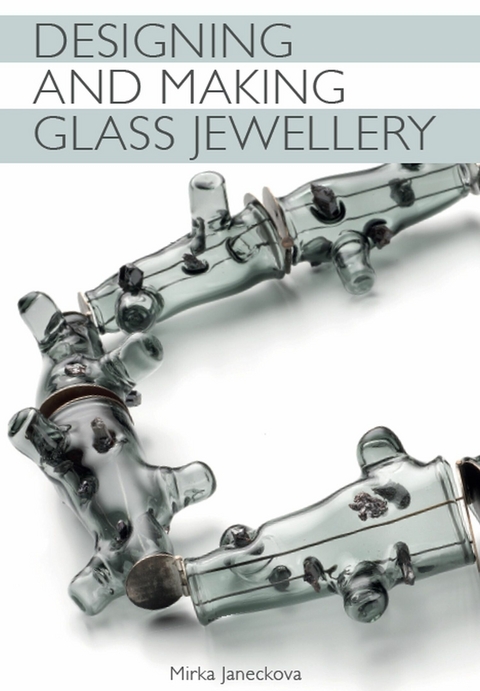
Designing and Making Glass Jewellery (eBook)
96 Seiten
Crowood (Verlag)
978-1-78500-678-4 (ISBN)
Mirka Janeckova is a respected jeweller who specializes in the lost-wax casting technique, and uses porcelain and glass in her pieces. Trained at the Royal College of Art, she now works and teaches in Edinburgh.
Mirka Janeckova is a respected jeweller who specializes in the lost-wax casting technique, and uses porcelain and glass in her pieces. Trained at the Royal College of Art, she now works and teaches in Edinburgh.
CHAPTER TWO
DESIGNING GLASS JEWELLERY
How to Start Designing
It is fine to look at the work of other artists or craftspeople for inspiration. You can examine such creations in books, magazines, museums or online. For centuries, copying the old masterpieces was considered the effective learning strategy across the world (although not so much now). This may be satisfactory for the start but after a while you may want to progress into realizing your own ideas. That is probably why you are reading this book. I believe that everybody has an inherent ability to source inspiration from their own interests, the things they like and the way they see the world.
Inspiration is everywhere. In order for your ideas to be authentic it is good to look at what you are already really interested in, what you like and what you find fascinating. It doesn’t need to be anything art-related at all – the work may be actually more interesting if it is not. Do you like travelling, going to cinema, cooking or gardening? Great!
Once you have identified the area of your interest you will start looking more closely at its visual forms. At this point it is good to have some sort of gathering method. You can use paper, a sketchbook, boards, sticky pads, your phone, a 3D scanner or anything else. Start collecting images, photos, colour schemes and textures related to your subject. You may want to include little sketches of your ideas. It doesn’t matter if you think you can’t draw; use line and colour to visualize ideas – it doesn’t need to be a masterpiece. Think about it as recording pieces of information, like scribbling a reminder note to yourself. Nobody needs to see your sketchbook anyway. It is really useful to get into habit of recording every idea which comes into your mind. It doesn’t mean you will actually make use of all of it but every little sketch can inspire you later on. Also, you may remember your ideas now but a week or a year later you may not. And it would be a shame to lose all that creative energy which is already in your head.
Ring sketches by Mirka Janečková.
I found out during my teaching practice that people tend to take this initial designing stage too seriously. It is more helpful if you think about designing as more like playing. Most adults do not have the chance to play enough so this could be your opportunity. There are some really enjoyable methods which you can try. You can use photographs and magazine cut-outs, combining them and making collages. You can draw or paint over your photographs. Using transparent papers to trace random found shapes is always good fun. Combine different colours, materials and textures into one board and see how they interact with each other. Take picture of your arrangements, print the images and work with them further. If you like using your computer or your phone, there are many easy-to-use software packages you can use to create imaginative shapes and effects. Or you may want to work more conceptually and find adequate visual expressions of abstract concept or issues important to you. Try some of these and later on you may see that you are naturally finding your own way of working. Please do not judge any of your outcomes during this initial stage of the process: this is purely the exercise needed to generate raw material; the critical evaluation and technical execution will be required later on.
Your sketchbook can be just a few scribbles in a notebook or on paper or it may take the form of free drawing. Sometimes I like to use black paper to visualize my ideas: drawing on black seems to be easier than on white for some reason.
Once you feel you have enough visual material and start having clearer ideas of what you want to try in practice, then it is time to use your evaluation mind. Not all of your ideas will be possible to realize in 3D. Glass jewellery has specific properties which we will discuss later on in this chapter and these will affect your approach.
The next stage is to do some tests and samples: I would recommend to always do at least one test piece before you commit to investing resources into a final piece. You need to understand the possibilities of the material and technique you are using first. The more samples and test pieces you make, the better chance you have of creating a successful final piece.
Some people feel more inclined to skip the whole sketching part and go directly to the test pieces and samples. The inspiration then will come directly from handling materials and experimenting practically. The process itself is a good source of ideas and design possibilities. You can try both ways and see which one produces more fruitful results for you. The main thing is that you enjoy the whole process.
Using collage techniques, you can play with your photographs, drawings and writings and then include glass and other materials to create the ‘mood’ for your work and explore the textures involved. This is your visual research and experimentation, not a finished, neat project.
I like to keep all my test pieces in such boxes for future reference, even those which have obviously failed; they may inspire something else in the future.
Glass has some unique properties, one of which is that it can behave slightly unpredictably. It is a material sensitive to a lot of outside conditions so a small change in your methodology can influence the results dramatically. There will be always the element of chance which actually makes working with glass so exciting. This is especially true about all kiln working techniques where you truly don’t know what you have made until you open the kiln the day (or days) after. It is good to embrace this and use the unexpected results as inspiration for your further work. Some of the greatest pieces of art were made because something ‘wrong’ happened: the artist was wise enough not to dismiss this as a mistake but look at the potential of such an event.
Now you are nearly ready to start making! Before we progress into technical explanations of the techniques I will discuss some specifics of using glass for wearable items.
Glass has very specific properties unlike those of any other material. There are a few things you must consider before you start making. We look at how to choose the right technique and finish for your project, at using colour and light and how to connect glass with other materials. We will also look at things you need to consider when using glass for a wearable item.
Selecting the Right Technique
I divide the glass techniques described in this book into two categories. The first are described as ‘forming’ techniques: by using these you can actually create the desired shape from a mass of glass. The second group are ‘decorating’ techniques: these are the ones you use to embellish or finish the surface of your glass piece. Below, each technique is introduced so that you can imagine what is possible and then you can read the appropriate chapter later in this book. I would recommend you read the whole book anyway, as each piece of information can spark a new idea. In most cases, you will probably use a combination of two or more techniques in one work.
Heat Forming Techniques
Heat forming techniques are the ones which use heat to make a shape out of your glass. Depending on the temperature the glass may become soft or liquid and can take any form. For fusing, slumping, casting and pâte de verre you would need to use a kiln so they are also referred to as kiln forming techniques. It is an indirect way of working: you prepare your glass and moulds before putting them into the kiln and then wait for the result. By contrast, with lampworking techniques you use a special glass torch to melt and shape the glass in the flame and so you can see the results immediately.
Necklace made from fused sheets of transparent clear and blue glasses. The loop findings were already fused inside the elements, which made it easier to assemble the whole piece.
Fusing and Slumping
Fusing is probably the easiest of the heat forming techniques and may be the first one you try. Fusing is basically sticking two or more layers of glass together in the kiln to create a new shape. Most of the time you would use flat sheets of glass but it is possible to fuse other shapes as well. You can then work further with fused sheets of glass and form them into more 3D shapes with slumping techniques. In this case you lay down your glass over or inside the mould. The heat of the kiln will then cause the glass to ‘slump’ over or into the mould and take its shape.
Casting and Pâte de Verre
With casting you melt glass in the kiln until it becomes liquid. It can then take any form you define by using your moulds. You can make basically any three-dimensional shape you can imagine with this technique. It is a little bit more demanding as you need to be able to prepare your moulds but the results are worth the extra effort.
Necklace by Deborah Timperley, made with pale copper blue glass, cast using a textured mould and combined with 23.5-carat gold sheet. (Photo: Nigel Frey)
Pâte de verre technique differs from casting in that you can easily create a hollow shape – this is really helpful for creating big but light pieces. Another advantage is that you can be more precise with placing your coloured glass in desired positions. You use a ‘paste’ of ground glass to create a layer inside your mould which is then fused together to create a solid...
| Erscheint lt. Verlag | 25.11.2019 |
|---|---|
| Verlagsort | London |
| Sprache | englisch |
| Themenwelt | Sachbuch/Ratgeber ► Freizeit / Hobby ► Heimwerken / Do it yourself |
| Sachbuch/Ratgeber ► Freizeit / Hobby ► Kreatives Gestalten | |
| Schlagworte | artisian • Assembly • bead • Casting • cold forming • decoration • firing • Fusing • Glass • glass crafts • hand crafts • Hot Forming • innovative jewellery • jewellery • jewellery design • lampwork • making jewellery • metal foil • Moulds • pate de verre • photography transfers • Polishing • Recycling • slumping • Tiffany • unusal jewellery • Upcycling • Wax • working with glass |
| ISBN-10 | 1-78500-678-9 / 1785006789 |
| ISBN-13 | 978-1-78500-678-4 / 9781785006784 |
| Informationen gemäß Produktsicherheitsverordnung (GPSR) | |
| Haben Sie eine Frage zum Produkt? |
 EPUB (Wasserzeichen)
DRM: Digitales Wasserzeichen
Dieses eBook enthält ein digitales Wasserzeichen und ist damit für Sie personalisiert. Bei einer missbräuchlichen Weitergabe des eBooks an Dritte ist eine Rückverfolgung an die Quelle möglich.
Dateiformat: EPUB (Electronic Publication)
EPUB ist ein offener Standard für eBooks und eignet sich besonders zur Darstellung von Belletristik und Sachbüchern. Der Fließtext wird dynamisch an die Display- und Schriftgröße angepasst. Auch für mobile Lesegeräte ist EPUB daher gut geeignet.
Systemvoraussetzungen:
PC/Mac: Mit einem PC oder Mac können Sie dieses eBook lesen. Sie benötigen dafür die kostenlose Software Adobe Digital Editions.
eReader: Dieses eBook kann mit (fast) allen eBook-Readern gelesen werden. Mit dem amazon-Kindle ist es aber nicht kompatibel.
Smartphone/Tablet: Egal ob Apple oder Android, dieses eBook können Sie lesen. Sie benötigen dafür eine kostenlose App.
Geräteliste und zusätzliche Hinweise
Buying eBooks from abroad
For tax law reasons we can sell eBooks just within Germany and Switzerland. Regrettably we cannot fulfill eBook-orders from other countries.
aus dem Bereich