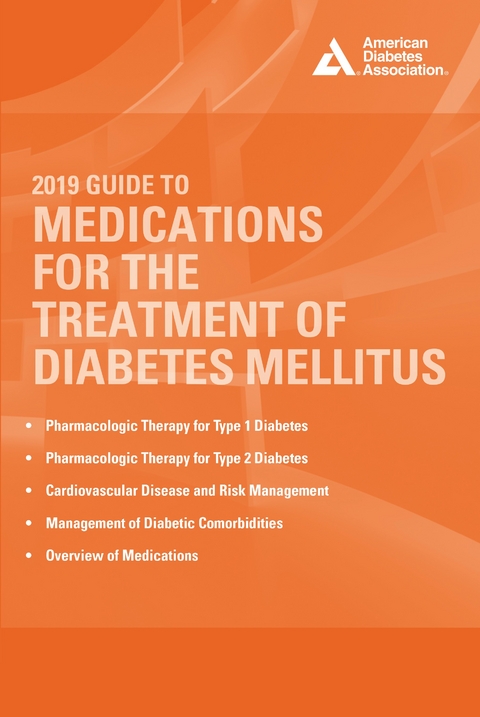
2019 Guide to Medications for the Treatment of Diabetes Mellitus (eBook)
American Diabetes Association (Verlag)
978-1-58040-734-2 (ISBN)
The first section includes:
-- Pharmacologic Therapy for Type 1 Diabetes
-- Management of Hyperglycemia in Type 1 DM– info from practical use of insulin, pathophysiology, treatment strategy
-- Insulins- RAIAs, Short-acting insulins, intermediate-acting insulins, LAIAs, Concentrated Insulins, Insulin pumps and patches, inhaled insulins, mixed and mixing insulin, use in Type 1, use in Type 2
-- Pharmacologic Therapy for Type 2 Diabetes
-- Management of Hyperglycemia in Type 2- brief overview, pathophysiology, treatment strategy, overview of medications
-- Biguanides
-- TZDs
-- SUs
-- Glinides
-- SGLT-2 Inhibitors
-- AGIs
-- DPP-IV inhibitors
-- GLP RAs
-- Amylin mimetics
-- BARs
-- DA-2 agonists
Each chapter in Section 1 includes:
1.Drug class overview and role in diabetes treatment
2.Pharmacology -- a. Mechanism of action, b. Pharmacokinetics
3.Treatment Advantages/Disadvantages -- a. General for the class, b.When applicable, a discussion of evidence that supports the benefits of using a particular drug in a class over another in the same class (eg, Avandia vs Actos)
4.Therapeutic Considerations -- a. Significant Warnings/Precautions, b. Special Populations, c. Pharmacogenomics, d. Adverse effects and monitoring, e. Drug Interactions, f. Dosage and administration
5.Table with Doses and Dose Adjustments
6.List of important combination products
7.References
The second section includes:
-- Cardiovascular Disease and Risk Management
-- Microvascular Complications and Foot Care
-- Medications for the Management of Hypertension
-- Medications for the Management of Hyperlipidemia
-- Antiplatelet Therapy
-- Medications for Smoking Cessation
-- Medications for the Management of Neuropathy (peripheral and autonomic)
-- Medications for the Management of Nephropathy
-- Medications for the Management of Retinopathy
-- Medications for the Management of Depression
-- Medications for the Management of Hypoglycemia
-- Medications for the Management of Obesity
-- Immunizations in Patients with Diabetes
Each chapter in Section 2 includes:
1.An overview of the condition or problem
2.Goals of treatment
3.Overview of the medications and rationale for the medications used for the problem
4.Overview of each class of medication
5.Overview of combination therapy -- a. first combination, b. second combination
6.Doses and Dose Adjustments for the more salient medications
7.List of important combination products
8.References
Volume Editor, John R. White Jr., is chair of the Department of Pharmacotherapy at the Washington State University College of Pharmacy. White is a licensed pharmacist and has a Doctor of Pharmacy (Pharm.D.) degree from Mercer University in Atlanta, GA, and completed a residency and a fellowship in pharmacokinetics/pharmacodynamics at the University of California, San Francisco. He has been affiliated with the WSU College of Pharmacy for more than 20 years. Extensively involved in diabetes research and education since 1987. He is a sought after lecturer on pharmocological research for the treatment of diabetes. In 1998 while a pharmacy professor at WSU, Dr. White completed the University of Washington’s physician assistant training.
Section I Drugs Used to Manage Hyperglycemia
Chapter 1- ADA Standards- Chapter 8- excerpt- Pharmacologic Therapy for Type 1 Diabetes
Chapter 2- Management of Hyperglycemia in Type 1 DM– info from practical use of insulin, pathophysiology, treatment strategy- J. Neumiller
Chapter 3- Insulins- RAIAs, Short-acting insulins, intermediate-acting insulins, LAIAs, Concentrated Insulins, Insulin pumps and patches, inhaled insulins, mixed and mixing insulin, use in Type 1, use in Type 2- J. Neumiller
Chapter 4- ADA Standards- Chapter 8- excerpt- Pharmacologic Therapy for Type 2 Diabetes
Chapter 5- Management of Hyperglycemia in Type 2- brief overview, pathophysiology, treatment strategy, overview of medications- J. White
Chapter 6- Biguanides- P. Odegard
Chapter 7- TZDs- P. Odegard
Chapter 8- SUs- L. Kroon
Chapter 9- Glinides- L. Kroon
Chapter 10- SGLT-2 Inhibitors- J. White
Chapter 11- AGIs- K. McKeirnan
Chapter 12- DPP-IV inhibitors-K. McKeirnan
Chapter 13- GLP RAs- J. Trujillo
Chapter 14-Amylin mimetics- J. Trujillo
Chapter 15- BARs- C. Buchman
Chapter 16- DA-2 agonists- C. Buchman
Section II Management of Co-morbidities
Chapter 17- ADA Standards- Chapter 9- Cardiovascular Disease and Risk Management
Chapter 18- ADA Standards- Chapter 9- Microvascular Complications and Foot Care
Chapter 19- Medications for the Management of Hypertension- C. Newsome
Chapter 20- Medications for the Management of Hyperlipidemia- C. Newsome
Chapter 21- Antiplatelet Therapy- M. Willson
Chapter 22- Medications for Smoking Cessation- A. Kim
Chapter 23- Medications for the Management of Neuropathy (peripheral and autonomic)- A. Kim
Chapter 24- Medications for the Management of Nephropathy- E. Tran
Chapter 25- Medications for the Management of Retinopathy- E. Tran
Chapter 26- Medications for the Management of Depression- M. Willson
Chapter 27- Medications for the Management of Hypoglycemia- M. Giruzzi
Chapter 28- Medications for the Management of Obesity- N. Giruzzi
Chapter 29- Immunizations in Patients with Diabetes- K. McKeirnan
| Erscheint lt. Verlag | 6.8.2019 |
|---|---|
| Verlagsort | Arlington |
| Sprache | englisch |
| Themenwelt | Sachbuch/Ratgeber ► Gesundheit / Leben / Psychologie |
| Medizin / Pharmazie ► Allgemeines / Lexika | |
| Medizinische Fachgebiete ► Innere Medizin ► Endokrinologie | |
| Medizin / Pharmazie ► Medizinische Fachgebiete ► Pharmakologie / Pharmakotherapie | |
| ISBN-10 | 1-58040-734-X / 158040734X |
| ISBN-13 | 978-1-58040-734-2 / 9781580407342 |
| Informationen gemäß Produktsicherheitsverordnung (GPSR) | |
| Haben Sie eine Frage zum Produkt? |
 EPUB (Adobe DRM)
Kopierschutz: Adobe-DRM
Adobe-DRM ist ein Kopierschutz, der das eBook vor Mißbrauch schützen soll. Dabei wird das eBook bereits beim Download auf Ihre persönliche Adobe-ID autorisiert. Lesen können Sie das eBook dann nur auf den Geräten, welche ebenfalls auf Ihre Adobe-ID registriert sind.
Details zum Adobe-DRM
Dateiformat: EPUB (Electronic Publication)
EPUB ist ein offener Standard für eBooks und eignet sich besonders zur Darstellung von Belletristik und Sachbüchern. Der Fließtext wird dynamisch an die Display- und Schriftgröße angepasst. Auch für mobile Lesegeräte ist EPUB daher gut geeignet.
Systemvoraussetzungen:
PC/Mac: Mit einem PC oder Mac können Sie dieses eBook lesen. Sie benötigen eine
eReader: Dieses eBook kann mit (fast) allen eBook-Readern gelesen werden. Mit dem amazon-Kindle ist es aber nicht kompatibel.
Smartphone/Tablet: Egal ob Apple oder Android, dieses eBook können Sie lesen. Sie benötigen eine
Geräteliste und zusätzliche Hinweise
Buying eBooks from abroad
For tax law reasons we can sell eBooks just within Germany and Switzerland. Regrettably we cannot fulfill eBook-orders from other countries.
aus dem Bereich