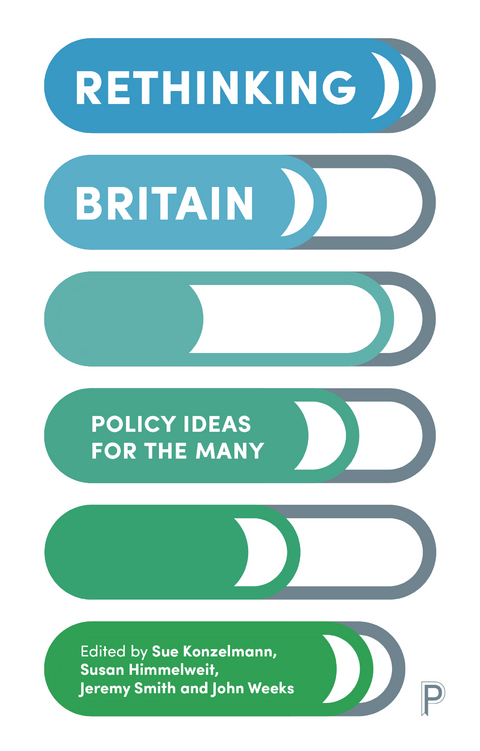
Rethinking Britain (eBook)
288 Seiten
Policy Press (Verlag)
978-1-4473-5253-2 (ISBN)
Sue Konzelmann is Reader in Management at Birkbeck, University of London. An economist by training, she is Co-executive Editor of Cambridge Journal of Economics. Susan Himmelweit is Emeritus Professor of Economics at the Open University. She is a past president of the International Association for Feminist Economics and founding chair and active member of the UK think tank the Women’s Budget Group. Her research interests are in gender issues in economic and social policy. Jeremy Smith is Co-Director of Prime Economics and a barrister by profession. He was formerly Chief Executive of the London Borough of Camden, and later worked for local government in Europe and internationally. He is an expert in international urban development, as well as EU and national constitutional issues. John Weeks (1941-2020) was Emeritus Professor in the Department of Development Studies, SOAS University of London.
Foreword ~ Patrick Allen;
Introduction ~ Jeremy Smith;
Interlude: ‘Mirror, mirror, on the wall – who has the highest debt of all?' ~ Sue Konzelmann and Marc Fovargue-Davies;
PART ONE: BUILDING A FULL-EMPLOYMENT ECONOMY;
Introduction ~ John Weeks;
When is austerity an appropriate economic policy? ~Sue Konzelmann;
Using the budget to manage output and employment ~ John Weeks;
Why assessing the equality impact of economic policies matters ~ Susan Himmelweit and Mary-Ann Stephenson;
How should we manage inflation? ~ John Weeks;
What should guide monetary policy? ~ Jan Toporowski;
Does the UK really have too much debt? ~ John Weeks;
The macroeconomic role of progressive taxation ~ John Weeks;
How do we build a fairer tax system? ~ Richard Murphy;
Should we have fiscal rules? ~ Jeremy Smith;
Interlude: Has privatisation come off the rails? ~ Sue Konzelmann and Marc Fovargue-Davies;
PART TWO ~ PUBLIC INVESTMENT – PRIORITISING SOCIETY RATHER THAN PROFIT;
Introduction ~ Sue Konzelmann and Marc Fovargue-Davies;
How could we build competitive new UK industries? ~ Sue Konzelmann and Marc Fovargue-Davies;
Reindustrialising the UK ~ Antonio Andreoni and Ha-Joon Chang;
How can labour law be the instrument of progressive economic policy? ~ Keith D. Ewing and John Hendy QC;
Wage policy and public investment for sustainable development ~ Özlem Onaran;
How do we build a sustainable economy? ~ Dan O'Neill
Investing in social infrastructure ~ Susan Himmelweit;
Why should the railway be renationalised? ~ Jeff Tan;
How can we fix the broken energy sector? ~ Hulya Dagdeviren;
Interlude: Why should citizens invest in losses, rather than for profit? ~ Sue Konzelmann and Marc Fovargue-Davies;
PART THREE: MAKING FINANCE WORK FOR SOCIETY;
Introduction ~ Sue Konzelmann and Marc Fovargue-Davies;
Why the UK needs a much better Companies Act ~ Simon Deakin;
What should be the limits to limited liability? ~ Colin Haslam;
Why do we need publicly listed companies? ~ Alan Shipman;
How can citizens’ wealth funds address the problem of inequality? ~ Stewart Lansley;
How can finance better serve the real economy? ~ Alan Shipman;
How can we channel credit to small and medium-sized enterprises (SMEs)? ~ John Marlow;
What can we learn from Germany’s national development bank? ~ Stephany Griffith-Jones and Natalya Naqvi;
Interlude: Safe as (council) houses... ~ Sue Konzelmann and Marc Fovargue-Davies;
PART FOUR: GENUINE SOCIAL SECURITY;
Introduction ~ Susan Himmelweit;
How can we tackle the UK’s private debt crisis? ~ Johnna Montgomerie;
How can we address the concerns of renters, without crashing house prices? ~ Beth Stratford and Duncan McCann;
How do we make occupational pension funds fit for purpose? ~ Bruno Bonizzi and Jennifer Churchill;
How can we stop the social security system aggravating mental distress? ~ John Grahl;
Reconstructing social security ~ Simon Deakin;
How could Universal Basic Income (UBI) improve social security? ~ Stewart Lansley and Howard Reed;
Would Universal Basic Income (UBI) address the causes of inequality, ill-being and injustice? ~ Ian Gough;
Interlude: What is ‘social’ infrastructure – and why does it matter so much? ~ Sue Konzelmann and Marc Fovargue-Davies;
PART FIVE: HOW TO PROVIDE FOR SOCIAL NEEDS;
Introduction ~ Susan Himmelweit;
How can we stop privatisation of public services? ~ Leslie Huckfield;
What has the market done to the English NHS and with what should we replace it? ~ Pauline Allen;
What’s the best way to tackle health inequalities? ~ Kate Pickett;
What’s the best way of delivering social care? ~ Jane Lethbridge;
How do we make drug prices an easier pill for the NHS to swallow? ~ Dean baker;
How much would high-quality childcare cost and how would we pay for it? ~ Jerome De Henau;
What should be done about private schools? ~ Francis Green and David Kynaston;
How do we make lifelong learning a reality for all? ~ Liz Marr;
Conclusion ~ Jeremy Smith;
Jargon busters
References and further reading
| Erscheint lt. Verlag | 19.9.2019 |
|---|---|
| Sprache | englisch |
| Themenwelt | Sachbuch/Ratgeber ► Beruf / Finanzen / Recht / Wirtschaft ► Wirtschaft |
| Sozialwissenschaften ► Politik / Verwaltung ► Staat / Verwaltung | |
| Sozialwissenschaften ► Soziologie | |
| Wirtschaft ► Volkswirtschaftslehre ► Wirtschaftspolitik | |
| Schlagworte | Economic Policy • Labour’s economic policy • Post-neoliberalism • Progressive Economics • Public Investment |
| ISBN-10 | 1-4473-5253-X / 144735253X |
| ISBN-13 | 978-1-4473-5253-2 / 9781447352532 |
| Informationen gemäß Produktsicherheitsverordnung (GPSR) | |
| Haben Sie eine Frage zum Produkt? |
 EPUB (Adobe DRM)
Kopierschutz: Adobe-DRM
Adobe-DRM ist ein Kopierschutz, der das eBook vor Mißbrauch schützen soll. Dabei wird das eBook bereits beim Download auf Ihre persönliche Adobe-ID autorisiert. Lesen können Sie das eBook dann nur auf den Geräten, welche ebenfalls auf Ihre Adobe-ID registriert sind.
Details zum Adobe-DRM
Dateiformat: EPUB (Electronic Publication)
EPUB ist ein offener Standard für eBooks und eignet sich besonders zur Darstellung von Belletristik und Sachbüchern. Der Fließtext wird dynamisch an die Display- und Schriftgröße angepasst. Auch für mobile Lesegeräte ist EPUB daher gut geeignet.
Systemvoraussetzungen:
PC/Mac: Mit einem PC oder Mac können Sie dieses eBook lesen. Sie benötigen eine
eReader: Dieses eBook kann mit (fast) allen eBook-Readern gelesen werden. Mit dem amazon-Kindle ist es aber nicht kompatibel.
Smartphone/Tablet: Egal ob Apple oder Android, dieses eBook können Sie lesen. Sie benötigen eine
Geräteliste und zusätzliche Hinweise
Buying eBooks from abroad
For tax law reasons we can sell eBooks just within Germany and Switzerland. Regrettably we cannot fulfill eBook-orders from other countries.
aus dem Bereich