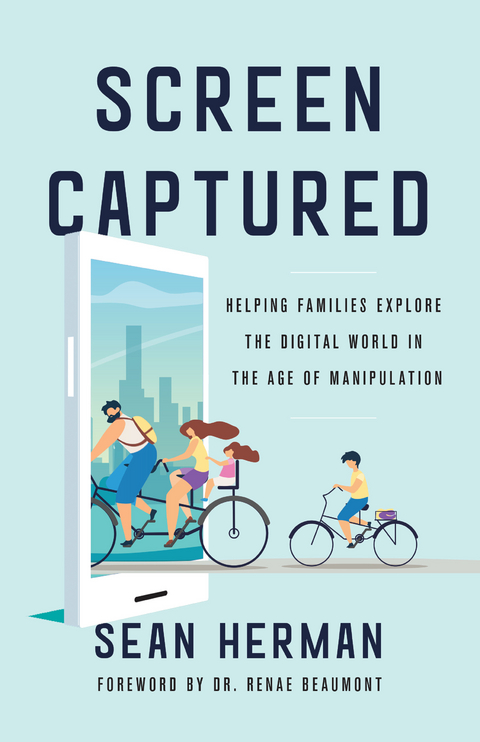
Screen Captured (eBook)
200 Seiten
Lioncrest Publishing (Verlag)
978-1-5445-0375-2 (ISBN)
If you're a parent, you can't escape the avalanche of news touting the negative effects of technology on children. You figure that screen time can't be as bad as experts are making it out to be, and yet, you're unsure which platforms to trust and may even have anxiety over what your kids are seeing online. You want to help them form good habits around technology use, but where can you turn for guidance?In Screen Captured, Sean Herman separates technology fact from fiction for his fellow parents. He highlights the difference between positive screen time, which focuses on education, connectedness, and creativity, and being screen captured, where we are manipulated by tech companies to crave the infinite feed. He acknowledges privacy concerns but digs deeper to reveal the true problem: a growing obsession among children with the social validation they receive online. Sean equips you with critical questions to ask so you can give your kids the best of technology-while eliminating the worst of it.
Chapter One
1. There’s an App for That (Including Validation)
How would your childhood have been different if you’d grown up in the age of social media?
I’ll always remember an incident that happened in the fifth grade, when I was playing outside at recess. I was often picked on in elementary school because I was overweight, nerdy, and extremely naïve. I had a lot of allergies as a kid, and in particular I was allergic to dandelions. On this particular day, a group of bullies approached me on the playground, and without warning, they tackled me and pinned me down on the ground.
As I struggled to twist out of their grip, another kid pulled a fistful of dandelions out of the grass. He smashed them in my face and rubbed them over my neck and arms. I had a bad allergic reaction, and my skin broke out in an angry red rash. I had to go home that day—and I was terrified to go back to school the next day.
While that experience still sticks in my mind, it may not have stayed in the memories of those bullies. If the same incident were to happen today, though, you can bet that one of those kids would have been there with a device, taking a video. That awful experience would have been recorded, posted, and spread across the school—not just as a story, but as an experience that people could watch on permanent record. Even people who weren’t there would have seen my struggle and my reaction.
While social media has made our interactions more accessible, instantaneous, and permanent, the drivers behind our behavior are still the same: we humans are driven by social validation.
I met my friend Jason in elementary school. I’m not sure if it was out of pity, but he was the one guy in the cool crowd who stood up for me. I followed Jason to high school—to a different school than the one my tormentors attended—and things started to turn around. Jason quickly got into the cool circles with the athletic types, and he brought me along. I had grown taller and thinned down, and I was starting to come into my own. I was actually a pretty decent athlete, and I joined the football and hockey teams. It was through those sports that I met Barney: he was charismatic, he was cool, and he was the ringleader of the athletic crowd.
Through these friendships, I became part of the inner circle. For the first time in my life, I was in, and I loved it. I even remember being invited to a kid’s party—in elementary school I was rarely invited to parties—and at the party Barney turned to Jason and while pointing at me said, “Hey, so this is a pretty cool guy.”
I didn’t realize it at the time, but knowing what I know now, I’m sure my brain was flooding with dopamine in that moment.
It wasn’t until later that I picked up on the peer pressure that comes with being part of a group. Some of the dumbest things I’ve ever done were driven by my need to fit in. One day in my senior year, a dozen or so of us football players were hanging out in the hallway at school. I did not want to lose my friends for anything, and so I said nothing as we made lines on either side of the hallway, waiting for new kids to pass. As unsuspecting ninth-graders approached us, we would pinball them down the line, shoving them back and forth across the hall.
I did nothing to stop us. Worse, I participated even though I’d been bullied myself and knew what it felt like. I wish I could have been as strong as Jason, who had stood up for me, especially because I knew what it was like to be on the other side of bullying. I’ve always been uncomfortable with that memory; especially as a father, I feel awful that I never stood up to my friends.
So why did I do it? Above anything else, I feared rejection from my friends.
Understanding Our Need to Belong
Humans are wired to fit in with group dynamics and predict our place in the group, an idea made famous by Abraham Maslow. Most of us at some point in our education were introduced to Maslow’s hierarchy of needs. Maslow studied human motivation, and in 1943, he introduced his eminent paper entitled “A Theory of Human Motivation.” He believed that humans are motivated for personal growth and change through basic needs, organized into a five-stage model:
- Biological and physiological needs including air, food, and shelter
- Safety needs including protection, security, and law
- Love and belonging needs
- Esteem needs, such as recognition and respect from others
- Self-actualization, or a desire to fully reach one’s potential
Maslow argued that people move up the hierarchy in terms of basic motivation. Once we are fed, sheltered, safe, and secure, our motivation shifts to belongingness. He explained it this way:
It is quite true that man lives by bread alone—when there is no bread. But what happens to man’s desires when there is plenty of bread and when his belly is chronically filled? At once other (and “higher”) needs emerge and these, rather than physiological hungers, dominate the organism. And when these in turn are satisfied, again new (and still “higher”) needs emerge and so on. This is what we mean by saying that the basic human needs are organized into a hierarchy of relative prepotency.1
Under this lens, it’s easy to see why we feel so much comfort from fitting into cliques. On the other hand, we feel pain when we’re left out. In elementary school, I often found myself on the outside looking in: I was almost always left out of birthday parties and other events with my peers. I felt intense pain from social exclusion in those early years.
Where I grew up in Saskatchewan, the elementary school system ranges from kindergarten to grade eight, and then you go to high school for grades 9 through 12. When I finally got to switch schools in high school, it was a new beginning. Through Jason, I became friends with many in the cool crowd, and suddenly, I was in. And I was willing to go along with the group to stay “in,” even if that meant picking on the freshmen in the hallway.
We go to extremes to fit in. In a 1995 study of social belonging, researchers Roy F. Baumeister and Mark R. Leary found that “members of some groups are pressured to commit violent acts ranging from vandalism to murder in order to be accepted and demonstrate commitment to the group.”2
The behavior I engaged in to seem cool to my buddies wasn’t violent, but it was consistent with a larger phenomenon of human nature.
Baumeister and Leary illustrated this phenomenon further in their study “The Need to Belong,” which remains one of the most cited studies on the subject. They looked at the work of dozens of researchers from Freud to Maslow and argued that the notion of belonging was often discussed but lacked conclusive empirical evidence. They set out to test their hypothesis: “Human beings have a pervasive drive to form and maintain at least a minimum quantity of lasting positivity and significant interpersonal relationships.”
The need to belong, they proposed, has two main features:
First, people need frequent personal contacts or interactions with the other person. Ideally, these interactions would be affectively positive or pleasant, but it is mainly important that the majority be free from conflict and negative affect. Second, people need to perceive that there is an interpersonal bond or relationship marked by stability, affective concern, and continuation into the foreseeable future.
Their work was predicated on the basis that the need to belong is driven by an “evolutionary basis” in which the need to belong in groups would have had benefits for our ancestors to survive and to reproduce.
They further argued that “if belonging is indeed a fundamental need, then aversive reactions to a loss of belongingness should go beyond negative affect to include some types of pathology.”
Baumeister and Leary described the fundamental effect our need to belong has on our emotions. In the study, they stated, “Many of the strongest emotions people experience, both positive and negative, are linked to belongingness. Evidence suggests a general conclusion that being accepted, included, or welcomed leases to a variety of positive emotions, whereas becoming rejected, excluded or ignored leads to potent negative feelings (e.g., anxiety, depression, grief, jealousy and loneliness).”
An earlier study by Baumeister and Dianne M. Tice (1990) even went so far as to say that social exclusion could be the most significant cause of anxiety.3 And as researchers continued to investigate the importance of belonging, a 2003 study of fMRI scans showed that being rejected activates the same parts of the brain as physical pain.4
This explains why particularly painful memories of rejection stick with us.
The Problem with Birthday Cake
I can share with you a personal version of this from my unforgettable days as a sixth-grader. Similar to the bullies with dandelions incident, I’ll always remember the birthday cake. I was very excited to be invited to a birthday party, and all the kids there were having a grand old time. As I’ve said, in grade school I was a hefty, overweight kid. I couldn’t wait for the cake. When it was finally served up, I had more than one helping. I mean, I really enjoyed that...
| Erscheint lt. Verlag | 24.9.2019 |
|---|---|
| Vorwort | Dr. Renae Beaumont |
| Sprache | englisch |
| Themenwelt | Sachbuch/Ratgeber ► Gesundheit / Leben / Psychologie ► Familie / Erziehung |
| ISBN-10 | 1-5445-0375-X / 154450375X |
| ISBN-13 | 978-1-5445-0375-2 / 9781544503752 |
| Informationen gemäß Produktsicherheitsverordnung (GPSR) | |
| Haben Sie eine Frage zum Produkt? |
 EPUB (Ohne DRM)
Größe: 2,6 MB
Digital Rights Management: ohne DRM
Dieses eBook enthält kein DRM oder Kopierschutz. Eine Weitergabe an Dritte ist jedoch rechtlich nicht zulässig, weil Sie beim Kauf nur die Rechte an der persönlichen Nutzung erwerben.
Dateiformat: EPUB (Electronic Publication)
EPUB ist ein offener Standard für eBooks und eignet sich besonders zur Darstellung von Belletristik und Sachbüchern. Der Fließtext wird dynamisch an die Display- und Schriftgröße angepasst. Auch für mobile Lesegeräte ist EPUB daher gut geeignet.
Systemvoraussetzungen:
PC/Mac: Mit einem PC oder Mac können Sie dieses eBook lesen. Sie benötigen dafür die kostenlose Software Adobe Digital Editions.
eReader: Dieses eBook kann mit (fast) allen eBook-Readern gelesen werden. Mit dem amazon-Kindle ist es aber nicht kompatibel.
Smartphone/Tablet: Egal ob Apple oder Android, dieses eBook können Sie lesen. Sie benötigen dafür eine kostenlose App.
Geräteliste und zusätzliche Hinweise
Buying eBooks from abroad
For tax law reasons we can sell eBooks just within Germany and Switzerland. Regrettably we cannot fulfill eBook-orders from other countries.
aus dem Bereich