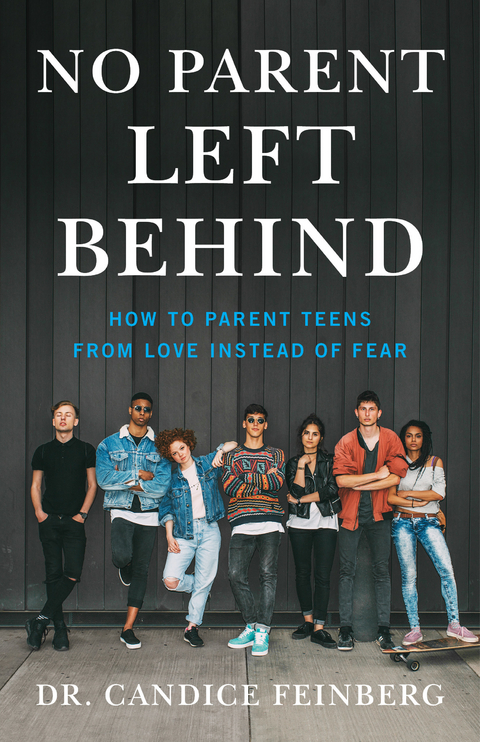
No Parent Left Behind (eBook)
200 Seiten
Lioncrest Publishing (Verlag)
978-1-5445-1367-6 (ISBN)
Parenting teenagers can be exhausting and often troubling. This is especially true if your child seems depressed, is engaging in self-harm, or simply refuses to get out of bed for school or do homework. It's only natural for you to be concerned when your teen starts acting out violently or gets involved in dangerous online activities. But there's no need to panic. With Dr. Candice Feinberg's help you can still raise a healthy, independent teenager, even if you're a single parent doing it on your own. Inspired by Dr. Feinberg's years of experience working with teenagers and their families, No Parent Left Behind provides practical advice and much- needed guidance based on the principle of parenting out of love rather than fear. The real-world examples and proven approaches included in this invaluable volume will enable you to better understand your individual situation and tackle your child's problematic behaviors. And it all begins with love.
Introduction
When your child is just a baby, staring up at you with those beautiful, trusting eyes, it’s impossible to imagine a day when they’ll be slamming doors, sneaking in after curfew, or slouching around the house with a group of questionable friends. It’s easy to think that if you just do everything right as a parent, your child will lead the charmed, successful, worry-free life you want for them.
But since you’re reading this book, you’ve probably already realized that even the most angelic babies encounter struggles once they hit the teen years.
For every kid, the struggle looks different. Perhaps your kid’s started out looking like standard teenager issues—a depressed and unmotivated attitude, outbursts of anger, over-the-top anxiety about school or social life—but then suddenly escalated into something much more serious.
Maybe you’ve been doing your son’s homework to make sure he doesn’t fail out of a class.
Maybe you’ve been monitoring your daughter’s phone and social media messages.
Maybe you’ve found yourself paying off repeated credit card debt, calling your college student to make sure they wake up for class, or bargaining with the local police to try to keep a drug bust off your kid’s record.
Maybe you got a call at work or in the middle of the night that sent your heart into your throat: an overdose, a car crash, a suicide attempt.
No matter what your child’s struggle may look like, yours is likely to resemble that of so many other parents who are dealing with the same kinds of issues you are. You’re frustrated, exhausted, sad, and, more than anything, scared. The fear you feel for your child, for their health, their safety, and their future, keeps you awake at night.
Your child’s struggle may have arisen all of a sudden, but more likely, it’s been going on for quite a while—months, or even years. If you think back, you realize the signs were there for a long time. You just didn’t see them, or you thought they were a passing thing. Or you hoped that if you didn’t pay too much attention to them, they would just go away.
But now you’re at the point where you can’t deal with it anymore. Not on your own.
And my question for you is, “What took you so long?”
In my experience, the average parent waits two years before seeking out help for their kid’s struggle. Two years is a long time, and can be a lot of heartache to go through. As a parent myself, I can understand wanting to do everything you can to help your child. But think about it: if your kid had diabetes, you wouldn’t try to treat it on your own for two years before you took them to a doctor.
The Hidden Script
As parents, we tend to have a script in mind for our child. We believe that if things happen in the right way and in the right order—if all the bits line up—everything will be fine. Following this script makes us feel secure and confident that our kids are going to be safe, happy, and healthy, and that we’ve done a good job as parents.
As parents, we can ensure that, up to a certain age, our kids follow this script. We decide what they eat for dinner, what time they go to bed, what sports they’re going to play, which friends they can spend time with. We have it all planned out: how they’re going to go to college (maybe even a certain college), get married (probably to a heterosexual partner), and raise beautiful grandkids (we may even know exactly how many). Yes, the script reflects our love for our kids, but it’s also filtered through our individual values.
You may not even know you have these detailed plans in mind until the day your kid goes off-script. Maybe they go off by just a little, or maybe it’s by a lot. Either way, they’re not on the right path anymore. That is, they’re not on your path anymore.
As soon as their kids do something that wasn’t part of the plan, many parents tumble down a rabbit hole of worst-case outcomes. My kid won’t get out of bed and go to school! She’s not going to graduate! She won’t get into college! She’ll never land a good career! This fear takes parents to a place where they can’t think about anything else. Their whole life is channeled into one thought: Fix my kid. They become obsessed with figuring out why the behavior began and trying to contain or control it.
The never-ending quest for “why” can become pretty extreme. A mother once came into my treatment center with a stack of papers about a nutritional supplement she was convinced her son needed. Another mother quit her job so that she could focus full-time on researching and understanding the “why” behind her daughter’s issues, and a father told me he was 100 percent sure his daughter’s behavior came from wearing thong underwear.
I always tell parents that if you have lung cancer, the treatment is the same whether you got it because you worked in a coal mine or because you smoked. Blame doesn’t help solve the problem. The solution lies in moving forward and acting differently.
Fueled by these fears and desperate to prevent their kid from failing, parents end up overcompensating to make up for their kids’ underperformance. They start doing their children’s homework or completing their college applications. They begin spying on their kids’ activities, both online and in real life. In some extreme cases, they might even sleep on their kids’ floors, or bribe an athletic coach to get their kid into college. They micromanage their kids’ lives, believing that placing fewer demands on them will make it harder for them to fail.
However, this parenting approach has the opposite effect. As soon as a parent gives in, they’ve effectively lowered the bar for a kid’s behavior, which causes harmful behavior to escalate. Even if the parent tries to pull back on what they’ll put up with, the pattern of enabling has already gone on so long they don’t have the strength to maintain any boundaries. The kid knows that if they push back hard enough or threaten the right things, those boundaries won’t be maintained.
Little by little, this dance of dependency becomes standard procedure in the house. Eventually, it reaches a breaking point. This may come in the form of a sudden disaster, or a parent waking up one day and realizing, “My God, when did this become our ‘normal’?”
A parent in these straits may spend hours researching their kid’s issues on the Internet or seeking advice from friends, but then still hesitate to seek out real help. Believing they can figure it out themselves makes the issue seem not that bad. In contrast, reaching out for a qualified resource makes the problem feel like, well, a real problem. As much as a parent may hate and fear their child’s negative behavior, they also fear what the behavior says about them as a parent.
A lot of this has to do with the stigma around mental health issues. You don’t think of yourself as a bad parent if your kid scrapes their knee or gets chickenpox, right? But so many parents feel that putting their kid in therapy invites judgment. “If I had parented exactly right,” they tell themselves, “this wouldn’t have happened.” Caring for one’s mental health is no different from caring for one’s physical health. After all, the brain works and grows stronger in the same way that any muscle in your body does. But there remains an unfortunate stigma around seeking professional resources when mental or emotional issues arise.
Underneath the fear associated with seeking professional help, there’s an even deeper fear centered around where their kid’s behavior could lead. It could be the loss of the child’s life or safety; it could be the loss of their promising future; it could be the loss of the parent’s relationship with their child. As concerned as the parent is, and as much as they may hate their child’s behavior, they may ultimately choose to enable it rather than risk losing them.
That’s why by the time a parent reaches out for a book like this one, they are probably in a state of absolute emotional chaos. They’ve spent years trying to prevent this deep loss that they fear, but they’ve finally come to a place where they realize that if they don’t get help, a loss is going to happen anyway.
Giving Up Control to Find Connection
As a clinical psychologist with over ten years in private practice and running treatment programs for teens with mental health issues, I’ve seen every unhealthy behavior you can imagine (and a few you can’t). I’ve also seen families change and heal in radical ways. I’m not exaggerating when I say that 100 percent of my clients report improvement in their relationship with their kids. But this doesn’t happen by accident. Success depends on parents committing to make the changes that are asked of them and discovering how to connect with their kids.
Connection is truly the missing key in parenting today. It’s also a word that gets tossed around a lot, and it’s often taken to mean a...
| Erscheint lt. Verlag | 1.10.2019 |
|---|---|
| Sprache | englisch |
| Themenwelt | Sachbuch/Ratgeber ► Gesundheit / Leben / Psychologie ► Familie / Erziehung |
| ISBN-10 | 1-5445-1367-4 / 1544513674 |
| ISBN-13 | 978-1-5445-1367-6 / 9781544513676 |
| Informationen gemäß Produktsicherheitsverordnung (GPSR) | |
| Haben Sie eine Frage zum Produkt? |
 EPUB (Ohne DRM)
Größe: 4,5 MB
Digital Rights Management: ohne DRM
Dieses eBook enthält kein DRM oder Kopierschutz. Eine Weitergabe an Dritte ist jedoch rechtlich nicht zulässig, weil Sie beim Kauf nur die Rechte an der persönlichen Nutzung erwerben.
Dateiformat: EPUB (Electronic Publication)
EPUB ist ein offener Standard für eBooks und eignet sich besonders zur Darstellung von Belletristik und Sachbüchern. Der Fließtext wird dynamisch an die Display- und Schriftgröße angepasst. Auch für mobile Lesegeräte ist EPUB daher gut geeignet.
Systemvoraussetzungen:
PC/Mac: Mit einem PC oder Mac können Sie dieses eBook lesen. Sie benötigen dafür die kostenlose Software Adobe Digital Editions.
eReader: Dieses eBook kann mit (fast) allen eBook-Readern gelesen werden. Mit dem amazon-Kindle ist es aber nicht kompatibel.
Smartphone/Tablet: Egal ob Apple oder Android, dieses eBook können Sie lesen. Sie benötigen dafür eine kostenlose App.
Geräteliste und zusätzliche Hinweise
Buying eBooks from abroad
For tax law reasons we can sell eBooks just within Germany and Switzerland. Regrettably we cannot fulfill eBook-orders from other countries.
aus dem Bereich