


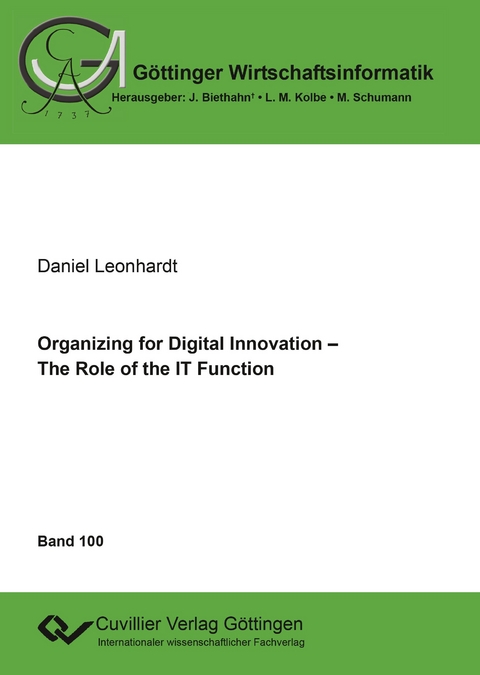
Organizing for Digital Innovation – The Role of the IT Function
Seiten
2019
Cuvillier Verlag
978-3-7369-7060-1 (ISBN)
Cuvillier Verlag
978-3-7369-7060-1 (ISBN)
- Keine Verlagsinformationen verfügbar
- Artikel merken
Companies across a wide range of industries are affected by the increasing relevance of digital innovation and their related organizing challenges. Against this background, it is unclear how this influences the role of the established IT function in incumbent firms. Although digital innovations require IT-related knowledge and capabilities, the corporate IT function seems unprepared with regards to their organizational structure and capabilities.
Therefore, this cumulative dissertation comprises four individual studies at the intersection of digital innovation and the IT function. These studies mainly address the following research goals: (1) to understand how the increasing prevalence of digital innovation is changing the IT function’s organizing logics, and (2) to understand how the IT function can contribute to the effective and efficient development of digital innovations.
On the one hand, the thesis shows that digital innovation projects can trigger new value commitments of IT functions regarding their organizing logic. On the other hand, the results implicate that IT functions require sufficient organizational support and decision rights, as well as organizational agility and ambidexterity, to successfully contribute to their firms’ digital innovation activities.
Companies across a wide range of industries are affected by the increasing relevance of digital innovation and their related organizing challenges. Against this background, it is unclear how this influences the role of the established IT function in incumbent firms. Although digital innovations require IT-related knowledge and capabilities, the corporate IT function seems unprepared with regards to their organizational structure and capabilities.
Therefore, this cumulative dissertation comprises four individual studies at the intersection of digital innovation and the IT function. These studies mainly address the following research goals: (1) to understand how the increasing prevalence of digital innovation is changing the IT function’s organizing logics, and (2) to understand how the IT function can contribute to the effective and efficient development of digital innovations.
On the one hand, the thesis shows that digital innovation projects can trigger new value commitments of IT functions regarding their organizing logic. On the other hand, the results implicate that IT functions require sufficient organizational support and decision rights, as well as organizational agility and ambidexterity, to successfully contribute to their firms’ digital innovation activities.
Therefore, this cumulative dissertation comprises four individual studies at the intersection of digital innovation and the IT function. These studies mainly address the following research goals: (1) to understand how the increasing prevalence of digital innovation is changing the IT function’s organizing logics, and (2) to understand how the IT function can contribute to the effective and efficient development of digital innovations.
On the one hand, the thesis shows that digital innovation projects can trigger new value commitments of IT functions regarding their organizing logic. On the other hand, the results implicate that IT functions require sufficient organizational support and decision rights, as well as organizational agility and ambidexterity, to successfully contribute to their firms’ digital innovation activities.
Companies across a wide range of industries are affected by the increasing relevance of digital innovation and their related organizing challenges. Against this background, it is unclear how this influences the role of the established IT function in incumbent firms. Although digital innovations require IT-related knowledge and capabilities, the corporate IT function seems unprepared with regards to their organizational structure and capabilities.
Therefore, this cumulative dissertation comprises four individual studies at the intersection of digital innovation and the IT function. These studies mainly address the following research goals: (1) to understand how the increasing prevalence of digital innovation is changing the IT function’s organizing logics, and (2) to understand how the IT function can contribute to the effective and efficient development of digital innovations.
On the one hand, the thesis shows that digital innovation projects can trigger new value commitments of IT functions regarding their organizing logic. On the other hand, the results implicate that IT functions require sufficient organizational support and decision rights, as well as organizational agility and ambidexterity, to successfully contribute to their firms’ digital innovation activities.
| Erscheinungsdatum | 02.08.2019 |
|---|---|
| Reihe/Serie | Göttinger Wirtschaftsinformatik ; 100 |
| Verlagsort | Göttingen |
| Sprache | deutsch |
| Maße | 148 x 210 mm |
| Gewicht | 237 g |
| Themenwelt | Sachbuch/Ratgeber ► Beruf / Finanzen / Recht / Wirtschaft ► Wirtschaft |
| Wirtschaft | |
| Schlagworte | Digitale Innovationen • digitale Transformation • Digitalisierung • Digitalization • Digital transformation • Innovation • IT-Abteilung • IT Agilität • IT Agility • IT Ambidexterität • IT Ambidexterity • IT Department • IT function • IT-Funktion • IT Governance, • IT-Organisationslogik • IT Organizing Logics |
| ISBN-10 | 3-7369-7060-9 / 3736970609 |
| ISBN-13 | 978-3-7369-7060-1 / 9783736970601 |
| Zustand | Neuware |
| Informationen gemäß Produktsicherheitsverordnung (GPSR) | |
| Haben Sie eine Frage zum Produkt? |
Mehr entdecken
aus dem Bereich



aus dem Bereich
warum wir vor den Tech-Milliardären noch nicht einmal auf dem Mars …
Buch | Softcover (2025)
Suhrkamp (Verlag)
CHF 30,80
zum Stand der Dinge (des Alltags)
Buch | Softcover (2025)
Suhrkamp (Verlag)
CHF 30,80


