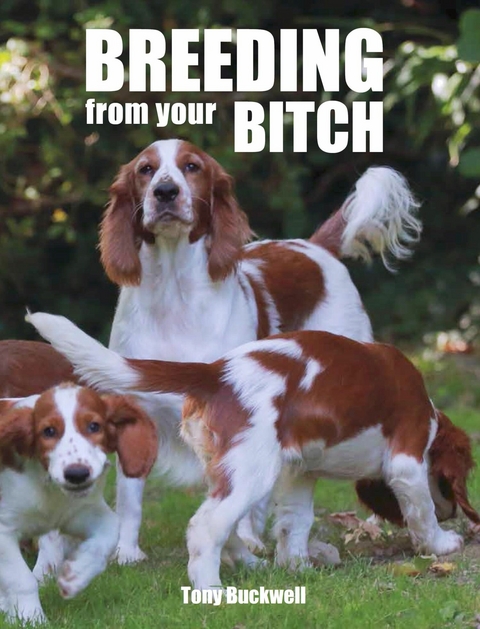
Breeding from your Bitch (eBook)
259 Seiten
Crowood (Verlag)
978-1-78500-654-8 (ISBN)

Tony Buckwell (BVet Med, DLAS, MRCVS) is a veterinary surgeon who worked predominantly in small animal practice, prior to a variety of senior management roles in industry, with a large animal breeder and in academia, each relating to the veterinary care and general welfare of a variety of animal species. Tony has a life-long passion for dogs, natural history and country pursuits, and its married to a pedigree gundog breeder. He volunteers his expertise to the Kennel Club and regularly writes for Shooting Times magazine, answering questions on the health care and general welfare of working dogs, and is the author of Gundog Health and Welfare (Crowood).
Breeding from your Bitch covers every aspect of breeding for anyone who might be considering mating their bitch. Written by a vet, this accessible and invaluable book dispels common misconceptions and addresses frankly the issues involved, ranging from the cost, time and effort concerned, through the mating process itself, to ensuring the health and welfare of both mother and puppies. The book covers factors to consider before breeding from your dog; choosing a stud dog and the mating process; care of the bitch during pregnancy; whelping and caring for neo-natal puppies; post-pregnancy care and, finally, rearing a healthy litter.
Tony Buckwell (BVet Med, DLAS, MRCVS) is a veterinary surgeon who worked predominantly in small animal practice, prior to a variety of senior management roles in industry, with a large animal breeder and in academia, each relating to the veterinary care and general welfare of a variety of animal species. Tony has a life-long passion for dogs, natural history and country pursuits, and its married to a pedigree gundog breeder. He volunteers his expertise to the Kennel Club and regularly writes for Shooting Times magazine, answering questions on the health care and general welfare of working dogs, and is the author of Gundog Health and Welfare (Crowood).
2PLANNING A LITTER, MATING AND CONFIRMING PREGNANCY
So you have read the first chapter, and been able to answer ‘yes’ to all of the questions. You have decided that you are thinking of breeding puppies for good reasons and are determined to go ahead; what initial steps do you need to take?
FORWARD PLANNING
It is useful to plan ahead with some realistic understanding of the necessary timescales. Waiting until your bitch is in season and ready to be mated before selecting the stud dog and arranging the mating is unlikely to achieve optimum success. However, by understanding the overall process and estimating how long each step will take, you will be able to plan ahead and anticipate any potential problems.
Forward planning will ensure that your bitch won’t whelp when it’s least convenient or you won’t have a large litter ready to go at times when people are least likely to want to take on and train a new puppy. Forward planning is also essential to ensure that the pups will be raised in the most appropriate environment, that the bitch is fully vaccinated, up to date with her vaccinations and wormed prior to mating and again before whelping.
The preparatory phase, selecting the stud dog and having all necessary health checks carried out (outlined in this chapter) should be undertaken well in advance of any intended litter; certainly nine to twelve months in advance of mating your bitch.
It is important to understand your bitch’s strengths and weaknesses; her good and bad points. Try to get an informed opinion from a reputable breeder and take advice concerning a suitable stud dog that will complement her good points and/or compensate for any weaknesses.
CHOOSING A STUD DOG
Finding a stud dog is a fairly fundamental requirement. A careful choice of stud dog will be essential. No doubt the process of selecting a suitable dog from the many that may potentially be available would appear to be a daunting task and whilst in many respects this is true, there are certain points to bear in mind that, when taken together, will help narrow the choice considerably.
Do your homework
Learn about any problems that are within your breed (such as hip dysplasia [HD], progressive retinal atrophy [PRA], and so on). Do as much research as you can to learn about any inherited traits you are hoping to change. Should any of your bitch’s unwanted traits be inherited, you do not want to use a stud dog that may also have the trait and therefore not be able to correct it.
In order to gauge the risks of a stud dog carrying a recessive gene, you would need to examine the stud dog’s ancestry; its pedigree. When it’s an unwanted trait that is inherited polygenically (caused by several genes when combined together), it would depend on how badly the stud dog is affected as to the outcome of the pups not inheriting the gene and the best way to establish this would be to check out the stud dog’s siblings.
Know your bitch – her strengths and weaknesses
Be honest with yourself and be as objective as you can when it comes to assessing your bitch’s strengths and weak points. Know what’s important and prioritize which traits you consider to be good, and which you would like to pass on in her pups.
Get an honest opinion of your bitch from a few breeders. Find out what they think; what do they consider to be her virtues and which are her faults. Get several breeders’ opinions of a good choice for a stud dog that will enhance your bitch’s strengths and correct any particular weaknesses. Your aim should be to use the dog that is most likely to correct any of her weaknesses and seek to avoid one that will undermine or dilute any of her good points.
You have to bear in mind that the chances of finding a stud dog that complements your bitch 100 per cent are low, so it is far better to focus on her weaker traits when looking for a stud dog. Certainly it will be important to find a dog that does not share her faults because, ideally, you will be seeking a stud dog that has a track record of correcting such weaknesses in the breed.
Health issues, soundness and temperament
Ideally both bitch and dog will be fully health tested so that you can be confident that in breeding, you are unlikely to pass on any inherited problems to the puppies.
Ask your vet to perform a physical examination and give advice regarding your bitch’s suitability for breeding. Most bitches should be at least a year old before mating and have had at least one normal season. It’s usually advisable, however, to breed from her a little later, once she’s fully mature, typically after she has had at least three to four normal seasons. Usually this will mean she is between three to six years of age. It is not advisable to start breeding an older bitch and certainly not beyond the age of eight. Knowing she cycles regularly will help you anticipate when she is likely to come into season, at what time she will be ready for mating, and when any puppies will be due to go to new homes.
Health testing will represent a financial commitment so take strategic advice and decide which tests to have carried out first. There is no point carrying out some blood tests to confirm the bitch is clear of a number of relatively rare conditions in the breed only to subsequently find she shows signs of a more common debilitating condition, such as hip dysplasia.
Once you know the bitch’s health status and suitability for breeding you will be in a better position to assess the comparative health status of potential stud dogs. Assuming the stud dog owners have undertaken health testing, ask to see copies of the results, don’t simply take their word for it. If you have done your homework and understand any health issues in the breed, see how familiar an owner is with these problems and how they compare their dogs in these respects. You should find that most reputable breeders will be very well informed, a ‘font of knowledge’, and in speaking with them your understanding of the health of the breed will improve considerably.
Stud dog owners who are members of the Kennel Club Assured Breeder Scheme undertake to carry out health testing of all their breed stock, will give you good advice and assistance, and will often take an interest in finding good homes for your puppies.
Aim to breed a litter that will represent an improvement on the parents
Resist the temptation to breed thinking you are likely to simply reproduce your bitch. Remember the stud dog will contribute equally to the characteristics of the puppies. The intention in breeding should be to improve on the dog you already own so identify the characteristics that you would wish to improve upon and then try to select a stud dog accordingly. Don’t necessarily select a stud simply because it happens to be in your locality and it is convenient. Try to use a proven stud dog wherever possible, preferably one owned by a reputable breeder and trainer who should be able to show you progeny of the ‘type’ you are seeking.
Don’t focus on just one line
It’s far better to keep your options open and judge your choice as objectively as you possibly can than arbitrarily selecting a well-known kennel from which to choose a stud dog. If a particular stud dog will match your bitch and help strengthen her good points and/or eliminate any weak traits, then you should consider that dog as an option to use.
It is essential to take temperament and soundness into consideration when selecting a suitable stud dog. These are important traits that you will aim to pass on to your puppies.
Check the coefficient of inbreeding
Inbreeding, the continuous mating of closely related individuals over successive generations, will have a detrimental influence on health. The coefficient of inbreeding (COI) indicates how genetically similar the offspring of a mating are. There are online programmes you can use to calculate the COI of every proposed pedigree, and some of these programmes, such as the UK Kennel Club’s ‘Mate-Select’, are free. This is a very good way of estimating how inbred any puppies you breed would actually be, which in turn helps calculate the risk of their inheriting recessive traits. You stand a much better chance of breeding healthier pups using matings with lower COIs because hereditary health issues are usually inherited recessively.
Calculate the COI that will result from breeding your bitch to each of the stud dogs that you are interested in using. The smaller the COI, and especially if the percentage is under 10 per cent, the better. If this is the case, you should definitely add the dog to your list of potential studs.
Never, however, become too preoccupied with any one particular criteria when selecting your stud dog. Remember that tools like COIs and EBVs (estimated breeder values) are available to assist in selecting the best dog to use; they should not be relied upon to solely dictate which particular dog to choose.
Temperament and soundness
Ideally you will want to use a healthy stud dog with a proven track record of producing sound puppies. Go to see as many of the stud dogs and their offspring as you can. You may instinctively feel it would be best to use a champion dog simply because he is a good representative of his breeds; however, a top show breeder once pointed out that, unless you are in a position to evaluate his progeny, the stud dog that produced that champion may be a better choice to sire successful...
| Erscheint lt. Verlag | 31.12.2019 |
|---|---|
| Verlagsort | London |
| Sprache | englisch |
| Themenwelt | Kunst / Musik / Theater ► Theater / Ballett |
| Sachbuch/Ratgeber ► Natur / Technik ► Tiere / Tierhaltung | |
| Naturwissenschaften | |
| Schlagworte | artifical insemination • Birth • Bitch • bottle-feeding puppies • Breeding • chilled semen • coat care • confirming pregnancy • congenital and developmental abnormalities • cost of breeding • dog breeding • dog ownership • dystocia • Frozen semen • insemination techniques • litter • mating • neo-natal care • nesting behaviour • post-parturient health concerns • Puppies • raising the litter • semen collection • semen storage • showing bitches in whelp • traditional wooden whelping box • Uterine Inertia • Weaning • whelp • worming |
| ISBN-10 | 1-78500-654-1 / 1785006541 |
| ISBN-13 | 978-1-78500-654-8 / 9781785006548 |
| Informationen gemäß Produktsicherheitsverordnung (GPSR) | |
| Haben Sie eine Frage zum Produkt? |
 EPUB (Adobe DRM)
Kopierschutz: Adobe-DRM
Adobe-DRM ist ein Kopierschutz, der das eBook vor Mißbrauch schützen soll. Dabei wird das eBook bereits beim Download auf Ihre persönliche Adobe-ID autorisiert. Lesen können Sie das eBook dann nur auf den Geräten, welche ebenfalls auf Ihre Adobe-ID registriert sind.
Details zum Adobe-DRM
Dateiformat: EPUB (Electronic Publication)
EPUB ist ein offener Standard für eBooks und eignet sich besonders zur Darstellung von Belletristik und Sachbüchern. Der Fließtext wird dynamisch an die Display- und Schriftgröße angepasst. Auch für mobile Lesegeräte ist EPUB daher gut geeignet.
Systemvoraussetzungen:
PC/Mac: Mit einem PC oder Mac können Sie dieses eBook lesen. Sie benötigen eine
eReader: Dieses eBook kann mit (fast) allen eBook-Readern gelesen werden. Mit dem amazon-Kindle ist es aber nicht kompatibel.
Smartphone/Tablet: Egal ob Apple oder Android, dieses eBook können Sie lesen. Sie benötigen eine
Geräteliste und zusätzliche Hinweise
Buying eBooks from abroad
For tax law reasons we can sell eBooks just within Germany and Switzerland. Regrettably we cannot fulfill eBook-orders from other countries.
aus dem Bereich