Roger Hubank is a novelist whose work is largely devoted to exploring risk-taking in a wilderness of one kind or another. He started climbing in the era of moleskin breeches, jammed knots and long run-outs. His first novel, North Wall, was praised by Al Alvarez as 'a genuine and moving work of imagination on a subject where true imagination is usually the one quality never found.' Hazard's Way, set in the Lake District, won the Boardman Tasker Prize, the Grand Prix at the Banff Mountain Book Festival, and a special commendation from the Royal Society of Literature. North, about a disastrous nineteenth-century American Arctic expedition, won a Special Jury Award at Banff and was hailed in The Observer as 'perhaps the first great historical novel of the twenty-first century.' Four of his novels were re-issued in the United States in 2014. A late novel, Holy Ground, set in the Cuillin against a background of the Spanish Civil War, awaits publication.
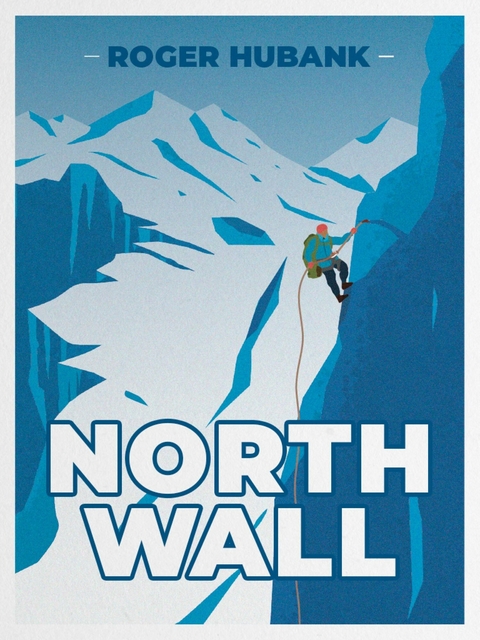
'Far off on the horizon the snowfields sparkled, and across the meadow the Piz Molino towered formidably above the glacier, its snow cone glittering in the pale blue sky.'North Wall is award-winning writer Roger Hubank's first novel. The premise is one familiar to those with a thirst for adventure at high altitude: two men attempting to climb one of the world's most challenging peaks; yet at its core this is a story that examines the nature of climbing itself: trading familiar earthbound comforts for the allure of the mountains and risking it all to achieve the extraordinary. Following a first ascent that ended in tragedy, the Alps' most demanding mountain the staggering 3,753-metre Piz Molino awaits a second ascent. Two very different climbers step up. Raymond, an experienced mountain guide, is struggling with demons after being left the sole survivor of a previous expedition. Daniel is an amateur torn between his need to climb and his responsibilities as a husband and father. Together they attempt the treacherous 1,200-metre North Face. 'Perhaps that is why we have been reduced like this deprived of those we love stripped of all certainty so that we may learn what it is to be ourselves.'North Wall takes the reader on a gripping journey. We follow Raymond and Daniel through tragedy and triumph as they face both the physical challenges of the dangerous ascent and the psychological turmoil of finding themselves along the way. A must-read for anyone interested in the quest to complete life's more extreme feats.
Schiavi … Giuseppe Mona … the two Rinuccinis.
They would have crossed this meadow twelve years earlier on their way to this face. Ahead of them, three days on the wall. Three days to force the sestogrado crack, discover the pendule, find a route up roof and corner until Schiavi led them out on to the summit, exhausted, into a blizzard. As they started down the voie normale Piero Rinuccini collapsed and died. The blizzard thickened. The broad slope dissolved in front of them. The landscape blotted out. They sank up to their thighs. Schiavi drove on relentlessly far into the third night with the younger Rinuccini stumbling on in blind obedience. Until he, too, crumpled into the snow. He died less than 300 metres from the hut.
As he plodded towards the glacier Raymond’s mind turned inevitably to the four Italians. He would have liked a few days’ rest at the tent. They were tired – of climbing, of travelling, of carrying heavy sacs. But the weather never settled for long. The face attracted many storms. Stonefall and storms. They could not afford to wait. So he plodded on, stepping skilfully between the broken boulders, with his companion following doggedly behind.
In the remote pasture where the two men walked there was scarcely a sound. No noise of the river. Only grass swishing under foot. The muffled chink of steel. All around them the grass shimmered in the still air. Sometimes a faint tinkling of bells drifted upwards from the pine trees, where the sheep stirred spasmodically, cropping the turf at the edge of the forest. And Raymond plodded on, thinking of the Italians. Without alarm. But taking stock of all the possibilities. It was his custom to do so. The mountain was remote. Inaccessible. The face rarely in condition – except in a dry season. Parts of it were always verglassed. Always difficult. And the consequences of being caught by a storm on the upper section could be extremely serious. He would not court danger for its own sake. There were such men, but he was not one of them. He climbed mountains to earn his living, not to lose it (as some of his friends had lost theirs). He was a professional. Yet there were times when that profession was not enough, when he needed to go beyond the safer limits of the strictly necessary. Even then he refused to risk life wantonly and was contemptuous of those who did.
Courage and determination were not for him merely romantic ideals. They were necessary, like fear. If ever he was frightened it was because he felt himself no longer in control. And the solution was always the same. Either he restored control or he retreated. Stonefall, avalanche, bad weather, he could not control. So he feared them always and avoided them if he could. But the hard move he never feared. Some shrewd instinct, born of a long experience of difficulty, told him whether it would go or not. And if he thought a move would go, performing it was for him merely a technical problem. If it wouldn’t go he left it alone. But there was always a possibility that chance might deprive him of his mastery of things. And that he feared. And since such a possibility was both a condition of his calling and a circumstance beyond his control he endured it stoically. On this occasion chance counted for more than he cared normally to accept. But he was well equipped. His ability beyond question. And Daniel a competent second. Raymond had a cautious faith in his power to survive all but the worst misfortune. Yet he kept a sharp eye on the weather.
He never climbed without protection. A few seasons earlier he’d had an object lesson in what happened to people who climbed without protection. A new route on the Triolet, with Sepp Böhlen, from Munich. Sharing the lead, pitch after pitch, for 200 metres. Then the greasy, overhanging corner. Böhlen embarked confidently, disappeared above the bulge while he remained below, wedged in the tiny stance, paying out the rope, waiting uneasily, waiting for the bang of a hammer.
It was an intimidating place. A bad place to hold a fall. But there was no sound of a hammer. Madman, he thought. The rope crept steadily upward. A few pebbles scattered down the corner.
Then, quite suddenly, a loud screech, the German dropping like a stone clear of the rock, the rope flying out, himself pulling it in desperately to check the fall, the flying coils tightening around Böhlen’s thigh, poor Sepp screaming as the bone snapped. He’d stopped the fall. But he’d not forgotten. His hands took nearly a month to heal.
Now, at the height of his powers, his great strength directed by shrewd judgement, Raymond was very good (better, perhaps, than Schiavi at his prime). And he knew it. And sometimes, upon the great faces, the knowledge weighed heavily. He was a profoundly responsible man. After his brother’s death on the Aiguille du Plan he’d wandered for weeks alone through the low woods and valleys of his home. Or forced himself up familiar routes, with perplexed clients wondering at the guide who scarcely spoke but took such care for their protection.
Gradually he came to accept that death as he had accepted the deaths of others. Bitterly, and without consent. He never considered abandoning his profession. He never questioned the validity of his work. Nor did he care to answer those who did. Though once, a long time ago in Chamonix, he’d spoken to a journalist.
‘You write,’ he said hesitantly, ‘of our conquering mountains – as if we were the heroes of some preposterous war. It’s not like that. What you call “victory”, or “defeat”, is meaningless. That we have survived again is the only victory. It is significant to us alone. There is nothing else.’
They came at last to a steep bank littered with boulders where the grass grew sparsely between heaps of rubble. They had reached the moraine. Below it the Vadrecc del Zoccone rolled past them like a grimy bandage. In summer the snow melted on the lower glacier. The ice was stained with puddles and scarred by the cracks of small crevasses. Patches of gravel and loose stones were scattered haphazardly, and a thin watery film covered the surface. Six hundred metres away a long spur from the Piz Zoccone curved down like a root into the medial moraine separating the main glacier from its tributary, the Vadrecc del Molino. Both were in retreat. The moraine was scattered for many yards on either side of the spur, and the deep ravine of the bergschrund below the rock had filled with rubbish. They descended cautiously through the debris and stepped out across the slippery ice, threading their way between the crevasses towards the ridge.
Even a dry, harmless glacier such as this was a strange place to be. Once it had filled the valley. Now, in its decline, it was retreating towards the snowfields, high in the mountains, which had been its source for nearly a million years. As they crossed the Zoccone glacier Daniel recognised that they had come to a place where time, as he understood it, was negligible. All the years of his entire life could count for scarcely more than a hundred feet in the imperceptible frozen journey that creaked and whispered all around him as the glacier shifted in its rocky bed. Such recognitions frightened him.
They came at last to the spur and climbed slowly over the easy slabs to the crest, twenty or thirty metres above the moraine. They paused for a few moments and looked down for the first time at the Molino glacier. Steep. Narrow. Heavily crevassed. The sun scarcely penetrated its enclosing walls. So the snow never melted here. It softened a little in the early morning, but towards midday, as the shadows lengthened over the glacier, it began to freeze again. They descended to a small shelf, just above the ice, where a bank of snow curled over the deep ravine of the bergschrund, within two or three metres of the rock. Here they took off the sacs, uncoiled the climbing rope and tied on to double lengths, half red, half white. Daniel waited while the leader secured the belay. These preparations always unsettled him.
‘OK,’ said Raymond.
Daniel took the ice axe in his right hand and a few coils of the doubled rope in his left, and leapt out, well clear of the bergschrund, on to the hard snow. He drove the ice axe deeply into the snow, well back from the lip, tied back his own rope in a figure-of-eight knot, clipped it to the axe head, and then collected the sacs as they came swaying down from the shelf above his head.
His companion leaped the gap with practised ease.
Then they began a weary trudge up between the Zoccone spur and the long, north ridge of the Piz Molino. Daniel carried coils of the doubled rope in his left hand. He plodded on between crevasses which he couldn’t see, following securely in the steps of his companion who read glaciers as other men read books. The shattered séracs stacked insecurely in the icefall, each depression in the snow – he strove to miss nothing. They climbed steadily for nearly a thousand metres until the glacier swung in a wide curve past the north-east face and swept up to its source in the great north-west couloir of the Piz Zoccone.
They halted at the very edge of the ice. They had come almost to the head of the glacier. The high ridge of the Molino–Zoccone traverse in front of them and the spur to the left reared abruptly for hundreds of metres above their heads. Behind them they saw their own steps fading down the steep slope to the valley. Across the bergschrund the twin buttresses of the north wall towered like gigantic...
| Erscheint lt. Verlag | 15.8.2019 |
|---|---|
| Verlagsort | London |
| Sprache | englisch |
| Themenwelt | Literatur ► Krimi / Thriller / Horror ► Krimi / Thriller |
| Literatur ► Romane / Erzählungen | |
| Sachbuch/Ratgeber ► Sport | |
| Reisen ► Reiseführer | |
| Schlagworte | adventure fiction • ALPINE • alpine climbing • Alps • amateur climber • Bregaglia • climber • Climbing • climbing fiction • climbing novel • climbing partnership • Eiger • Grindelwald • gripping • high-altitude • Italy • Mountaineering • mountain guide • North face • North Wall • Philosophical • Piz Badile • Promontogno • Psychological • Survival Story • Suspense • suspense fiction • Swiss • Switzerland • the Dru • thrilling • Tragedy |
| ISBN-10 | 1-912560-56-9 / 1912560569 |
| ISBN-13 | 978-1-912560-56-1 / 9781912560561 |
| Informationen gemäß Produktsicherheitsverordnung (GPSR) | |
| Haben Sie eine Frage zum Produkt? |
 EPUB (Adobe DRM)
Kopierschutz: Adobe-DRM
Adobe-DRM ist ein Kopierschutz, der das eBook vor Mißbrauch schützen soll. Dabei wird das eBook bereits beim Download auf Ihre persönliche Adobe-ID autorisiert. Lesen können Sie das eBook dann nur auf den Geräten, welche ebenfalls auf Ihre Adobe-ID registriert sind.
Details zum Adobe-DRM
Dateiformat: EPUB (Electronic Publication)
EPUB ist ein offener Standard für eBooks und eignet sich besonders zur Darstellung von Belletristik und Sachbüchern. Der Fließtext wird dynamisch an die Display- und Schriftgröße angepasst. Auch für mobile Lesegeräte ist EPUB daher gut geeignet.
Systemvoraussetzungen:
PC/Mac: Mit einem PC oder Mac können Sie dieses eBook lesen. Sie benötigen eine
eReader: Dieses eBook kann mit (fast) allen eBook-Readern gelesen werden. Mit dem amazon-Kindle ist es aber nicht kompatibel.
Smartphone/Tablet: Egal ob Apple oder Android, dieses eBook können Sie lesen. Sie benötigen eine
Geräteliste und zusätzliche Hinweise
Buying eBooks from abroad
For tax law reasons we can sell eBooks just within Germany and Switzerland. Regrettably we cannot fulfill eBook-orders from other countries.
aus dem Bereich