


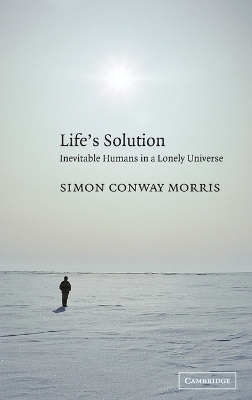
Life's Solution
Inevitable Humans in a Lonely Universe
Seiten
2003
Cambridge University Press (Verlag)
978-0-521-82704-1 (ISBN)
Cambridge University Press (Verlag)
978-0-521-82704-1 (ISBN)
The eminent evolutionary palaeobiologist Simon Conway Morris challenges the accepted view that if the tape of life were wound back, the replay would be very different. He also asks: are we alone?
The assassin's bullet misses, the Archduke's carriage moves forward, and a catastrophic war is avoided. So too with the history of life. Re-run the tape of life, as Stephen J. Gould claimed, and the outcome must be entirely different: an alien world, without humans and maybe not even intelligence. The history of life is littered with accidents: any twist or turn may lead to a completely different world. Now this view is being challenged. Simon Conway Morris explores the evidence demonstrating life's almost eerie ability to navigate to a single solution, repeatedly. Eyes, brains, tools, even culture: all are very much on the cards. So if these are all evolutionary inevitabilities, where are our counterparts across the galaxy? The tape of life can only run on a suitable planet, and it seems that such Earth-like planets may be much rarer than hoped. Inevitable humans, yes, but in a lonely Universe.
The assassin's bullet misses, the Archduke's carriage moves forward, and a catastrophic war is avoided. So too with the history of life. Re-run the tape of life, as Stephen J. Gould claimed, and the outcome must be entirely different: an alien world, without humans and maybe not even intelligence. The history of life is littered with accidents: any twist or turn may lead to a completely different world. Now this view is being challenged. Simon Conway Morris explores the evidence demonstrating life's almost eerie ability to navigate to a single solution, repeatedly. Eyes, brains, tools, even culture: all are very much on the cards. So if these are all evolutionary inevitabilities, where are our counterparts across the galaxy? The tape of life can only run on a suitable planet, and it seems that such Earth-like planets may be much rarer than hoped. Inevitable humans, yes, but in a lonely Universe.
Professor of Evolutionary Palaeobiology at the University of Cambridge, he is also the author of The Crucible of Creation (1998).
The Cambridge Sandwich; 1. Looking for Easter Island; 2. Can we break the great code?; 3. Universal Goo: life as a cosmic principle?; 4. The origin of life: straining the soup or our credulity?; 5. Uniquely lucky? The strangeness of Earth; 6. Converging on the extreme; 7. Seeing convergence; 8. Alien convergences?; 9. The non-prevalence of humanoids?; 10. Evolution bound: the ubiquity of convergence; 11. Towards a theology of evolution; 12. Last word.
| Erscheint lt. Verlag | 4.9.2003 |
|---|---|
| Zusatzinfo | 23 Halftones, unspecified; 27 Line drawings, unspecified |
| Verlagsort | Cambridge |
| Sprache | englisch |
| Maße | 160 x 236 mm |
| Gewicht | 926 g |
| Themenwelt | Sachbuch/Ratgeber ► Natur / Technik |
| Naturwissenschaften ► Geowissenschaften ► Mineralogie / Paläontologie | |
| ISBN-10 | 0-521-82704-3 / 0521827043 |
| ISBN-13 | 978-0-521-82704-1 / 9780521827041 |
| Zustand | Neuware |
| Informationen gemäß Produktsicherheitsverordnung (GPSR) | |
| Haben Sie eine Frage zum Produkt? |
Mehr entdecken
aus dem Bereich


aus dem Bereich
66 Entdeckungen vom Alpenrand bis zum Ostseestrand
Buch | Softcover (2025)
Nünnerich-Asmus Verlag
CHF 24,90
eine Geschichte über Sex, Feuer und den Kipp-Punkten des Lebens
Buch | Softcover (2025)
Naturhistorisches Museum (Verlag)
CHF 27,85
Buch | Softcover (2021)
John Wiley & Sons Inc (Verlag)
CHF 49,95


