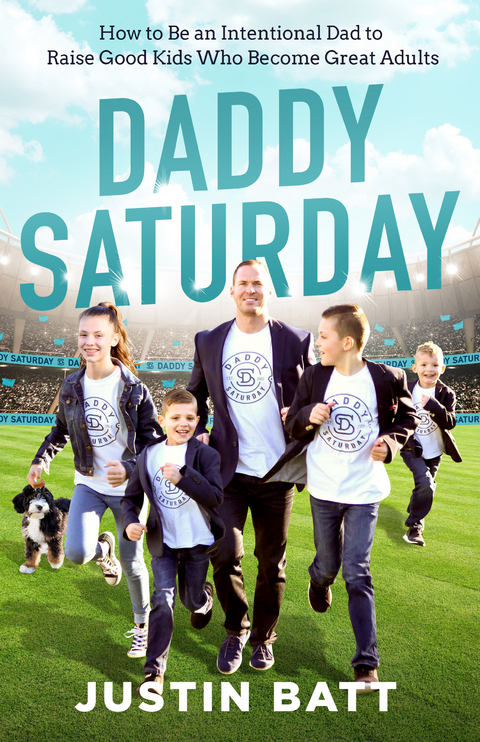
Daddy Saturday (eBook)
200 Seiten
Lioncrest Publishing (Verlag)
978-1-5445-0296-0 (ISBN)
Fatherhood is no longer a playground-it's a battleground. The demands placed on fathers have never been greater, yet neither has the importance of a father's role in the life of his child. This creates a dilemma: how can fathers balance career and family while connecting with their children in a meaningful and intentional way?In Daddy Saturday, Justin Batt will show you how. Justin has spent over 13,000 hours on Saturdays over the past 11 years engaging his children with intentionality. In this easy-to-follow guide, Justin walks fathers through the steps to creating their own Daddy Saturdays-from how to achieve peak performance as a dad, to connecting with your child's heart and mind. You'll learn tactical ideas to implement daily with your children, and understand how to create epic memories that will change the trajectory of their lives forever. Being seen as a great father in the eyes of your children and raising fantastic kids who become productive, confident, happy adults is the dream of every father. Daddy Saturday is a national movement every father can join to help them bring that dream to life.
Chapter Two
2. Blessing or Burden Mindset
“I prayed for this child, and the Lord has granted me what I have asked of him.”
1 Samuel 1:27
“Having a two year old is like having a blender, you just don’t have a top for it.”
—Jerry Seinfeld, comedian
I had just completed a long Daddy Saturday with the kids. It was late in the day and we had been going at it since early in the morning. The kids were back inside resting and we were all pretty tired from our escapades that day. I was the last man standing and as I walked around the house, I saw toys strewn from one end to the next. I started picking them up, and by the tenth toy, I started to think to myself, Why am I out here doing this? Where are my kids? They should be out here helping me. Isn’t that why I had four kids in the first place, so that I didn’t have to do all this by myself?
I was viewing each of those toys as a burden and feeling the pain in my back as I bent down to pick up each one and looking at all the others I still had to put away. And then I had one of those lightning-bolt moments where I had yet another perspective shift. As a man of faith, I believe that God put this thought in my head. Justin, you’ve got a choice: you can look at situations in life like they’re a blessing or a burden and you can view your children the same way. My perspective immediately shifted, and each one of those toys then became a blessing as they were visual reminders of the epic day I just finished with my kids. It wasn’t about the mess of toys in the yard. It was about recognizing in every moment we always have a conscious decision to make in our minds about our children and how we’re going to view them. Are we going to be grateful for our children and realize how lucky we are or are we going to be ungrateful and view them as a problem? Possessing a blessing verses a burden mindset is critical because every time we have an interaction with our kids, if we’re mindful, we can move the relationship forward and respond in a loving way.
We just put a pool in our backyard, and there’s a large area of new sod between our home and the pool. When the sod was first laid, the grass was green and thick. However, over a period of about two weeks, I began to notice a path in the sod. The area where the kids ran from the house to the pool had become trampled down and began turning brown. At that point I had two options: either redirect their path to a new area and allow the sod to recover or put in hardscape and not worry about maintaining the sod. The process in our brains as it relates to the neural pathways that form in our thinking is exactly the same as the sod in my backyard. Over time, each decision we make adds up to form neural pathways that determine how we respond or react to certain situations, like disciplining our children. If we choose to respond with a blessing mindset over and over, we can actually form a highway of positive thinking in our minds through the development of neural pathways. We can also go the other direction and form a highway of negative thinking by reacting with a burden mindset.
Like most dads after a long day at work, I can be a little revved up when I walk in the house, which is usually full of kids running around after being sedentary in school all day. I’m extremely extroverted, and I’m speaking to people and surrounded by people all day. When I get home, part of how I like to recharge is by spending time with Heather and my kids one-on-one. However, this rarely happens as I get attacked the moment I walk in the door and it’s “Dad, can you come play football?” “Dad, come jump on the trampoline!” “Dad, help me with my homework!” It’s in that moment I have a decision to make: am I going to treat their request as a blessing or a burden? One thing that’s helped me immensely is letting go of my expectations for what I want to happen the moment I walk in the door. Although it seems trivial, by letting go of my expectations I now have the freedom to respond to whatever the dynamic is when I walk in the door rather than react to what I thought it should be. If I may also offer advice to the married men reading this: If you want to dramatically improve your marriage, not only do you need to let go of your expectations, but you also need to completely rid yourself of all criticism. When we were first married our home had carpet just off the main living area. When I came in the front door I could visibly see if there were carpet lines in the floor from Heather vacuuming. If I failed to point out the carpet lines on my own she would say, “Notice anything?” Fast forward years later, if I say anything critical toward Heather, she will often respond, “Carpet lines!” I’ve learned no one has ever changed based on criticism they received so I’ve made the decision to eliminate criticism from my marriage and role as a father. Not easy, but necessary. It’s through conscious decisions like turning criticism into affirmation or changing your thought process from burden to blessing that we are able to create the positive neural pathways in our brains allowing us to naturally respond in the moment.
Being a father who wins is 80 percent mindset and 20 percent action. To be a successful father, I found I have to create those positive pathways, so that over time I can respond and react to my children in the appropriate way. As I’ve pointed out in Chapter One, feelings follow behavior, and that’s really critical to understand because oftentimes I may not feel like engaging with my children, but once I begin doing it, the feelings of wanting to engage my children will tend to follow. You can’t wait on the feeling or you’ll be waiting a long time. It starts with the right mindset and ends with taking action.
Mel Robbins wrote a book called The Five Second Rule in which she says the way the human brain is wired, when you have a thought you literally have five seconds to act on a decision; otherwise, it becomes just a fleeting thought. If you wake up in the morning and think, I need to get out of bed and work out, you only have those five seconds to act on that thought and get out of bed. If you don’t, chances are you’ll hit the snooze button and won’t do it.
It’s the same thing with parenting—you’ve got to act on an impulse to engage your kids right away or you’ll hit the parenting snooze button and say to yourself, I’ll do it later. You might have the best of intentions, but it’s not likely to happen. The more you act on the impulse, the easier it will get, too, because you’re reprogramming and training your brain to react in a positive way.
It’s human nature to react rather than respond, so it’s also critical to understand your personality style and how you react. From my experience there are two personality types, exploders and imploders. I tend to be an exploder. I have a really high intensity, high personal velocity. People with this personality style tend to have triggers that set them off and cause them to react. I’ve found an exploder can benefit from a form of recognition when they get triggered, so I wear two orange motivational rubber bracelets on my right wrist. One is by a brand called Active Faith and the other is from a group called Focus 3, and it states E + R = O, which means we can’t control the events that happen in our lives, but we can control our response, and that determines the outcome. A lot of times I’ll either look at my wrist and stop or I’ll pull the bands and snap them against my wrist as my key to be mindful of my reaction. That’s the reminder to say, Calm down, think about this before you engage. Heather will often remind me if she sees my intensity level escalating and say, “Hey, Justin, snap your wrist.” Accountability is great—having someone there who can see it from the outside because it’s hard to see it yourself sometimes.
On the flip side of the exploder is the imploder. This type of personality tends to become more introverted, holds their emotions inside when they get mad, and has a more passive-aggressive type of behavior. This personality type requires similar self-awareness, but it tends to be more of a process than an impulse like the exploder. The introvert needs to say, “I’m starting to smolder here. I’m holding this internally. I’m building bitterness and resentment toward my children or toward the situation. I’ve got to be able to express this in a positive way to get it out because if I hold it in, that’s not healthy.”
Regardless of your personality type, it goes back creating positive neural pathways. Each and every time you engage in a certain behavior, good or bad, you’re literally creating a pathway in your brain that says, “This is how I’m supposed to react.” and it becomes more and more ingrained. It becomes easier and easier to react that way because you’ve trained yourself to do it.
But if you do overact, which we all do from time to time, the biggest thing is to have mindfulness to see your mistake and apologize. “Hey, I overreacted here. That’s not the way that Daddy should have responded. I wish I would have responded differently. Can you forgive me?” It’s having the awareness to come back and admit your mistake. Showing your deficiency in front of your kids is an...
| Erscheint lt. Verlag | 16.5.2019 |
|---|---|
| Sprache | englisch |
| Themenwelt | Sachbuch/Ratgeber ► Gesundheit / Leben / Psychologie ► Familie / Erziehung |
| ISBN-10 | 1-5445-0296-6 / 1544502966 |
| ISBN-13 | 978-1-5445-0296-0 / 9781544502960 |
| Informationen gemäß Produktsicherheitsverordnung (GPSR) | |
| Haben Sie eine Frage zum Produkt? |
 EPUB (Ohne DRM)
Größe: 2,0 MB
Digital Rights Management: ohne DRM
Dieses eBook enthält kein DRM oder Kopierschutz. Eine Weitergabe an Dritte ist jedoch rechtlich nicht zulässig, weil Sie beim Kauf nur die Rechte an der persönlichen Nutzung erwerben.
Dateiformat: EPUB (Electronic Publication)
EPUB ist ein offener Standard für eBooks und eignet sich besonders zur Darstellung von Belletristik und Sachbüchern. Der Fließtext wird dynamisch an die Display- und Schriftgröße angepasst. Auch für mobile Lesegeräte ist EPUB daher gut geeignet.
Systemvoraussetzungen:
PC/Mac: Mit einem PC oder Mac können Sie dieses eBook lesen. Sie benötigen dafür die kostenlose Software Adobe Digital Editions.
eReader: Dieses eBook kann mit (fast) allen eBook-Readern gelesen werden. Mit dem amazon-Kindle ist es aber nicht kompatibel.
Smartphone/Tablet: Egal ob Apple oder Android, dieses eBook können Sie lesen. Sie benötigen dafür eine kostenlose App.
Geräteliste und zusätzliche Hinweise
Buying eBooks from abroad
For tax law reasons we can sell eBooks just within Germany and Switzerland. Regrettably we cannot fulfill eBook-orders from other countries.
aus dem Bereich