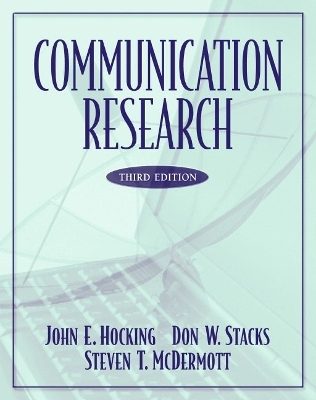
Communication Research
Pearson (Verlag)
978-0-321-08807-9 (ISBN)
- Titel ist leider vergriffen;
keine Neuauflage - Artikel merken
Communication Research provides a reader-friendly introduction to social research in all communication-related disciplines.
While its emphasis is on science, this text covers rhetorical and historical research and emphasizes that their methodologies are complementary. Communication Research is designed to arm students with some of the essential critical thinking skills that are necessary to survive the information overload of the 21st century, helping them to sort the sense from the nonsense. Complex ideas are explained in a readable way without ever "dumbing down" the material.
Communication Research is placed squarely within the communication discipline and prepares students to succeed in all communication-related fields. Organized around the research process, this text provides students with the means to conduct, analyze and interact with research in the field of communication.
Most chapters begin with “Objectives” and conclude with “Applying Knowledge in Communication,” “Summary,” “Probes,” “Research Projects,” “Suggested Reading,” “Notes,” and “References.”
Preface.
PART I THEORY AND RESEARCH METHODS.
1. Asking and Answering Questions.
Research and Sources of Information.
Research and the Consumption of Information.
Asking Questions About Communication.
Epistemology.
2. The Role of Theory in Communication Research.
Approaches to Studying Communication.
Theoretical Orientations.
Scientific Research and Theory.
Humanistic Research and Theory.
3. Considerations: Knowledge, Ethics, and Science.
Rules of Scholarship.
Treatment of Human Subjects (People).
Debriefing.
Ethical Appropriateness.
A Parting Note.
PART 2 METHODS OF COMMUNICATION RESEARCH.
4. Getting Started: Finding and Evaluating Documents.
Obtaining Documents.
Establishing the Parameters of Study.
The Role of Documents.
Primary versus Secondary Sources.
Finding Sources.
Establishing a Notation System.
Establishing a Document's Credibility.
Putting It All Together: The Literature Review.
Creating the End Product.
5. Evaluating Sources: Historical/Rhetorical-Critical Methodology.
An Overview of Historical Research.
Historical Methodology.
Rhetorical-Critical Methodology.
Limitations and Hazards in Historical Research.
6. Measurement Theory.
What is Measurement?
Reliability.
Validity.
The Relationship Between Reliability and Validity.
7. Measurement Scales.
Attitudes as Examples of Intervening Variables.
Types of Measurement Scales.
Other Measurement Techniques.
8. Content Analysis
Uses of Content Analysis.
Defining the Method.
Conducting the Content Analysis.
Sampling.
Use of Computers in Content Analysis.
Advantages and Limitation of Content Analysis.
9. Qualitative/Descriptive (Participant-Observation/Focus Group/In-Depth Interview).
Methodology.
Participant-Observation.
Focus Groups.
In-Depth Interviews.
10. Quantitative/Sampling.
Sampling Theory.
Nonprobability Sampling.
Probability Sampling.
Sample Selection.
Contacting Respondents.
11. Quantitative/Descriptive (Survey) Research.
Types of Descriptive Research.
The Survey as Descriptive Methodology.
Collecting the Data.
Structuring the Survey.
“Journalistic” Surveys.
Other Considerations.
12. The True Communication Experiment.
Advantages.
Establishing Relationships.
Establishing Causation.
Questions Appropriate for Experiments.
The Laboratory Experiment.
Role-Playing as an Alternative to Deception In Experiments.
Limitations of the Laboratory Experiment.
13. Experimental Strategies and Designs.
Quasi-Experimental Design.
External Validity.
More Complex Designs.
PART 3 MODES OF ANALYSIS.
14. Descriptive Statistics.
Types of Data.
Distributions.
Coding Data for Analysis.
Describing Nonparametric Data.
Bivariate: Correlational Analysis.
15. Applications of Communication Research.
Various Applications of Communication Research.
16. Inferential Statistics.
Using Statistics to Test Hypotheses.
Nonparametric Statistics.
Parametric Analysis.
17. Bringing it Together: Writing and Presenting Research.
Preparing the Final Product.
Writing the Academic Research Report.
Writing the Nonacademic Research Report.
Visual and Oral Presentations.
Special Case: The Research Prospectus/Proposal.
Glossary.
Index.
| Erscheint lt. Verlag | 9.6.2003 |
|---|---|
| Sprache | englisch |
| Maße | 191 x 235 mm |
| Gewicht | 839 g |
| Themenwelt | Kunst / Musik / Theater ► Theater / Ballett |
| Sachbuch/Ratgeber ► Sport ► Tanzen / Tanzsport | |
| Schulbuch / Wörterbuch ► Wörterbuch / Fremdsprachen | |
| Geisteswissenschaften ► Sprach- / Literaturwissenschaft ► Sprachwissenschaft | |
| Naturwissenschaften | |
| Sozialwissenschaften ► Kommunikation / Medien ► Kommunikationswissenschaft | |
| Sozialwissenschaften ► Kommunikation / Medien ► Medienwissenschaft | |
| ISBN-10 | 0-321-08807-7 / 0321088077 |
| ISBN-13 | 978-0-321-08807-9 / 9780321088079 |
| Zustand | Neuware |
| Informationen gemäß Produktsicherheitsverordnung (GPSR) | |
| Haben Sie eine Frage zum Produkt? |
aus dem Bereich