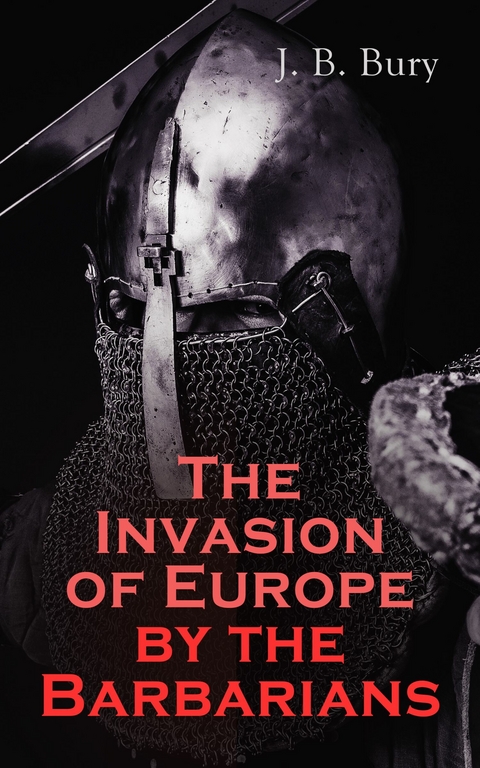
The Invasion of Europe by the Barbarians (eBook)
176 Seiten
e-artnow (Verlag)
978-80-273-0319-9 (ISBN)
John Bagnell Bury (1861 - 1927) was an Irish historian, classical scholar, Medieval Roman historian and philologist. He objected to the label 'Byzantinist' explicitly in the preface to the 1889 edition of his Later Roman Empire. He held the position of Erasmus Smith's Professor of Modern History at Trinity College Dublin.
John Bagnell Bury (1861 – 1927) was an Irish historian, classical scholar, Medieval Roman historian and philologist. He objected to the label "Byzantinist" explicitly in the preface to the 1889 edition of his Later Roman Empire. He held the position of Erasmus Smith's Professor of Modern History at Trinity College Dublin.
Lecture 2:
The Roman Empire and the Germans
THE GOTHIC ATTACK IN THE THIRD CENTURY A.D. – THE VISIGOTHIC OCCUPATION OF DACIA – OSTROGOTHIC AND VISIGOTHIC SETTLEMENTS – NEW ORGANISATION OF THE EMPIRE
THE GOTHIC ATTACK IN THE THIRD CENTURY A.D.
The recorded attacks of the Goths on the Roman Empire began about A.D. 247. The success of these attacks was due to (1) the internal weakness of the Empire at the time; for it had suffered from a succession of incompetent rulers since the death of Septimius Severus in A.D. 211, and (2) the simultaneous rise of the new Persian Empire, which had given it a very formidable enemy in the east. The Goths now inflicted upon Rome the most grievous and shameful blow that had been struck by northern barbarians since the reign of Augustus when Arminius annihilated the legions of Varus in the forest of Teutoburg. They drew the army of the Emperor Decius into a swamp near the mouths of the Danube, destroyed the army, and slew the Emperor, A.D. 251. Soon afterwards they took to the sea, and sailing forth from the ports of south Russia they became the terror of the cities of the Black Sea, the Marmora, and the Aegean. These ravages did not cease till they attempted a great joint invasion by sea and land, which was decisively repelled by the Emperor Claudius I. (A.D. 269). A despatch is preserved professing to have been written by the Emperor when the foes had been defeated and routed. It runs thus: “We have destroyed 320,000 Goths, we have sunk 2000 of their ships. The rivers are bridged over with shields; the fields are hidden by their bones; no road is free.” But the despatch is a later fabrication. The number of 320,000 is a ludicrous exaggeration, as we shall see afterwards when we come to consider the general question as to the numbers of the German invaders and the size of their armies. The achievement of Claudius – who is generally known, in consequence, as Claudius Gothicus – secured peace from the Goths for a long time in the regions south of the Danube; but it would not have done so if he had not been followed by a series of able rulers.
THE VISIGOTHIC OCCUPATION OF DACIA
But meanwhile the Goths were securing a success of a more abiding and important nature than their sensational victory in which a Roman Emperor had perished. They had in fact begun the actual dismemberment of the Empire by penetrating and ultimately occupying one of its provinces – the province of Dacia, north of the Danube, which had been conquered nearly a hundred and fifty years before by the Emperor Trajan, the country which is called Transilvania or Siebenburgen. It was the last European province to be acquired by Rome; it was the first to fall away. No Roman coins, no Roman inscription of date later than about A.D. 256 have been found in Dacia. The Emperor Aurelian, who succeeded Claudius Gothicus in A.D. 270, withdrew the Roman officials and military garrisons from Dacia, and made the Danube once more the frontier of the Empire. Evidently the Goths had been gradually and steadily encroaching on Roman territory for fifteen or twenty years, and Aurelian simply decided to abandon a province which was already virtually lost. No doubt there was a considerable exodus of the provincials when the imperial government withdrew its protection; but we have no trustworthy evidence as to what exactly happened. It is an obscure question, and one on which a great deal of ink has been wasted; for it has been the subject of heated discussions in modern times between the Roumanians and Hungarians. As you know, the Roumanians speak a romance, that is, a Latin language, and they claim to be descendants of the Latin-speaking inhabitants of Roman Dacia, surviving throughout all the vicissitudes of the Middle Ages, throughout all changes of master, since the time of Aurelian, in Transilvania. The Hungarians have strenuously denied this. Transilvania belonged to Hungary up to the recent war, the results of which enabled it to fulfil its aspiration of shaking off the Hungarian yoke and of being united in the free kingdom of Roumania to its eastern neighbours who speak the same language. The view of the Hungarians was that all the romance-speaking peoples north of the Danube were later immigrants from the lands south of the Danube – the Balkan peninsula – who moved northward as late as the twelfth and thirteenth centuries. I can only just call your attention to the existence of this burning question. To discuss it usefully or even intelligibly would take us away to the history of the Danubian lands in the twelfth century. The main thing to point out now is that the Roman period of the history of Dacia or Transilvania comes to an end about A.D. 270 (having lasted for 150 years) and that the Gothic period begins.
Incursions of the Goths continued during the following sixty years. After the Emperor Constantine the Great became sole Emperor in A.D. 324, he gave his attention to the danger, and endeavoured to secure the lower Danube frontier by fortified camps and castles. He built a wall in the north-east corner of Thrace across the region which is now known as the Dobrudzha – a region which in modern times has been disputed between Roumania and Bulgaria. Towards the end of his reign Constantine concluded a forced treaty with the Visigoths. They became federates of the Empire; that is, they undertook to protect the frontier and to supply a certain contingent of soldiers to the imperial army in case of wars. In return for this they received yearly subsidies which, theoretically a supply of corn, was actually paid in money, and was technically called annonae foederaticae (federal corn supplies). Federal relations of this kind are a standing feature of the whole period during which the German people were encroaching upon the provinces of the Empire from the fourth to the sixth century. They were nearly all federates of the Empire, for a longer or shorter time, before they were independent masters of the lands which they had seized. Through this treaty Dacia, occupied by the Visigoths, became nominally a dependency of the Empire, and Constantine might boast that he had in a sense recovered Dacia. The peace lasted for a generation, and during this time the Visigoths, unable to press from the southward or westward, took to more settled habits and began to learn the arts of agriculture.
OSTROGOTHIC AND VISIGOTHIC SETTLEMENTS
The territory of the Goths as a whole, including Visigoths and Ostrogoths, now, towards the middle of the fourth century, extended from the river Theiss or somewhere near it on the west to the river Dnieper on the east. The Visigoths held Dacia, and also parts of what are now Moldavia and Walachia; the Ostrogoths lived in the steppes beyond the Dniester, but we do not know the exact line of division between the two branches of the Gothic race.
These two peoples remained independent of each other. Our sources give us abundant proof that throughout the period up to the end of the fourth century the Visigoths had no king; their constitution was republican. The gaus acted in common, and some of the gau chiefs had a predominant influence in guiding the council of the nation and were recognised as natural leaders in the case of war; but we must not be misled by the occasional use of the term rex, instead of the more usual and proper judex, in Roman writers, into supposing that there was a king. Prominent leaders like Athanaric and Fritigern meet us, but they are only judices, gau chiefs; they are not kings.
On the other hand, royalty was adopted or maintained by the Ostrogoths. We meet an Ostrogothic king before the end of the third century, and in the fourth there arose the prominent figure of Hermanric, of whom more will have to be said presently.
After this peace in the reign of Constantine there is a pause for a generation in the hostilities between the Empire and the East Germans. For about fifty years the Germanic wars of Rome are almost wholly with the West Germans – the Franks and the Alamanni – who give a great deal of trouble on the Rhine frontier. The really grave dangers for Rome in the east will begin in A.D. 378; after which the Emperors will begin to realise how formidable the German peril is.
NEW ORGANISATION OF THE EMPIRE
At this point it will be convenient for us to examine the strength of the Empire itself and compare it with the strength of the Germans. We are greatly handicapped in attempting to form an idea of the actual state of things by not having any accurate statistics of population, and the inferences which we may draw from the very few trustworthy figures we have must be taken with a great deal of reserve.
The first thing to grasp is that in the third century the Empire was declining. This was due not only to external troubles, such as wars with the new Persian Empire which had arisen in the east, but much more to internal dissensions and disruptions, civil wars and contests for the imperial throne. The central government had become weak and almost bankrupt; the various parts of the Roman world were showing tendencies to fall asunder and to set up rulers of their own. One of the most significant symptoms of decay was the depreciation of the coinage.
This state of things was ended by two great Emperors, viz. Aurelian, who obtained the supreme power in 270, and Diocletian, who ascended the throne fifteen years later (285) and reigned for twenty years till 305. In the generation – thirty-five years – which elapsed between the accession of Aurelian, who rescued the Empire at the brink of an abyss, and the end of...
| Erscheint lt. Verlag | 6.2.2019 |
|---|---|
| Verlagsort | Prague |
| Sprache | englisch |
| Themenwelt | Sachbuch/Ratgeber ► Geschichte / Politik ► Vor- und Frühgeschichte / Antike |
| Geschichte ► Allgemeine Geschichte ► Vor- und Frühgeschichte | |
| Geschichte ► Allgemeine Geschichte ► Mittelalter | |
| Schlagworte | Ancient history • A Wrinkle in Time • Barbarian invasions • Crusades • European migrations • foreign invasions • Game of Thrones • Germanic tribes • Historical Review • Huns invasion • Ken Follett • King Arthur • Mediterranean Countries • Migration Period • ragnar lothbrok • Roman Empire decline • The Templars • Thor • Umberto Eco • Vikings |
| ISBN-10 | 80-273-0319-2 / 8027303192 |
| ISBN-13 | 978-80-273-0319-9 / 9788027303199 |
| Informationen gemäß Produktsicherheitsverordnung (GPSR) | |
| Haben Sie eine Frage zum Produkt? |
 EPUB (Wasserzeichen)
DRM: Digitales Wasserzeichen
Dieses eBook enthält ein digitales Wasserzeichen und ist damit für Sie personalisiert. Bei einer missbräuchlichen Weitergabe des eBooks an Dritte ist eine Rückverfolgung an die Quelle möglich.
Dateiformat: EPUB (Electronic Publication)
EPUB ist ein offener Standard für eBooks und eignet sich besonders zur Darstellung von Belletristik und Sachbüchern. Der Fließtext wird dynamisch an die Display- und Schriftgröße angepasst. Auch für mobile Lesegeräte ist EPUB daher gut geeignet.
Systemvoraussetzungen:
PC/Mac: Mit einem PC oder Mac können Sie dieses eBook lesen. Sie benötigen dafür die kostenlose Software Adobe Digital Editions.
eReader: Dieses eBook kann mit (fast) allen eBook-Readern gelesen werden. Mit dem amazon-Kindle ist es aber nicht kompatibel.
Smartphone/Tablet: Egal ob Apple oder Android, dieses eBook können Sie lesen. Sie benötigen dafür eine kostenlose App.
Geräteliste und zusätzliche Hinweise
Buying eBooks from abroad
For tax law reasons we can sell eBooks just within Germany and Switzerland. Regrettably we cannot fulfill eBook-orders from other countries.
aus dem Bereich