


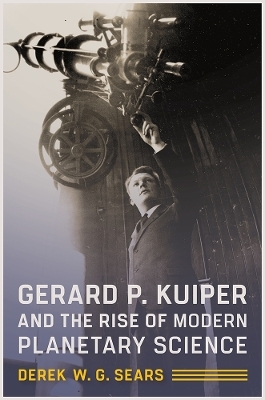
Gerard P. Kuiper and the Rise of Modern Planetary Science
Seiten
2019
University of Arizona Press (Verlag)
978-0-8165-3900-0 (ISBN)
University of Arizona Press (Verlag)
978-0-8165-3900-0 (ISBN)
Astronomer Gerard P. Kuiper ignored the traditional boundaries of his subject. Using telescopes and the laboratory, he made the solar system a familiar, intriguing place. Sears shows a brilliant but at times unpopular man who attracted as much dislike as acclaim.
Astronomer Gerard P. Kuiper ignored the traditional boundaries of his subject. Using telescopes and the laboratory, he made the solar system a familiar, intriguing place. “It is not astronomy,” complained his colleagues, and they were right. Kuiper had created a new discipline we now call planetary science.
Kuiper was an acclaimed astronomer of binary stars and white dwarfs when he accidentally discovered that Titan, the massive moon of Saturn, had an atmosphere. This turned our understanding of planetary atmospheres on its head, and it set Kuiper on a path of staggering discoveries: Pluto was not a planet, planets around other stars were common, some asteroids were primary while some were just fragments of bigger asteroids, some moons were primary and some were captured asteroids or comets, the atmosphere of Mars was carbon dioxide, and there were two new moons in the sky, one orbiting Uranus and one orbiting Neptune.
He produced a monumental photographic atlas of the Moon at a time when men were landing on our nearest neighbor, and he played an important part in that effort. He also created some of the world's major observatories in Hawai‘i and Chile. However, most remarkable was that the keys to his success sprang from his wartime activities, which led him to new techniques. This would change everything.
Sears shows a brilliant but at times unpopular man who attracted as much dislike as acclaim. This in-depth history includes some of the twentieth century's most intriguing scientists, from Harold Urey to Carl Sagan, who worked with—and sometimes against—the father of modern planetary science. Now, as NASA and other space agencies explore the solar system, they take with them many of the ideas and concepts first described by Gerard P. Kuiper.
Astronomer Gerard P. Kuiper ignored the traditional boundaries of his subject. Using telescopes and the laboratory, he made the solar system a familiar, intriguing place. “It is not astronomy,” complained his colleagues, and they were right. Kuiper had created a new discipline we now call planetary science.
Kuiper was an acclaimed astronomer of binary stars and white dwarfs when he accidentally discovered that Titan, the massive moon of Saturn, had an atmosphere. This turned our understanding of planetary atmospheres on its head, and it set Kuiper on a path of staggering discoveries: Pluto was not a planet, planets around other stars were common, some asteroids were primary while some were just fragments of bigger asteroids, some moons were primary and some were captured asteroids or comets, the atmosphere of Mars was carbon dioxide, and there were two new moons in the sky, one orbiting Uranus and one orbiting Neptune.
He produced a monumental photographic atlas of the Moon at a time when men were landing on our nearest neighbor, and he played an important part in that effort. He also created some of the world's major observatories in Hawai‘i and Chile. However, most remarkable was that the keys to his success sprang from his wartime activities, which led him to new techniques. This would change everything.
Sears shows a brilliant but at times unpopular man who attracted as much dislike as acclaim. This in-depth history includes some of the twentieth century's most intriguing scientists, from Harold Urey to Carl Sagan, who worked with—and sometimes against—the father of modern planetary science. Now, as NASA and other space agencies explore the solar system, they take with them many of the ideas and concepts first described by Gerard P. Kuiper.
Derek W. G. Sears was a professor at the University of Arkansas for thirty years and is now a senior research scientist at NASA. He has published widely on meteorites, lunar samples, asteroids, and the history of planetary science.
| Erscheinungsdatum | 26.02.2019 |
|---|---|
| Zusatzinfo | 64 black & white illustrations |
| Verlagsort | Tucson |
| Sprache | englisch |
| Maße | 152 x 231 mm |
| Gewicht | 635 g |
| Themenwelt | Sachbuch/Ratgeber ► Natur / Technik |
| Naturwissenschaften | |
| Technik | |
| ISBN-10 | 0-8165-3900-6 / 0816539006 |
| ISBN-13 | 978-0-8165-3900-0 / 9780816539000 |
| Zustand | Neuware |
| Informationen gemäß Produktsicherheitsverordnung (GPSR) | |
| Haben Sie eine Frage zum Produkt? |
Mehr entdecken
aus dem Bereich



aus dem Bereich
wenn Mensch und Maschine eins werden
Buch | Hardcover (2024)
Piper (Verlag)
CHF 33,55


