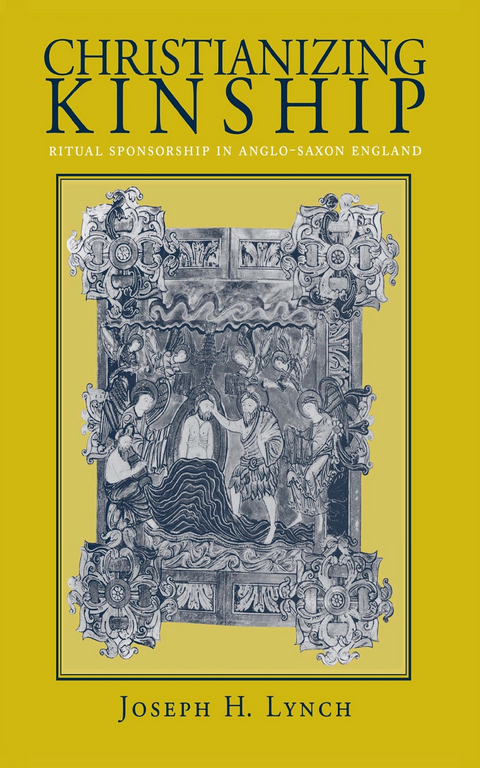
Christianizing Kinship (eBook)
288 Seiten
Cornell University Press (Verlag)
978-1-5017-2832-7 (ISBN)
When Christianity spread from its Mediterranean base into the Germanic and Celtic north, it initiated profound changes, particularly in kinship relations and sexual mores. Joseph H. Lynch traces the introduction and assimilation of the concept of...
When Christianity spread from its Mediterranean base into the Germanic and Celtic north, it initiated profound changes, particularly in kinship relations and sexual mores. Joseph H. Lynch traces the introduction and assimilation of the concept of spiritual kinship into Anglo-Saxon England. Covering the years 597 to 1066, he shows how this notion unsettled and in time altered the structures of the society.In early Germanic societies, kinship was a major organizing principle. Spiritual kinship of various kinds began to take hold among the Anglo-Saxons with the arrival of Christian missionaries from Rome in the seventh century. Lynch discusses in detail sponsorship at baptism, confirmation, and other rituals in which an individual other than a biological parent presented someone, often an infant, for initiation into Christianity. After the ceremony, the sponsor was regarded as the child's spiritual parent or godparent, whose role complemented that of the natural mother and father, with whom the sponsor had become a "coparent." He describes the difficulties posed by the incest taboo, which included a ban on marriage between spiritual kin. Lynch's work reveals how Anglo-Saxons, though never accepting the sexual taboos that were so prominent in the Frankish, Roman, and Byzantine churches, did create new forms of spiritual kinship. Unusual in its focus and scope, this book illuminates an integral element in the religious, social, and diplomatic life of Anglo-Saxon England. It also contributes to our understanding of the ways in which Christianization reshaped societal relations and moral attitudes.
When Christianity spread from its Mediterranean base into the Germanic and Celtic north, it initiated profound changes, particularly in kinship relations and sexual mores. Joseph H. Lynch traces the introduction and assimilation of the concept of spiritual kinship into Anglo-Saxon England. Covering the years 597 to 1066, he shows how this notion unsettled and in time altered the structures of the society.
In early Germanic societies, kinship was a major organizing principle. Spiritual kinship of various kinds began to take hold among the Anglo-Saxons with the arrival of Christian missionaries from Rome in the seventh century. Lynch discusses in detail sponsorship at baptism, confirmation, and other rituals in which an individual other than a biological parent presented someone, often an infant, for initiation into Christianity. After the ceremony, the sponsor was regarded as the child's spiritual parent or godparent, whose role complemented that of the natural mother and father, with whom the sponsor had become a "coparent." He describes the difficulties posed by the incest taboo, which included a ban on marriage between spiritual kin. Lynch's work reveals how Anglo-Saxons, though never accepting the sexual taboos that were so prominent in the Frankish, Roman, and Byzantine churches, did create new forms of spiritual kinship. Unusual in its focus and scope, this book illuminates an integral element in the religious, social, and diplomatic life of Anglo-Saxon England. It also contributes to our understanding of the ways in which Christianization reshaped societal relations and moral attitudes.
Joseph H. Lynch is Distinguished University Professor and Joe R. Engle Designated Professor of the History of Christianity at The Ohio State University. His previous books include The Medieval Church: A Brief History and Godparents and Kinship in Early Medieval Europe.
| Erscheint lt. Verlag | 5.9.2018 |
|---|---|
| Verlagsort | Ithaca |
| Sprache | englisch |
| Maße | 150 x 150 mm |
| Themenwelt | Sachbuch/Ratgeber ► Geschichte / Politik ► Mittelalter |
| Geschichte ► Allgemeine Geschichte ► Mittelalter | |
| Geisteswissenschaften ► Geschichte ► Regional- / Ländergeschichte | |
| Religion / Theologie ► Christentum ► Kirchengeschichte | |
| Sozialwissenschaften ► Soziologie ► Mikrosoziologie | |
| ISBN-10 | 1-5017-2832-6 / 1501728326 |
| ISBN-13 | 978-1-5017-2832-7 / 9781501728327 |
| Informationen gemäß Produktsicherheitsverordnung (GPSR) | |
| Haben Sie eine Frage zum Produkt? |
 PDF (Adobe DRM)
Kopierschutz: Adobe-DRM
Adobe-DRM ist ein Kopierschutz, der das eBook vor Mißbrauch schützen soll. Dabei wird das eBook bereits beim Download auf Ihre persönliche Adobe-ID autorisiert. Lesen können Sie das eBook dann nur auf den Geräten, welche ebenfalls auf Ihre Adobe-ID registriert sind.
Details zum Adobe-DRM
Dateiformat: PDF (Portable Document Format)
Mit einem festen Seitenlayout eignet sich die PDF besonders für Fachbücher mit Spalten, Tabellen und Abbildungen. Eine PDF kann auf fast allen Geräten angezeigt werden, ist aber für kleine Displays (Smartphone, eReader) nur eingeschränkt geeignet.
Systemvoraussetzungen:
PC/Mac: Mit einem PC oder Mac können Sie dieses eBook lesen. Sie benötigen eine
eReader: Dieses eBook kann mit (fast) allen eBook-Readern gelesen werden. Mit dem amazon-Kindle ist es aber nicht kompatibel.
Smartphone/Tablet: Egal ob Apple oder Android, dieses eBook können Sie lesen. Sie benötigen eine
Geräteliste und zusätzliche Hinweise
Buying eBooks from abroad
For tax law reasons we can sell eBooks just within Germany and Switzerland. Regrettably we cannot fulfill eBook-orders from other countries.
aus dem Bereich