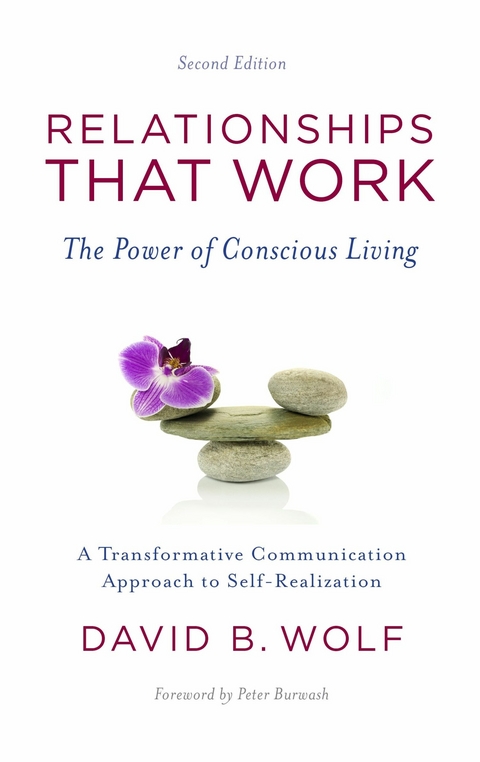
Relationships That Work: The Power of Conscious Living (eBook)
262 Seiten
Satvatove Institute (Verlag)
978-0-9984843-3-4 (ISBN)
In Relationships That Work, David B. Wolf, provides practical exercises and principles for you to master strategies for high-level communication. You will learn empathic listening and conflict resolution skills, and ways of assertion that align with principles rooted in your spiritual truth. This book shows you how to be in more honest, satisfying relationships, enhance self-awareness, and live a life of purposeful action. You will be guided to recognize patterns of assumptions by which you've been living your life, and to replace unhealthy and ineffective belief systems with truths and values rooted in your core identity. Wolf reveals an effective and accessible model for realizing our spiritual essence while creating trust and connection. Through processes of courageous introspection described in this book, you are empowered to connect with what is vitally important and live with intentionality to manifest your highest purpose while helping others do the same. Relationships that work begin with the relationship with our self. On the first page, we distinguish the self from the body. To cite Teilhard de Chardin, We are not human beings having a spiritual experience. We are spiritual beings having a human experience. The process of reading this book is meant to facilitate a connection with your authentic personality the spiritual core that is not defined by any role you play or possessions attached to your name. As confirmed by the great wisdom traditions, this consciousness is the foundation for a life of peaceful existence, powerful vision and purposeful action. Living from truly spiritual consciousness, our qualities of compassion, vitality and love naturally radiate. Sharing confidenceswith others is a heartfelt way to exchange affection. Such exchange engenders change, as we embody genuine love by supporting and challenging each other to grow. Love is the greatest wealth, and like material wealth, it can multiply. Cultivate mastery of the methods of transformative communication and you will possess the currency to express the richness of your soul in every situation and to create relationships that work. Each of us seeks to expand our consciousness, perhaps through a study of history, philosophy, or maybe through thepolitics and economics of the day. We strive for happiness, knowledge, and eternity in so many ways, but often do not find the joy and fulfillment we seek. This indicates that our activities may be misdirected with respect to spiritual development, and leads us to wonder, What is my essential activity as a spiritual being? From observation we can understand that our dharma is to serve. As sugar cannot avoid being sweet, so we too cannot avoid serving. It is our constitutional nature. Where there is a human being, there is service. Paul Tillich once remarked that "e;the first duty of love is to listen."e; And, as a drowning person needs and wants only air, a person experiencing emotion needs to feel understood. In this mode of illuminated, compassionate nonattachment, we are alert and attentive to the other person and support our respective journies of self-realization. In both practical application and philosophical foundation, this second edition provides substantially enriched opportunity forexperiencing the power of conscious living. Concepts that further support the readers self-realization have been expanded, and more real-life examples to enhance understanding, added. It was inspired by the experiences of reading groups to practice skills and self-discovery using the principles and processes in the first edition. In order to increase the accessibility of experiential aspects of the book, more exercises and summaries of material have been added as well as reference sections including detailed index and table of contents. Beautiful illustrations now enrich the experience of the transcendental purpose of this book.
Creating Sacred Space
Vasudeva listened with great attention; he heard all about [Siddhartha’s] origin and childhood, about his studies, his seekings, his pleasures and needs. It was one of the ferryman’s greatest virtues that, like few people, he knew how to listen. Without his saying a word, the speaker felt that Vasudeva took in every word, quietly, expectantly, that he missed nothing. He did not await anything with impatience and gave neither praise nor blame—he only listened. Siddhartha felt how wonderful it was to have such a listener who could be absorbed in another person’s life, his strivings, his sorrows... ‘I thank you,’ said Siddhartha...‘I thank you, Vasudeva, for listening so well. There are few people who know how to listen and I have not met anybody who can do so like you. I will learn from you in this respect.’18
— Herman Hesse, Siddhartha
To be understood is a basic human desire. To know how to effectively listen and convey understanding is a key element in expressing love and care. Illuminating this principle, philosopher Paul Tillich once remarked that "the first duty of love is to listen."19 Listening becomes especially important when we realize that as people we come together in community. A characteristic of genuine community is that conflicts and tensions are addressed or communicated in ways that enhance closeness and mutual understanding. According to psychologist Rollo May, “Communication leads to community, that is, to understanding, intimacy and mutual valuing.”20 In this chapter we will examine communication principles and strategies that facilitate deeper connection on a spiritual level. These principles and techniques are effective for anyone interested in high-level interpersonal living.
More than Words
When all other means of communication fail, try words.21
— Anonymous
Studies have shown that in expressing our feelings and attitudes, only about 7 percent of what we communicate is conveyed through words. About 38 percent of communication is paralinguistic, referring to certain qualities of our voice such as tone, emphasis, volume, inflection and pitch. Think about the vastly different paralinguistic behavior of saying “How are you doing?” as a social formality, compared with “How are you doing?” expressed to a person who is dear to us, whom we have not seen for many years.
Research has indicated that about 55 percent of communication regarding feelings and attitudes is nonverbal, meaning not related to our voice in any way.22 There have been studies with college students and their teachers in which the students knew they were part of the experiment and the professors were unaware they were being studied. During a lecture, the students were instructed to exhibit classic elements of what is known as attending behavior. These include sitting squarely, in open-body position, leaning forward slightly and making comfortable eye contact. The result was that the professors would speak spontaneously, make eye contact and be animated in their motions. At a certain cue the students would switch to poor nonverbal attending behavior. The teachers' demeanor changed, becoming stiff. They began speaking in a monotone, looking down and reading from their notes.23 Although we may not be conscious of it, our nonverbal behavior affects others in a profound way.
The term psychotherapy derives from two Greek words: psyche, indicating the self or soul, and therapeia, meaning "to attend to."24 To be a therapeutic influence for someone entails attending with our entire being, including our consciousness, words, tone, body language, and facial expressions. The physical aspects of proper attending behavior can be summed up as SOLE.
S=Sitting squarely
O=Open-body position
L=Leaning forward slightly
E=Eye contact
If we want to attend to someone, essentially we want to convey sincere interest, respect and caring, so that the person feels valued. Elements of SOLE are helpful in communicating this. Of course, in practical application we should consider circumstances such as culture. Eye contact between genders, or a particular amount of body space, may mean different things across different cultures. Or perhaps we may be speaking on the phone, or in a car, where constituents of standard good attending are not practical. However, when it is practically appropriate, applying SOLE will usually enhance mutual trust in communication.
WEG
Researchers have conducted a multitude of studies on the effects of the many types of therapies to determine which approaches are most effective in helping someone feel better and solve problems. These studies have indicated that outcomes are not primarily correlated with the type of counseling being practiced. What do correlate highly with positive outcomes are the qualities of the counselor.
The essential qualities of an effective helper are warmth, empathy and genuineness (WEG).25 That is to say, regardless of the theoretical orientation of the counselor or school of techniques used, the extent to which the practitioners possessed warmth, empathy and genuineness directly corresponded with successful results. Warmth, empathy and genuineness are inherent qualities of the self.
Thus, effective helping is not dependent on university degrees or experience in the mental health professions. Egan cites research evidence "indicating that many graduate students in the helping professions become less capable of helping because of the training they receive! Overly cognitive, non-systematic training programs run by educators who themselves lack basic helping skills—this is a devastating combination."26
Essential Qualities of an Effective Helper
W = Warmth
E = Empathy
G = Genuineness
It is important to note that true warmth is not a sentimental emotive expression. It is sincere understanding and caring. We do not want to use warmth to cover for lack of competence in communication skills. Natural warmth inspires trust.
With empathy we understand the other person’s perspective. This does not mean that we necessarily agree with that perspective. We can leave our frame of reference without abandoning it.
Genuineness means that we are authentic and spontaneous. While acknowledging that we may play various roles in life, we do not hide behind those roles. For example, though a person might recognize that he is the manager, child, youngest or senior member of a group, counselor or parent in a relationship, he does not allow these roles to become obstacles to genuine human interaction.
Roadblocks to Effective Communication
Imagine that you are in your workplace, about to enthusiastically share some ideas at a staff meeting. Your supervisor, however, repeatedly shuts you down every time you want to express yourself. Afterwards you approach a colleague and say, “Can you believe how he ran that meeting? He didn’t care what anyone had to say. And the way he treated me? I’m quitting this place!”
Below are several possible responses from your friend. After reading each statement, notice your gut reaction to it.
- “You should sit down and talk with him. The two of you really need to clear things up. You need to initiate a conversation.”
- “With that attitude you’ll be fired before you can quit, and let me tell you, you won’t find it easy to get a new job.”
- “Just because you had a rough time at this one meeting is no reason to leave the company.”
- “I know that you are a resilient and tolerant person. You are one of the best employees in the office.”
- “Oh, don’t worry, it will be okay.”
- “Life is like that, and you really need to accept it. Each of us takes it on the chin once in a while.”
- “It sounds to me like you have authority issues, probably stemming from unresolved anger toward your father.”
- “Hey, remember that restaurant we both really liked last week? Let’s go there for lunch.”
- “Well, you have been lagging in producing those reports, so I don’t think you are in a position to point your finger at anyone. And also, you need...
| Erscheint lt. Verlag | 17.11.2017 |
|---|---|
| Vorwort | Peter Burwash |
| Sprache | englisch |
| Themenwelt | Sachbuch/Ratgeber ► Gesundheit / Leben / Psychologie ► Partnerschaft / Sexualität |
| ISBN-10 | 0-9984843-3-4 / 0998484334 |
| ISBN-13 | 978-0-9984843-3-4 / 9780998484334 |
| Informationen gemäß Produktsicherheitsverordnung (GPSR) | |
| Haben Sie eine Frage zum Produkt? |
 EPUB (Ohne DRM)
Größe: 6,0 MB
Digital Rights Management: ohne DRM
Dieses eBook enthält kein DRM oder Kopierschutz. Eine Weitergabe an Dritte ist jedoch rechtlich nicht zulässig, weil Sie beim Kauf nur die Rechte an der persönlichen Nutzung erwerben.
Dateiformat: EPUB (Electronic Publication)
EPUB ist ein offener Standard für eBooks und eignet sich besonders zur Darstellung von Belletristik und Sachbüchern. Der Fließtext wird dynamisch an die Display- und Schriftgröße angepasst. Auch für mobile Lesegeräte ist EPUB daher gut geeignet.
Systemvoraussetzungen:
PC/Mac: Mit einem PC oder Mac können Sie dieses eBook lesen. Sie benötigen dafür die kostenlose Software Adobe Digital Editions.
eReader: Dieses eBook kann mit (fast) allen eBook-Readern gelesen werden. Mit dem amazon-Kindle ist es aber nicht kompatibel.
Smartphone/Tablet: Egal ob Apple oder Android, dieses eBook können Sie lesen. Sie benötigen dafür eine kostenlose App.
Geräteliste und zusätzliche Hinweise
Buying eBooks from abroad
For tax law reasons we can sell eBooks just within Germany and Switzerland. Regrettably we cannot fulfill eBook-orders from other countries.
aus dem Bereich