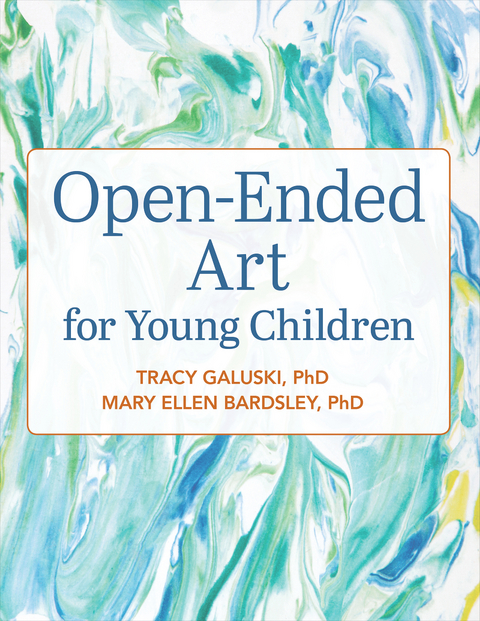
Open-ended art is defined as art activity where children are free to use their imagination as they explore a variety of materials without a planned outcome. When teachers embrace open-ended art, they emphasize the process of creating, and observe the developmental growth being experienced by the children. Open-ended art provides children an important opportunity to think about, feel, and express ideas. It helps teachers slow down the pace of the activity in order to observe and feel the environment all around.There are many books available to educators that include art ideas and projects, but Open-Ended Art for Young Children goes beyond the basics to highlight why the field of early childhood education advocates for open-ended art, and explain how to adapt to new ways of thinking about art. Authors Dr. Tracy Galuski and Dr. Mary Ellen Bardsley present, chapter by chapter, the challenges teachers encounter when faced with best practices and expectations related art process and product. Each chapter begins with a classroom vignette that describes the challenge, followed by a plethora of solutions, grounded in research and illustrated through practical examples. Each chapter includes full color pictures and photos, and ends with an activity or investigation for reflection.
Dr. Tracy Galuski has worked in the field of early childhood education for many years. Serving initially as a toddler teacher, she moved into different roles such as preschool teacher, child care program administrator, training specialist with both the Child Care Resource Network and Success by 6 at the United Way, and finally as a college professor at SUNY Empire State College. Dr. Galuski served for many years on the board for Association for the Education of Young Children of Western New York, the New York State Association for the Education of Young Children, and Directors and Leaders in Western New York. She was awarded the Level 3 Early Learner Training Credential in 2010, and she continues to offer training on a wide variety of topics in the local community.Dr. Mary Ellen Bardsley, an associate professor at Niagara University, has been involved in early childhood education for over fifteen years. Dr. Bardsley holds a doctoral and master’s degree from the University of Buffalo and bachelor’s degrees from Cornell University and Medaille College. She initially served as a Head Start teacher in Buffalo, New York. Through her position with Head Start she became involved in the local early childhood community serving in various roles for the board for the for Association for the Education of Young Children of Western New York, the New York State Association for the Education of Young Children, ACEI, and the New York State Association of Early Childhood Educators. She has the Level 3 Early Learner Training Credential (New York State).
IntroductionPart 1: Curriculum, Instruction and AssessmentChapter 1: Getting Started: What is art?Chapter 2: Planning for Art: Aren’t we supposed to make projects related to our theme?Chapter 3: Learning Outcomes: If art is supposed to be creative, why do I need to assess it?Chapter 4: Evaluation, Assessment, and Feedback: How do I know we’re on the right track?Chapter 5: Getting Families on Board: Why aren’t you sending home any work?Part 2: Art and Child DevelopmentChapter 6: Infants: What does art look like in the infant classroom?Chapter 7: Toddlers: Do messy toddlers really need free access to materials?Chapter 8: Preschoolers: What does art look like in the preschool classroom?Chapter 9: School-Age Programs: What does art look like in an afterschool program?Part 3: Finding New and Different TechniquesChapter 10: Sensory Activities and Special Needs: What about children with special needs?Chapter 11: Strategies and Techniques: Where do I find something new and different to use in the classroom?Chapter 12: Wasted Materials and Inexpensive Alternatives: All the fun, with no expense!Chapter 13: Art Appreciation: I don’t know much about different artists, so how do I teach children to appreciate art?Chapter 14: ConclusionRecommended Children’s Books and ResourcesReferences IntroductionPart 1: Curriculum, Instruction and AssessmentChapter 1: Getting Started: What is art?Chapter 2: Planning for Art: Aren’t we supposed to make projects related to our theme?Chapter 3: Learning Outcomes: If art is supposed to be creative, why do I need to assess it?Chapter 4: Evaluation, Assessment, and Feedback: How do I know we’re on the right track?Chapter 5: Getting Families on Board: Why aren’t you sending home any work?Part 2: Art and Child DevelopmentChapter 6: Infants: What does art look like in the infant classroom?Chapter 7: Toddlers: Do messy toddlers really need free access to materials?Chapter 8: Preschoolers: What does art look like in the preschool classroom?Chapter 9: School-Age Programs: What does art look like in an after school program?Part 3: Finding New and Different TechniquesChapter 10: Sensory Activities and Special Needs: What about children with special needs?Chapter 11: Strategies and Techniques: Where do I find something new and different to use in the classroom?Chapter 12: Wasted Materials and Inexpensive Alternatives: All the fun, with no expense!Chapter 13: Art Appreciation: I don’t know much about different artists, so how do I teach children to appreciate art?Chapter 14: ConclusionRecommended Children’s Books and ResourcesReferences
| Erscheint lt. Verlag | 16.10.2018 |
|---|---|
| Zusatzinfo | 4-color interior |
| Sprache | englisch |
| Themenwelt | Kunst / Musik / Theater ► Allgemeines / Lexika |
| Sachbuch/Ratgeber ► Freizeit / Hobby ► Kreatives Gestalten | |
| Sachbuch/Ratgeber ► Gesundheit / Leben / Psychologie ► Familie / Erziehung | |
| Schulbuch / Wörterbuch ► Schulbuch / Allgemeinbildende Schulen | |
| Sozialwissenschaften ► Pädagogik ► Vorschulpädagogik | |
| Schlagworte | Activities • administrators • ART • Art education • art for young children • artisitc reflections • art process • children with differing abilities • Creative • Curriculum • early childhood • Early childhood education • experimentation • Free Art • how can I teach art to my child • how can I teach art to my toddler • how to do art with children • Mary Ellen Bardsley • messy play • open-ended • open-ended art • sensory activities • Special Needs • toddler • toddler art • Tracy Galuski • young children |
| ISBN-10 | 1-60554-599-6 / 1605545996 |
| ISBN-13 | 978-1-60554-599-8 / 9781605545998 |
| Informationen gemäß Produktsicherheitsverordnung (GPSR) | |
| Haben Sie eine Frage zum Produkt? |
 EPUB (Adobe DRM)
Kopierschutz: Adobe-DRM
Adobe-DRM ist ein Kopierschutz, der das eBook vor Mißbrauch schützen soll. Dabei wird das eBook bereits beim Download auf Ihre persönliche Adobe-ID autorisiert. Lesen können Sie das eBook dann nur auf den Geräten, welche ebenfalls auf Ihre Adobe-ID registriert sind.
Details zum Adobe-DRM
Dateiformat: EPUB (Electronic Publication)
EPUB ist ein offener Standard für eBooks und eignet sich besonders zur Darstellung von Belletristik und Sachbüchern. Der Fließtext wird dynamisch an die Display- und Schriftgröße angepasst. Auch für mobile Lesegeräte ist EPUB daher gut geeignet.
Systemvoraussetzungen:
PC/Mac: Mit einem PC oder Mac können Sie dieses eBook lesen. Sie benötigen eine
eReader: Dieses eBook kann mit (fast) allen eBook-Readern gelesen werden. Mit dem amazon-Kindle ist es aber nicht kompatibel.
Smartphone/Tablet: Egal ob Apple oder Android, dieses eBook können Sie lesen. Sie benötigen eine
Geräteliste und zusätzliche Hinweise
Buying eBooks from abroad
For tax law reasons we can sell eBooks just within Germany and Switzerland. Regrettably we cannot fulfill eBook-orders from other countries.
aus dem Bereich