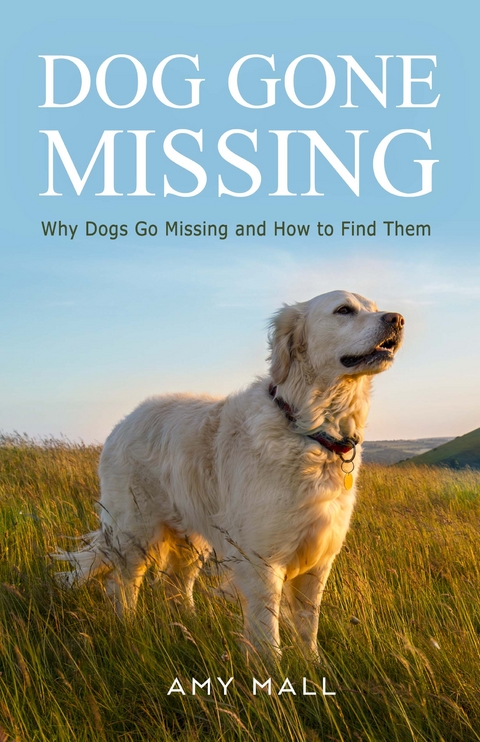
Dog Gone Missing (eBook)
130 Seiten
Oh Street Press (Verlag)
661000004246-3 (EAN)
Whether your dog is lost right now or safe at home, Dog Gone Missing has information you can use. If your dog is missing, it has the ten most effective tactics to find them. If your dog is lounging at your feet, it includes the top ten things you can do right now to prevent them from getting lost in the first place. Dog Gone Missingcombines scientific research, expert interviews, practical advice on everything from pet detectives to tracking apps, and incredible real-life stories of lost dogs from around the country and their owners' efforts to find them.
You'll learn about the best ways to find lost dogs, the fascinating science behind dog navigation skills, why some dogs can find their way home while others can't, and how to keep your dog from going missing.
It's estimated that more than one million dogs go missing every year in the United States. Author Amy Mall shares the information you need to make sure your dog is not part of this statistic.
What experts are saying:
'I am a professional tracker specializing in missing pet recovery....I am constantly researching my field and read countless books relating to the missing pets. This book is BANG ON! Very well written and great advice for pet owners. Amy truly knows what she is talking about! GREAT BOOK! Buy it BEFORE you need it!'
Kevin McCormick, Tracker's Edge
2: Is My Dog Like Lassie?
Lassie is probably the most famous dog of all time. A beautiful collie who appeared in books, films, and television programs, she had renowned navigation skills and could find her way home over long distances through unfamiliar and rough terrain despite an ongoing series of seemingly insurmountable challenges. Readers and viewers were fascinated with her for generations. Then again, she was fictional.
But beyond fictional accounts, we’ve all seen news articles and video clips about real dogs with miraculous tales of navigation and survival, some finding their way home after years away, some over distances of hundreds (or even thousands!) of miles.
Since that day in 2001 when Lola ran away and found her way to Melanie’s house, I’ve shared my life with three other dogs: Louie, Roxanne, and Shanti. All were mixed-breed rescues of various origins, found as strays. As dog owners know, every dog has their own personality and talents, and I loved each of my dogs for their quirky individuality. My relationship with each one was a little different, and from each I learned distinct lessons about a dog’s attachment to their family, as well as the canine homing instinct.
Roxy: Fear and Hiding
Roxanne (a.k.a. Roxy) was a red-headed mix of unknown breed and origin who came to my home as a foster dog. When first rescued, she was terrified of humans. A trainer thought she was “semi-feral.” At first, Roxy wouldn’t eat or drink if a human was in the same room. She wouldn’t make eye contact. On walks she would try to crawl under parked cars. She took every opportunity she could to hide behind or beneath something. I sometimes found her peeking out from behind the headboard of my bed, or under the back porch. As much as I prided myself on being a dog person, I had to admit that she seemed to feel no attachment to me at all. I tried not to take it personally.
Although she was terrified around people or loud noises, I saw glimpses of unrestrained playfulness in Roxy. When alone, she would joyfully run in circles around the yard, throw a toy up in the air and try to catch it. She also got along well with Lola, my other dog. Since it seemed unlikely that anyone else would ever adopt her, given her disinterest in humans, she ultimately became what is known in the dog rescue world as a “failed foster.” In other words, her foster mom adopted her! She became a full-fledged member of the family.
Roxanne, photo by Amy Mall
Shortly after I adopted Roxy, we moved to Colorado. One summer day in the Sangre de Cristo Mountains, I was cleaning a cabin where we had been staying, nine miles from the nearest town. Roxy got spooked by the sound of the vacuum cleaner and ran out an open door. By the time I realized she was missing, there was no sign of her, and she didn’t come when called. My then-boyfriend and I began looking for her. We called her name for hours and, assuming she had kept running once she got out the door, gradually expanded our search farther and farther from the cabin.
After a few hours of fruitless searching, a memory popped into my mind of the last time I was searching for Roxy, months earlier, in Washington, D.C., when she had gotten away from us in a park. We had eventually found her when someone spotted the end of her leash sticking out from under a bush. A light bulb lit up over my head, and we returned to the cabin to start our search over. I went inside, found Lola, put her on a leash, and began to walk with her around the grounds, staying close to the bushes in the immediate vicinity of the cabin. Sure enough, within just a few minutes, Roxy crawled out from underneath one of those bushes, perhaps because Lola was there. I’m sure she’d been hiding there the entire time we searched.
Lost dog lesson #3:
Know your dog well, and keep that knowledge in mind when searching. It can help you figure out where your dog might be.
Homing Instincts
The homing instinct of an animal is a combination of their drive to return home and their ability to do so over long distances. It requires some sense of home as well as keen navigation skills. With time, Roxy became more confident and, I believe, came to understand the concept of home. She escaped a few more times but I ultimately always found her waiting on the front step of our house in Boulder, Colorado, panting and looking completely tuckered out. It seemed to me that she had stopped running away to hide, and had instead begun running just to have fun, coming home when she decided her adventure was over.
I’ll never know whether Roxy ran in pursuit of a scent or just to explore. While I would panic when she escaped the house or yard, it was always a joy to see her come home on her own. She made enormous progress in bonding to me—or at least to the concept of our house as a home base. If we were out hiking and she ran off, she always found me on the trail. Despite all her running, Roxy never got lost, and I eventually successfully trained her to come back to me when I called her. She would spend hours hanging out underneath a large bush in the fenced back yard, but I think she came to feel that hiding, like running, was something she could do for the sheer pleasure of it, rather than because of fear.
Josey: Visiting Friends
Legends abound about canine navigational abilities. I’ve observed small miracles myself.
One day while inside the house where I was living in Boulder, I heard Lola and Roxy barking in the back yard. I went outside to get a closer look at what had gotten their attention. They were barking at something outside the six-foot-high privacy fence. I couldn’t see through the fence, so I opened the gate that led to the alley. Into the yard ran Josey, a black Lab mix who belongs to my friend Julie.
Just like my friend Melanie had done years earlier when she found Lola, I called Julie to ask her why Josey was at my house. Julie, not at home, had no idea that Josey was gone. It turned out that Julie had gotten a phone call earlier that day from a flower shop that wanted to make a delivery. Since she wasn’t going to be at home, Julie told the florist it was okay to open the door to the front porch and place the flowers inside. Josey had never been the kind of dog who would bolt out through an open door. This time, however, she escaped. We don’t know whether she was afraid of the stranger who opened her front door, or made a quick decision to visit her canine friends.
Josey, photo by Julie Teel Simmonds
Josey had visited my house many times before, and had even stayed with me when Julie traveled out of town, so she felt like a member of the family. But she had never arrived by herself, or through the back gate, or by walking the route between her house and mine. Julie’s house was about two miles away, and Julie always parked her car in front of my house, not in the alley. Yet Josey knew the route well enough to navigate by herself, cross several streets, and find her way to the alley and my back gate.
Shanti: Home and Attachment
After Roxy passed away, I adopted a dog I named Shanti. Shanti was a mix of American Staffordshire Terrier, a type of pit bull, and unknown other breeds. He spent seven years in a municipal shelter before I adopted him. I don’t know whether it was nature or nurture, but Shanti was the exact opposite of Roxy. He was confident around people and quickly bonded to me. If he wasn’t at home, there was only one place he wanted to be, and that was by my side.
Shanti, photo by Amy Mall
One summer he joined me on a trip to a small village in Vermont. Late one night, we arrived at the carriage house I had rented. Neither one of us had been there before. The next morning we went for a run to explore a nearby trail. As soon as I reached the farthest point on our route and decided to turn around, Shanti started hightailing it back to the carriage house. He ran ahead of me the entire way until we reached the front door, as if he wanted to get back to the place that seemed like a home base to him. Somehow he knew exactly how to find the way back on his own. I don’t think any of my other dogs would have done that.
I had a similar experience with him the first time he hiked with me in Washington’s Rock Creek Park. After a few hours of hiking, we were nearing the parking lot where we had started. He pulled me off the trail and crossed a field, stopping right in front of our car. Perhaps I gave him some cues about direction without realizing it, but he seemed to have an excellent ability to navigate, and an uncanny instinct that the car was our destination and our connection to home.
Quint: Instinct or Intelligence?
I met Ann Yoder through her daughter-in-law, a work colleague of mine. Ann told me the story of her dog Quint, a small dog, only 12 inches high, who looked like a Spitz mix. The Yoder family purchased Quint from another family when he was less than a year old. Quint, Ann said, had the spirit of a big dog inside a small dog’s body. He was very attached to the three Yoder children, but would also take any opportunity to squeeze out an open door and run around their neighborhood in the Shenandoah Valley of Virginia....
| Erscheint lt. Verlag | 30.11.2017 |
|---|---|
| Sprache | englisch |
| Themenwelt | Sachbuch/Ratgeber ► Natur / Technik ► Tiere / Tierhaltung |
| Schlagworte | Dog • dog behavior • dog intelligence • Dogs • lost dog • missing dog • runaway dog |
| Informationen gemäß Produktsicherheitsverordnung (GPSR) | |
| Haben Sie eine Frage zum Produkt? |
 EPUB (Adobe DRM)
Größe: 2,8 MB
Kopierschutz: Adobe-DRM
Adobe-DRM ist ein Kopierschutz, der das eBook vor Mißbrauch schützen soll. Dabei wird das eBook bereits beim Download auf Ihre persönliche Adobe-ID autorisiert. Lesen können Sie das eBook dann nur auf den Geräten, welche ebenfalls auf Ihre Adobe-ID registriert sind.
Details zum Adobe-DRM
Dateiformat: EPUB (Electronic Publication)
EPUB ist ein offener Standard für eBooks und eignet sich besonders zur Darstellung von Belletristik und Sachbüchern. Der Fließtext wird dynamisch an die Display- und Schriftgröße angepasst. Auch für mobile Lesegeräte ist EPUB daher gut geeignet.
Systemvoraussetzungen:
PC/Mac: Mit einem PC oder Mac können Sie dieses eBook lesen. Sie benötigen eine
eReader: Dieses eBook kann mit (fast) allen eBook-Readern gelesen werden. Mit dem amazon-Kindle ist es aber nicht kompatibel.
Smartphone/Tablet: Egal ob Apple oder Android, dieses eBook können Sie lesen. Sie benötigen eine
Geräteliste und zusätzliche Hinweise
Buying eBooks from abroad
For tax law reasons we can sell eBooks just within Germany and Switzerland. Regrettably we cannot fulfill eBook-orders from other countries.
EPUB (Ohne DRM)Digital Rights Management: ohne DRM
Dieses eBook enthält kein DRM oder Kopierschutz. Eine Weitergabe an Dritte ist jedoch rechtlich nicht zulässig, weil Sie beim Kauf nur die Rechte an der persönlichen Nutzung erwerben.
Dateiformat: EPUB (Electronic Publication)
EPUB ist ein offener Standard für eBooks und eignet sich besonders zur Darstellung von Belletristik und Sachbüchern. Der Fließtext wird dynamisch an die Display- und Schriftgröße angepasst. Auch für mobile Lesegeräte ist EPUB daher gut geeignet.
Systemvoraussetzungen:
PC/Mac: Mit einem PC oder Mac können Sie dieses eBook lesen. Sie benötigen dafür die kostenlose Software Adobe Digital Editions.
eReader: Dieses eBook kann mit (fast) allen eBook-Readern gelesen werden. Mit dem amazon-Kindle ist es aber nicht kompatibel.
Smartphone/Tablet: Egal ob Apple oder Android, dieses eBook können Sie lesen. Sie benötigen dafür eine kostenlose App.
Geräteliste und zusätzliche Hinweise
Buying eBooks from abroad
For tax law reasons we can sell eBooks just within Germany and Switzerland. Regrettably we cannot fulfill eBook-orders from other countries.
aus dem Bereich