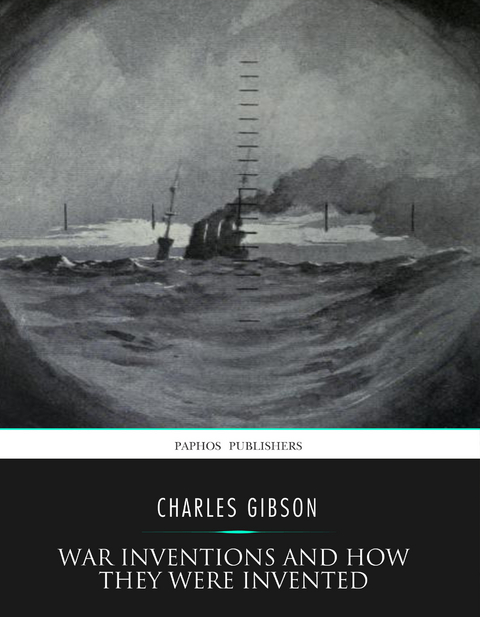
War Inventions and How They Were Invented (eBook)
161 Seiten
Charles River Editors (Verlag)
978-1-5080-7876-0 (ISBN)
Paphos Publishers offers a wide catalog of rare classic titles, published for a new generation. War Inventions and How They Were Invented is a fascinating overview of many tools of war.
HOW GUNS WERE INVENTED
YOU KNOW THAT WHEN THE shepherd boy went out to fight the great big Philistine soldier neither of them had a gun. You know the reason why: guns had not been invented at that time.
If you had happened to be one of the children living about three thousand years ago, and if you had seen David and Goliath, I wonder what you would have thought about their weapons of war. Of course you can judge better now that you know the result of the fight, but if you had seen them before the fight I have no doubt that you would have said that the shepherd boy could not have any chance against the giant soldier who possessed such a large sword.
It is true that the Philistine soldier’s great sword was a deadly weapon of war, but it was of no use until he got close up to his enemy, whereas the shepherd boy was able to attack the huge soldier from a distance. You know how the boy threw a stone from his sling, with such force and with such a practised aim that the stone struck the soldier right on his forehead and killed him.
You have heard, doubtless, how the ancient Romans used to fling heavy stones at their enemies by means of a simple machine called a balista, and how they shot heavy metal bolts by means of large catapults. Then you know of the powerful cross-bows which shot deadly arrows, and how that gave rise to the long-bows which the archers could carry conveniently.
In all these weapons you see that the idea was to attack the enemy from a distance. The archer himself had to supply the energy which forced the arrow towards the enemy. With a gun it is different, for the soldier merely points the gun in the proper direction and pulls a trigger, when bang goes the gunpowder or other explosive, and off flies the bullet towards the enemy.
Who, then, invented guns? And when was the first gun invented? These are very simple and direct questions, but they are not answered so easily. I could tell you who invented the different kinds of guns within the last hundred years or so, but no one can find out when or by whom the first gun was invented. From that fact you will be able to guess that it must have been a very long time ago.
We have old writings which tell us of guns being used seven hundred years ago, and we believe that there must have been some sort of guns more than two thousand years ago, which takes us back before the time of Christ. A Greek historian, writing at the time of one of the wars of Alexander the Great, tells us that the Hindus “had the means of discharging flame and missiles on their enemies from a distance.”
You must not picture these ancient people as possessing guns at all similar to what we know as guns nowadays. The early attempt at guns may have helped to frighten the enemy from approaching the walls of a besieged city, but it is not likely that they did any real damage to the enemy at a distance. However, we see that away back before the time of Christ, people had the idea of guns.
But a gun that would shoot far and straight was not made so easily as you might imagine; it is only in recent times that we have been able to make really accurate guns.
The first idea was to make a gun from long bars of iron, fixing them firmly together so as to form a tube, iron hoops being used to tie them together, just as a wooden barrel is hooped together. These tubes, or guns, were called cannons, because the French word for a tube is canon.
These early guns shot heavy stone balls. Then, about five hundred years ago, came the idea of making a solid cast-iron cannon and solid cast-iron cannon-balls. We have preserved many of these old weapons of war, and you have probably seen some of them in our parks or other public places. If you were to examine one of these old guns you would find that it is just a great iron tube closed at one end. We call the closed end the breech of the gun, just as we speak of the hinder part of a horse’s harness as the breeching. Then we speak of the open end or mouth of the gun as the muzzle, just as we may speak of the projecting nose and mouth of an animal as its muzzle.
If the old cast-iron cannon which you examine has been very well preserved, you should find a small hole near the closed end or breech of the gun. You probably know that this little chimney, or passage, leading down into the open bore of the gun, is called the touch-hole.
I have no doubt you have pictured to yourself some old-time soldiers firing one of these guns. We see them putting a quantity of gunpowder in at the open muzzle of the gun, and pushing it along the barrel until it is hard up against the breech or hinder part of the gun. Then they place a soft wad against the powder to keep it in its place. Then we see them place a big, round, solid ball of iron into the muzzle and ram it back against the wad. The cannon-ball is a loose fit for the bore of the gun, so the soldier wraps it in an oily cloth, before ramming it home. Then a little gunpowder is poured down the touch-hole. This is called the priming charge, as its duty is to set off the big charge of gunpowder crowded in behind the cannon-ball. You see the connection between the word “priming “and the word “primer,” which describes your first lesson-books. Both words are made from a Latin word meaning “first.”
When these soldiers of long ago have their gun all ready, we see one of them apply a light to the powder in the touch-hole, and this priming charge soon passes the flame on to the large charge of gunpowder within the gun. The sudden explosion of the powder sends the cannon-ball flying out of the muzzle of the gun, and towards the enemy.
All this seems very primitive to us nowadays, and yet it was with such weapons that the Duke of Wellington and Napoleon fought at Waterloo in 1815, and which our armies have used even in later wars.
Large cannons were very heavy things to move about with an army, so attempts were made long ago to supply the foot soldiers with small guns which they would be able to carry about just as the old archers carried their long-bows. Some six or seven hundred years ago the infantryman was given a miniature cannon, mounted with a wooden butt end, which he could steady against his chest. These hand-guns had a touch-hole, to which the soldier applied a flame just as in the larger cannons. Then someone suggested that the soldier would be able to take much better aim if he had not to worry about finding the touch-hole. And so a trigger was attached, and when this was pulled, it brought a lighted match down on to the touch-hole. It is not difficult to guess what led to this invention, for the old cross-bows had triggers, which when pulled released the springs and shot the bolts or arrows.
Then it was found that the soldier could not get his eye down low enough to take proper aim, while the butt of the gun rested on his chest. This difficulty suggested the butt being made suitable to rest against the shoulder, and you know that this plan, which was adopted four hundred years ago, is still in use today.
These early hand-guns, in which a trigger pulled a lighted match against the touch-hole, were called “match-lock muskets.” The lock of any gun is the mechanism by which it is fired, so you see the meaning of the word match-lock. But why should the gun be called a musket? This was a name given to describe the quickness of firing; the name having been made up from the French word for a sparrow-hawk. You know how very rapid are the movements of these birds.
You must not picture these old-time soldiers with matches such as we possess. If you have any friends who are “very old,” you will find that they can remember the invention of the matches that light by merely rubbing their heads. The musketeers who used the match-lock muskets had no such self-lighting matches. They had to carry several yards of slow match wound round their muskets, and when they wished to shoot, they had first to produce a spark by means of a flint and steel, and thus light the end of the slow match. Imagine a musketeer on the battle-field, with wind and rain extinguishing his match, and the wind blowing the gunpowder out of the small pan fixed over the touch-hole.
These difficulties led to the invention of the wheel-lock musket, in which the lock, or firing mechanism, consisted of a small wheel, with teeth, which by rubbing on a piece of flint produced sparks which set the powder alight. When the trigger was pulled, not only did it set the wheel in motion, but it also uncovered the pan at the same moment. Before the trigger was pulled, the soldier had to wind up the firing mechanism, just as you wind up a clock. All this meant delay.
By-and-by the difficulties of this wheel-lock musket led to the invention of the flint-lock musket, in which a piece of flint was made to strike a piece of furrowed steel, and thus produce the necessary sparks. This was done without any clockwork, and therefore saved a lot of time. It was these flint-lock muskets that were used in the battle of Waterloo. Among the soldiers of the Duke of Wellington this musket was nicknamed “Brown Bess,” from the color of its barrel.
Although it was a famous musket in its day, it was really a very poor affair. One of the great soldiers of these days said that this musket might shoot a man if he were only 80 yards away, but that a soldier would be very unfortunate indeed to be wounded by one of these muskets if the enemy was firing from a distance of 150 yards. He adds these words: “provided his antagonist aims at him.” By this he means that a soldier might be hit by a stray...
| Erscheint lt. Verlag | 22.3.2018 |
|---|---|
| Sprache | englisch |
| Themenwelt | Sachbuch/Ratgeber ► Geschichte / Politik ► Allgemeines / Lexika |
| Geschichte ► Teilgebiete der Geschichte ► Militärgeschichte | |
| Schlagworte | Free • Guns • submarines • Weapons • World War |
| ISBN-10 | 1-5080-7876-9 / 1508078769 |
| ISBN-13 | 978-1-5080-7876-0 / 9781508078760 |
| Informationen gemäß Produktsicherheitsverordnung (GPSR) | |
| Haben Sie eine Frage zum Produkt? |
 EPUB (Adobe DRM)
Größe: 616 KB
Kopierschutz: Adobe-DRM
Adobe-DRM ist ein Kopierschutz, der das eBook vor Mißbrauch schützen soll. Dabei wird das eBook bereits beim Download auf Ihre persönliche Adobe-ID autorisiert. Lesen können Sie das eBook dann nur auf den Geräten, welche ebenfalls auf Ihre Adobe-ID registriert sind.
Details zum Adobe-DRM
Dateiformat: EPUB (Electronic Publication)
EPUB ist ein offener Standard für eBooks und eignet sich besonders zur Darstellung von Belletristik und Sachbüchern. Der Fließtext wird dynamisch an die Display- und Schriftgröße angepasst. Auch für mobile Lesegeräte ist EPUB daher gut geeignet.
Systemvoraussetzungen:
PC/Mac: Mit einem PC oder Mac können Sie dieses eBook lesen. Sie benötigen eine
eReader: Dieses eBook kann mit (fast) allen eBook-Readern gelesen werden. Mit dem amazon-Kindle ist es aber nicht kompatibel.
Smartphone/Tablet: Egal ob Apple oder Android, dieses eBook können Sie lesen. Sie benötigen eine
Geräteliste und zusätzliche Hinweise
Buying eBooks from abroad
For tax law reasons we can sell eBooks just within Germany and Switzerland. Regrettably we cannot fulfill eBook-orders from other countries.
EPUB (Ohne DRM)Digital Rights Management: ohne DRM
Dieses eBook enthält kein DRM oder Kopierschutz. Eine Weitergabe an Dritte ist jedoch rechtlich nicht zulässig, weil Sie beim Kauf nur die Rechte an der persönlichen Nutzung erwerben.
Dateiformat: EPUB (Electronic Publication)
EPUB ist ein offener Standard für eBooks und eignet sich besonders zur Darstellung von Belletristik und Sachbüchern. Der Fließtext wird dynamisch an die Display- und Schriftgröße angepasst. Auch für mobile Lesegeräte ist EPUB daher gut geeignet.
Systemvoraussetzungen:
PC/Mac: Mit einem PC oder Mac können Sie dieses eBook lesen. Sie benötigen dafür die kostenlose Software Adobe Digital Editions.
eReader: Dieses eBook kann mit (fast) allen eBook-Readern gelesen werden. Mit dem amazon-Kindle ist es aber nicht kompatibel.
Smartphone/Tablet: Egal ob Apple oder Android, dieses eBook können Sie lesen. Sie benötigen dafür eine kostenlose App.
Geräteliste und zusätzliche Hinweise
Buying eBooks from abroad
For tax law reasons we can sell eBooks just within Germany and Switzerland. Regrettably we cannot fulfill eBook-orders from other countries.
aus dem Bereich