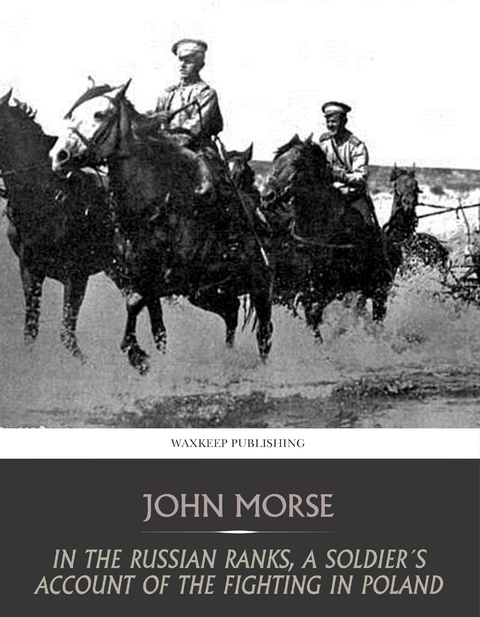
In the Russian Ranks, a Soldier's Account of the Fighting in Poland (eBook)
359 Seiten
Charles River Editors (Verlag)
978-1-5080-1813-1 (ISBN)
In the Russian Ranks, a Soldier's Account of the Fighting in Poland are the experiences of an Englishman fighting with Russia during World War I. The original illustrations and a table of contents are included.
CHAPTER II THE SCENE AT KALISZ ON THE 2ND AUGUST, 1914
HAD I NOT BEEN under military escort I could not possibly have got along any of the roads in the neighbourhood of Ostrovo—all were crowded by Prussian infantry. I did not see any other branches of the service, but I understood that the engineers were mining the railway-line, and about half an hour after we started my friends declared that it would be hopeless to try to reach Kalisz from the German side. They said they must leave me, as it was imperative that they should rejoin their regiments before the hour of parade. A road was pointed out to me as one that led straight to the frontier, and that frontier I was recommended to endeavour to cross. The horse was taken away, and, after shaking hands with the officers and receiving their wishes of good-luck, I proceeded across the fields on foot.
Pickets of cavalry and infantry were moving about the country, but I avoided them, and after a two-hours’ walk reached the low bank which I knew marked the frontier-line. It was then after three o’clock, and daylight was beginning to break. As far as I could see, nobody was about. Some cows were in the field, and they followed me a short distance—a worry at the time, as I feared they would attract attention to my movements.
I jumped over the boundary, and walked in the direction of Kalisz, the dome and spire and taller buildings of which were now visible some miles to the northward. The country is very flat here—typical Polish ground, without trees or bushes or hedges, the fields being generally separated by ditches. It is a wild and lonely district, and very thinly peopled. And I do not think there were any Russian troops in the town. If there were, it must have been a very slender detachment, which fell back at once; for if any firing had occurred, I must have seen and heard it. Not a sound of this description reached my ears, but when I reached Kalisz at 5.30 a.m. it was full of German soldiers, infantry and Uhlans—the first definite information I had that war was actually declared between the two countries, and the first intimation I received of how this war was likely to be conducted, for many of the Germans were mad drunk, and many more acting like wild beasts.
I passed through crowds of soldiers without being interfered with—a wonderful circumstance. None of the shops were opened at that early hour, but the Germans had smashed into some of them, and were helping themselves to eatables and other things. I saw one unter-officer cramming watches, rings, and other jewellery into his pockets. He was quickly joined by other wretches, who cleared the shop in a very few minutes.
Hardly knowing what to do, but realizing the danger of lurking about without an apparent object in view, I continued to walk through the streets in search of the railway-station, or a place where I could rest. A provost and a party of military policemen were closing the public-houses by nailing up the doors, and I saw a man only partly dressed, the proprietor of one of these houses, I supposed, murdered. He made an excited protest, and a soldier drove his bayonet into the poor man’s chest. He uttered a terrible scream, and was instantly transfixed by a dozen bayonets. A woman, attracted by the fearful cry, came rushing out of the house screaming and crying. She had nothing on except a chemise, and the soldiers treated her with brutal indecency. I was impelled to interfere for her protection. At that moment an officer came up, and restored some order amongst the men, striking and pricking several of them with his sword. He said something to me which I did not understand, and, receiving no reply, struck me with his fist, and then arrogantly waved his hand for me to be gone. I had no alternative. I suppressed my wrath and moved away, but the horrible sight of the bleeding man and the weeping woman haunted me until I became used to such sights—and worse.
As I walked through the streets I heard the screams of women and children on all sides, mingled with the coarse laughter and shouts of men, which told plainly enough what was taking place, though I could not understand a word of what was said. I was struck by drunken or excited soldiers more than once, and kicked, but to retaliate or use the weapon with which I was armed would, I could perceive, result in my instant destruction; so I smothered my wrath for the time.
Many women rushed into the streets dressed in their night-clothes only, some of them stained with blood, as evidence of the ill-usage they had suffered; and I passed the dead bodies of two men lying in the road, one of which was that of a youth. These, there can be no doubt, were the first acts of war on the part of Germany against Russia—the slaughter of unarmed and defenceless people.
In one of the principal streets I found two hotels or large public-houses open. They were both full of German officers, some of whom were drunk. At an upper window one man was being held out by his legs, while a comrade playfully spanked him, and a wild orgy was going on in the room behind. Bottles and glasses were thrown into the street, and a party of German prostitutes vied in bestiality with the men. I saw the hellish scene. Had I read an account of it, I should at once have stamped the writer in my heart as a liar. I am not going to dwell on the filthy horrors of that day. I do little more than hint at what took place, and only remark that at this hour no act of war, no fair fight or military operation, had taken place on any of Germany’s borders. She showed the bestiality of the cowardly hyena before a fang had been bared against her. This was the information I afterwards obtained from Russian sources. On the morning Kalisz was sacked, not a shot had been fired by the Russian soldiers.
My needs compelled me to take risks. All the belongings I had with me were contained in a small bag which I carried in my hand. I had some German money in my pocket, and a number of English sovereigns. The remainder of my luggage I had been compelled to leave behind at Ostrovo. Entering the quietest of the two hotels, I found the proprietor and several of his servants or members of his family trembling in the basement. I was stopped at the door by a sentry, but he was a quiet sort of youth, accepted a few marks, and while he was putting them in his pouch permitted me to slip into the house.
I have already intimated that I am no linguist. I could not muster a dozen words of German, and not one of Russian; so, holding the proprietor to insure his attention (the poor man was almost in a state of collapse), I made motions that I wished to eat and drink. No doubt they took me for a German. One of the maids literally rushed to the cellar, and returned with two large bottles of champagne of the size which our great-grandfathers, I believe, called “magnums,” containing about two quarts apiece.
But champagne was not what I wanted, so I looked round till I found a huge teapot. The face of the maid was expressionless, but she was not lacking in intelligence. The Russians are great tea-drinkers, and I soon had a good breakfast before me, with plenty of the refreshing beverage. A Russian breakfast differs much from an English early morning meal, but on this occasion I contrived to obtain bacon and eggs, which, in spite of all doctors and economists say to the contrary, is one of the best foods in existence for travelling or fighting on.
Before I had well finished this meal one of the riotous officers came downstairs. He made a sudden stop when he saw me, and blinked and winked like an owl in sunlight, for he had had plenty of liquor. He asked some question, and as I could not very well sit like a speechless booby, I replied in my own language.
“Good-morning,” rather dryly, I am afraid.
“An English pig!” he exclaimed.
“An Englishman,” I corrected.
[At least 50 per cent. of German officers speak English quite fluently, and an even greater number French, learned in the native countries of these languages.]
“Bah-a-a-a!” he exclaimed, prolonging the interjection grotesquely. “Do you know that we have wrecked London, blown your wonderful Tower and Tower Bridge and your St. Paul’s to dust, killed your King, and our Zeppelins are now wrecking Manchester and Liverpool and your other fine manufacturing towns?”
“Nonsense!” I said.
“It is true, I assure you,” he replied.
The news sent a terrible thrill through my nerves, for I did not yet know what liars Germans could be, and I did not think a Prussian officer could stoop to be so mendacious a scoundrel as this fellow proved to be.
“Then there is war between England and Germany?” I asked, wondering at its sudden outbreak. “When was it declared?”
“It is not declared. We have taken time by the forelock, as you British say—as we mean to take it with all who dare to oppose us. You are a stinking Englishman, and I’ll have you shot!” he concluded furiously.
Going to the foot of the stairs, he began to call to his companions, reviling the English, and declaring that there was a spy below. As his drunken comrades did not hear him or immediately respond, he ascended the stairs, and I took the opportunity to put down some money for my breakfast, catch up my bag, and escape from the house.
At the top of the street the road broadened out into a kind of square or open space, and as I reached this spot a large number of soldiers brought eight prisoners into the centre of it. Three of them were dressed in what I took to be the...
| Erscheint lt. Verlag | 22.3.2018 |
|---|---|
| Sprache | englisch |
| Themenwelt | Sachbuch/Ratgeber ► Geschichte / Politik ► Allgemeines / Lexika |
| Geschichte ► Allgemeine Geschichte ► Neuzeit (bis 1918) | |
| Geschichte ► Allgemeine Geschichte ► 1918 bis 1945 | |
| Schlagworte | Free • Russia • tsar • World War I |
| ISBN-10 | 1-5080-1813-8 / 1508018138 |
| ISBN-13 | 978-1-5080-1813-1 / 9781508018131 |
| Informationen gemäß Produktsicherheitsverordnung (GPSR) | |
| Haben Sie eine Frage zum Produkt? |
 EPUB (Adobe DRM)
Größe: 835 KB
Kopierschutz: Adobe-DRM
Adobe-DRM ist ein Kopierschutz, der das eBook vor Mißbrauch schützen soll. Dabei wird das eBook bereits beim Download auf Ihre persönliche Adobe-ID autorisiert. Lesen können Sie das eBook dann nur auf den Geräten, welche ebenfalls auf Ihre Adobe-ID registriert sind.
Details zum Adobe-DRM
Dateiformat: EPUB (Electronic Publication)
EPUB ist ein offener Standard für eBooks und eignet sich besonders zur Darstellung von Belletristik und Sachbüchern. Der Fließtext wird dynamisch an die Display- und Schriftgröße angepasst. Auch für mobile Lesegeräte ist EPUB daher gut geeignet.
Systemvoraussetzungen:
PC/Mac: Mit einem PC oder Mac können Sie dieses eBook lesen. Sie benötigen eine
eReader: Dieses eBook kann mit (fast) allen eBook-Readern gelesen werden. Mit dem amazon-Kindle ist es aber nicht kompatibel.
Smartphone/Tablet: Egal ob Apple oder Android, dieses eBook können Sie lesen. Sie benötigen eine
Geräteliste und zusätzliche Hinweise
Buying eBooks from abroad
For tax law reasons we can sell eBooks just within Germany and Switzerland. Regrettably we cannot fulfill eBook-orders from other countries.
EPUB (Ohne DRM)Digital Rights Management: ohne DRM
Dieses eBook enthält kein DRM oder Kopierschutz. Eine Weitergabe an Dritte ist jedoch rechtlich nicht zulässig, weil Sie beim Kauf nur die Rechte an der persönlichen Nutzung erwerben.
Dateiformat: EPUB (Electronic Publication)
EPUB ist ein offener Standard für eBooks und eignet sich besonders zur Darstellung von Belletristik und Sachbüchern. Der Fließtext wird dynamisch an die Display- und Schriftgröße angepasst. Auch für mobile Lesegeräte ist EPUB daher gut geeignet.
Systemvoraussetzungen:
PC/Mac: Mit einem PC oder Mac können Sie dieses eBook lesen. Sie benötigen dafür die kostenlose Software Adobe Digital Editions.
eReader: Dieses eBook kann mit (fast) allen eBook-Readern gelesen werden. Mit dem amazon-Kindle ist es aber nicht kompatibel.
Smartphone/Tablet: Egal ob Apple oder Android, dieses eBook können Sie lesen. Sie benötigen dafür eine kostenlose App.
Geräteliste und zusätzliche Hinweise
Buying eBooks from abroad
For tax law reasons we can sell eBooks just within Germany and Switzerland. Regrettably we cannot fulfill eBook-orders from other countries.
aus dem Bereich