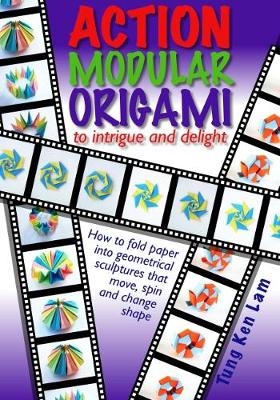
Action Modular Origami
Tarquin Publications (Verlag)
978-1-911093-94-7 (ISBN)
Fold paper into geometrical sculptures that move, spin and change shape. This book by a long-time creator will appeal to enthusiasts of mathematics and puzzles as well as fans of modular origami. Over thirty elegant projects are absorbing to make and rewarding to assemble - without glue or scissors. When finished, not only do the projects please the eye and stimulate the imagination, they have a bonus feature: they move, spin or change shape in unique and fascinating ways.
All in one place, fully diagrammed - clear step-by-step instructions with thoughts behind the folds. Many have been improved during years of experimentation and experiences of making and teaching.
"beautiful and elegant designs...immaculate diagrams." British Origami Society
"WXYZ model is so iconic...the most elegant model in all of modular origami." trivialknot
"his modular creations are fine examples of original and economical folding" David Petty, author of Origami A-B-C and Origami 1-2-3
Tung Ken Lam is a well-known origami creator, best known for "Jitterbug" and "WXYZ" inspired by the works of graphic artist MC Escher, architect/designer/polymath R Buckminster Fuller and origami creators such as Tomoko Fuse, Paul Jackson, Dave Brill, Dave Mitchell and Robert Neale. First introduced to origami as a child, he developed his interest through the books of Robert Harbin, Eric Kenneway, Kunihiko Kasahara, Samuel Randlett and John Montroll. "Origami crosses the boundaries of art, craft, play, mathematics, puzzles and practical geometry. The possibilities of folding paper seem limited, but these limitations have inspired creativity and imagination. Paper might seem an everyday material but it's magical to turn it into something unique just by folding. Following instruction to make someone else's origami work is akin to experiencing the folder's worldview and their act of creation." A member of the British Origami Society who has edited its magazine and publications, he has completed several commercial and educational origami commissions involving origami over the last 20 years. Although best know for modular origami, he has created animals, human figures and faces, tessellations and quirky subjects like a convincing hand with four finger and a thumb. He has taught origami in Britain, Europe, USA and Asia in schools, shopping centres, science and cultural festivals and many other venues. He co-authored "Learning Mathematics with Origami" with Sue Pope; published by the Association of Teachers of Mathematics, it was one of their top three bestsellers of 2016.
Sliders
Simple to fold and only sightly harder to assemble, these flat shapes grow and shrink creating many different intermediate shapes. They use convenient paper sizes and landmarks during folding. They are inspired by Robert Neale's classic "Pinwheel-Ring-Pinwheel". The first is a spiral version of his design that makes a surprising spiral. The others use similar and different sliding mechanisms with four, six and eight units.
Flexagons and Rotating Rings
These models use a variety of classic and new flexing mechanisms. The first is a three-piece version of Arthur Stone's original "Tri-hexaflexagon": the advantages are that three different colours are easily used and glue is avoided. The other models are flat flexagons and 3D rotating rings, each of which moves in its own pleasing way.
Magic Wallet Series
My origami version of the well-known magic wallet hinge is the basis of four new models. The first is a "Jacob's Ladder" whose fascinating motion is a kind of optical illusion. The next two are flexagons using four magic wallet hinges. The flat square version transforms with alternate single vertical and horizontal flexes, but curiously the cube version transforms with two vertical flexes and two horizontal flexes. The last model is the "Fluxicube" where the connected cubes roll with a smooth flowing motion. Connecting the cubes in a slightly different way produces the "Pseudo-Fluxicube" that transforms in a very different way.
Spinners and Wheels
These are models that you turn like a spinning top or blow like a pinwheel.
3D Shapeshifters
These models smoothly transform from one three-dimensional shape to another. "Radioactive Ball" can roll but is in this section as it can be transformed from a truncated octahedron to an icosahedron. The other models appear to be stable but change shape easily. Pressing opposite faces of "Jitterbug" transforms it from a truncated cuboctahedron to an octahedron - let go and it springs back to its original shape. "Petrie-Coxeter Honeycomb" and "Collapsoid" appear stable but both can be squashed completely flat. "Flexicuboctahedron" uses the well-known Flexicube mechanism. The final two are nets that fold between two polyhedra. Here "Skeletal Cube-Rhombic Dodecahedron" is a "solid" to "nolid" transformation. "Cube-Regular Dodecahedron" is a "solid" to "solid" transformation.
| Erscheinungsdatum | 10.10.2018 |
|---|---|
| Zusatzinfo | 300 Illustrations; Illustrations, color; 300 Illustrations; Illustrations, color |
| Verlagsort | Diss |
| Sprache | englisch |
| Maße | 170 x 244 mm |
| Themenwelt | Sachbuch/Ratgeber ► Freizeit / Hobby ► Kreatives Gestalten |
| Sachbuch/Ratgeber ► Freizeit / Hobby ► Malen / Zeichnen | |
| ISBN-10 | 1-911093-94-0 / 1911093940 |
| ISBN-13 | 978-1-911093-94-7 / 9781911093947 |
| Zustand | Neuware |
| Informationen gemäß Produktsicherheitsverordnung (GPSR) | |
| Haben Sie eine Frage zum Produkt? |
aus dem Bereich