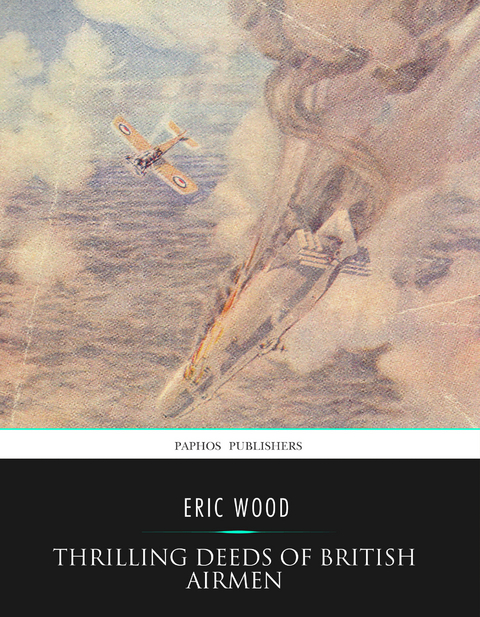
Thrilling Deeds of British Airmen (eBook)
214 Seiten
Charles River Editors (Verlag)
978-1-5080-8561-4 (ISBN)
Paphos Publishers offers a wide catalog of rare classic titles, published for a new generation. Thrilling Deeds of British Airmen is a history of the British during World War I.
THE SPOTTERS
IN THE CHANGED CONDITIONS OF modern warfare airmen have become the eyes of the army. Starting from their bases, aviators wing their way over the enemy’s lines and observe every passing thing that comes within their vision, so that generals, sitting at headquarters, know exactly to where enemy reinforcements have gone, how many trains of munitions have been sent to certain places, where batteries are placed, and a thousand things that the brains of an army must be cognizant of. Trenches dug overnight are noted the next morning and inscribed upon the large-scale maps which are used as bases for the plans of operations. In fact, little that happens escapes notice—if the flying corps of an army has won command of the air.
In yet another sense are airmen the eyes of an army. During a bombardment observers, hovering over the field of battle, note the effect of artillery fire, obtain the range and wireless it back to the batteries; then, when the guns have hurled forth their bolts of destruction, they observe whether the range is accurate, and, if not, signal back instant correction. So the work goes on—and always under intense fire from anti-aircraft guns, for the enemy knows how vital to the batteries hidden away back behind the front lines is the ‘spotting’ of the aerial onlookers. It is work to try the strongest nerves, for the aeroplane is continually dodging like some giant dragon-fly, in the effort to avoid screaming shells, bursting shrapnel, or some enemy machine that has been sent up to put an end to the work of observation. Quick calculations have to be made, and made accurately, otherwise shells, each costing hundreds of pounds, may be flung across No Man’s Land only to tear up vacant fields. Failure to explode in some vital place will cost many valuable lives when the infantry advance.
The following stories illustrate the peril and the glory involved in the work of ‘spotting’ on active service.
It naturally follows that when aeroplanes are on artillery observation service, enemy planes, as we have indicated, endeavor to bring them down or else to drive them away, and such efforts lead to aerial combats. During a battle on July 6, 1915, one of our ‘spotting’ machines was strenuously attacked by German aviators, after it had been found hopeless to try to drive it away by gun-fire. In those days the ‘spotters’ had to be fighters too, because aerial tactics had not developed into such a fine art as it, is today, when the observing machines are protected by fighting planes which fly much higher to keep a look-out for and to attack any enemy machines which may attempt to engage the ‘spotters.’
The British artillery was doing good work, thanks to the information from the officers flying in the British machine. These were the pilot, Second-Lieutenant Dwight Filley, R.F.C. (Special Reserve), and Lieutenant Lambert Playfair (1st Royal Scots and R.F.C.), who was acting as observer. Their ‘spotting’ had resulted in so many direct hits that, the hostile anti-aircraft guns having proved ineffectual, a number of German fighting machines were sent up to attack them. As one by one they rose to the attack the gallant pilot of the British machine, with a word through the speaking-tube to his observer, made a drive which brought him alongside or above the enemy, and a fair supply of ammunition for the machine-gun being to hand, it was expended to such good purpose that one after another the Germans were compelled to retire. In the breathing spaces between the different combats Filley would drop back into position favourable for observation, and Playfair would resume his interrupted work of taking notes and sending back news to the battery.
The work in hand was important enough to call for all the attention of the two officers, but so far as they themselves were concerned, they did not seem to mind the interruptions. Down below, however, the Germans were becoming greatly exasperated, and finally some officer, having apparently made up his mind that the British aeroplane must be brought down or driven off if the position were to be tenable much longer, sent up a couple of aeroplanes simultaneously, with instructions to attack together.
One can, in imagination, hear one of the British airmen shouting through the speaking-tube: “Now for it!” or see the other passing to his companion a slip of paper with a few words scribbled upon it telling him to get ready for the scrap, with the added titbit: “There are only five rounds left!”
A final message was sent back to the battery, and then, while a shell from one of the guns crashed on to the spot indicated, Filley, without waiting for the Germans to attack him, swooped toward them in order to get in the first shots. It was a right royal battle while it lasted, but, unfortunately, it did not last very long. The British were badly outmatched, being short of ammunition and having two enemies to fight. Filley, however, maneuvered his machine so skillfully, and Playfair worked his gun so cleverly, that, but for an unlucky bullet from one of the German machines, they might have come off with flying colors. That bullet, however, put an end to Filley’s hopes, for Lieutenant Playfair was killed in the very act of firing his gun.
Practiced as he was in the ways of engines, Lieutenant Filley, after recovering from the shock he had suffered at seeing his comrade killed, realized that his engine had been damaged by some of the spraying bullets from the German gun. He was helpless for attack now that his companion was dead, and his one idea henceforth was to save his machine. To stay where he was would mean being shot down by the Germans, in which case the aeroplane would be captured and he himself made prisoner, even if he were not killed.
The true soldier knows when it is time to leave the scene of battle, and Filley realized that his duty was to get back as quickly as possible. The enemy, thinking that they now had him, closed in upon him, but the Lieutenant swung round, and, with his engine making weird noises, as though it resented being driven while so severely mauled, made for the British lines. Presently the Germans came within range of the British anti-aircraft guns, whereupon they promptly turned tail, leaving Filley to go on his way unmolested to a graceful landing which he soon was able to make.
For his courageous part in this brilliant combat Lieutenant Filley was awarded the Military Cross.
The same coveted decoration was awarded to Lieutenant W. R. Freeman (Manchester Regiment and R.F.C.) for his “gallantry, ability, and very valuable work,” about the same time and in somewhat similar circumstances. Hidden German batteries had been making things decidedly uncomfortable in a certain part of the British line, and the Lieutenant was detailed to reconnoiter their position. Despite continual attempts to bring him down, the Lieutenant held on his way over the German lines until he succeeded in ‘spotting’ the guns. His machine was fitted with wireless transmitting apparatus, and he proceeded to send back the results of his observations, until at last the British artillery got the range to a nicety.
Hovering over the German lines Lieutenant Freeman had some exciting moments. All about him shells were bursting and rifle bullets came thick and fast. German aeroplanes were not absent either, but for five solid hours the aviator stuck to the task allotted to him, and, although his propeller and his planes were damaged by bullets, he refused to be driven off until he considered that his work was done. Only then did he make for his base, no doubt highly pleased with what he had achieved.
Another ‘spotter,’ Second-Lieutenant A. A. Benjamin Thomson (Royal Warwicks and R.F.C.), earned the Military Cross at Neuve-Chapelle in 1915. Hewas working in conjuction with a heavy gun, well behind the front line, was bombarding the German trenches. On August 29th the rain was coming down in torrents and the clouds were at 500 feet only, which naturally involved flying observation work, at a height which was distinctly uncomfortable from several points of view. In some way, perhaps, the clouds may have proved friendly, for when the German fire became too hot for safety, the Lieutenant could dart above a cloud bank and remain sheltered—to come through at a different spot and so compel the enemy to readjust sights and go to the trouble of getting the new range; all of which meant that the observer was given time to make his notes and send messages to the big gun, which, owing to his excellent work, was registering direct hits in quick succession.
Once, however, the clouds nearly brought disaster. Even we who grovel on terra firma will understand that it can be no easy matter to keep one’s bearings in mid-air when, owing to a driving rain, one can scarcely see the ground below, and when one gets tucked away among thick clouds it is easy to overshoot the mark. This is what Lieutenant Thomson did. He had got in among clouds which hid everything from his sight, and when he finally came down out of them, he found himself well over the German trenches. He was quickly espied by the enemy, and a very tornado of fire instantly enveloped him. Lieutenant Thomson, however, favoured by the gods who guard the brave, lived through the storm and succeeded in driving his machine back toward our lines, over which he calmly hovered, continuing his observations, with the result that, in the course of a couple of hours, the British heavy gun tossed no fewer than ten big shells plump on to the required...
| Erscheint lt. Verlag | 22.3.2018 |
|---|---|
| Sprache | englisch |
| Themenwelt | Sachbuch/Ratgeber ► Geschichte / Politik ► Allgemeines / Lexika |
| Geschichte ► Allgemeine Geschichte ► Neuzeit (bis 1918) | |
| Geschichte ► Allgemeine Geschichte ► 1918 bis 1945 | |
| Schlagworte | Air Force • Free • RAF • World War I |
| ISBN-10 | 1-5080-8561-7 / 1508085617 |
| ISBN-13 | 978-1-5080-8561-4 / 9781508085614 |
| Informationen gemäß Produktsicherheitsverordnung (GPSR) | |
| Haben Sie eine Frage zum Produkt? |
 EPUB (Adobe DRM)
Größe: 959 KB
Kopierschutz: Adobe-DRM
Adobe-DRM ist ein Kopierschutz, der das eBook vor Mißbrauch schützen soll. Dabei wird das eBook bereits beim Download auf Ihre persönliche Adobe-ID autorisiert. Lesen können Sie das eBook dann nur auf den Geräten, welche ebenfalls auf Ihre Adobe-ID registriert sind.
Details zum Adobe-DRM
Dateiformat: EPUB (Electronic Publication)
EPUB ist ein offener Standard für eBooks und eignet sich besonders zur Darstellung von Belletristik und Sachbüchern. Der Fließtext wird dynamisch an die Display- und Schriftgröße angepasst. Auch für mobile Lesegeräte ist EPUB daher gut geeignet.
Systemvoraussetzungen:
PC/Mac: Mit einem PC oder Mac können Sie dieses eBook lesen. Sie benötigen eine
eReader: Dieses eBook kann mit (fast) allen eBook-Readern gelesen werden. Mit dem amazon-Kindle ist es aber nicht kompatibel.
Smartphone/Tablet: Egal ob Apple oder Android, dieses eBook können Sie lesen. Sie benötigen eine
Geräteliste und zusätzliche Hinweise
Buying eBooks from abroad
For tax law reasons we can sell eBooks just within Germany and Switzerland. Regrettably we cannot fulfill eBook-orders from other countries.
EPUB (Ohne DRM)Digital Rights Management: ohne DRM
Dieses eBook enthält kein DRM oder Kopierschutz. Eine Weitergabe an Dritte ist jedoch rechtlich nicht zulässig, weil Sie beim Kauf nur die Rechte an der persönlichen Nutzung erwerben.
Dateiformat: EPUB (Electronic Publication)
EPUB ist ein offener Standard für eBooks und eignet sich besonders zur Darstellung von Belletristik und Sachbüchern. Der Fließtext wird dynamisch an die Display- und Schriftgröße angepasst. Auch für mobile Lesegeräte ist EPUB daher gut geeignet.
Systemvoraussetzungen:
PC/Mac: Mit einem PC oder Mac können Sie dieses eBook lesen. Sie benötigen dafür die kostenlose Software Adobe Digital Editions.
eReader: Dieses eBook kann mit (fast) allen eBook-Readern gelesen werden. Mit dem amazon-Kindle ist es aber nicht kompatibel.
Smartphone/Tablet: Egal ob Apple oder Android, dieses eBook können Sie lesen. Sie benötigen dafür eine kostenlose App.
Geräteliste und zusätzliche Hinweise
Buying eBooks from abroad
For tax law reasons we can sell eBooks just within Germany and Switzerland. Regrettably we cannot fulfill eBook-orders from other countries.
aus dem Bereich