


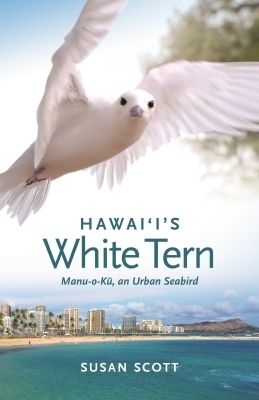
Hawai'i's White Tern
Manu-o-Kū, an Urban Seabird
Seiten
2018
University of Hawai'i Press (Verlag)
978-0-8248-7802-3 (ISBN)
University of Hawai'i Press (Verlag)
978-0-8248-7802-3 (ISBN)
- Lieferbar (Termin unbekannt)
- Portofrei ab CHF 40
- Auch auf Rechnung
- Artikel merken
White Terns are a common sight in Honolulu, and these photogenic birds are gaining in popularity as their range increases. In bringing together data about White Terns, marine biologist Susan Scott has crafted a reliable, informative resource filled with remarkable photographs for anyone curious about Manu-o-Ku, Honolulu's official bird.
White Terns are native throughout the world’s tropics and subtropics, where they breed almost exclusively on remote islands that are free of predators like cats, dogs, rats, and mongooses. Historically, this was also true in Hawai‘i, but in 1961 a pair of White Terns laid an egg and raised a chick near Hanauma Bay. Since then their numbers in the city of Honolulu have steadily increased, and in 2007 the White Tern, also known by its Hawaiian name, Manu-o-Ku, was designated the official bird of the City and County of Honolulu.
Other native seabirds nest on O‘ahu and its nearby islands, but the graceful White Tern is the only species known to lay its eggs in the city’s nonnative trees, on window ledges, and on other man-made structures, making Honolulu unique among world cities. People who live in apartment buildings and work in office towers can watch parents brooding eggs and feeding chicks. An energetic fishing bird, the Manu-o-Ku can fly far from land in its search for fish and squid. Sailors on traditional voyaging canoes keep a close eye on them: as the sun starts to go down, the birds head home, effectively providing the bearing of nearby islands.
Today, White Terns are a common sight in Honolulu, from downtown parks to Nu‘uanu and Manoa valleys to bustling Waikiki, and the photogenic birds are gaining in popularity as their range increases. In bringing together data about White Terns from here and abroad, marine biologist Susan Scott has crafted a reliable, informative resource filled with remarkable photographs for anyone curious about Manu-o-Ku, Honolulu’s official bird.
White Terns are native throughout the world’s tropics and subtropics, where they breed almost exclusively on remote islands that are free of predators like cats, dogs, rats, and mongooses. Historically, this was also true in Hawai‘i, but in 1961 a pair of White Terns laid an egg and raised a chick near Hanauma Bay. Since then their numbers in the city of Honolulu have steadily increased, and in 2007 the White Tern, also known by its Hawaiian name, Manu-o-Ku, was designated the official bird of the City and County of Honolulu.
Other native seabirds nest on O‘ahu and its nearby islands, but the graceful White Tern is the only species known to lay its eggs in the city’s nonnative trees, on window ledges, and on other man-made structures, making Honolulu unique among world cities. People who live in apartment buildings and work in office towers can watch parents brooding eggs and feeding chicks. An energetic fishing bird, the Manu-o-Ku can fly far from land in its search for fish and squid. Sailors on traditional voyaging canoes keep a close eye on them: as the sun starts to go down, the birds head home, effectively providing the bearing of nearby islands.
Today, White Terns are a common sight in Honolulu, from downtown parks to Nu‘uanu and Manoa valleys to bustling Waikiki, and the photogenic birds are gaining in popularity as their range increases. In bringing together data about White Terns from here and abroad, marine biologist Susan Scott has crafted a reliable, informative resource filled with remarkable photographs for anyone curious about Manu-o-Ku, Honolulu’s official bird.
A former registered nurse, Susan Scott earned a bachelor’s degree in biology from the University of Hawai‘i in 1985 and is a graduate of the university’s Marine Option Program, where she specialized in marine science journalism. Since 1987, Susan has written the weekly “Ocean Watch” column for the Honolulu Star-Advertiser and since 1989 worked as a volunteer for the U.S. Fish and Wildlife Service. This is her ninth book about nature in Hawai‘i.
| Erscheinungsdatum | 14.11.2018 |
|---|---|
| Zusatzinfo | 79 colour illustrations |
| Verlagsort | Honolulu, HI |
| Sprache | englisch |
| Maße | 139 x 213 mm |
| Gewicht | 200 g |
| Themenwelt | Sachbuch/Ratgeber ► Natur / Technik ► Natur / Ökologie |
| Sachbuch/Ratgeber ► Natur / Technik ► Naturführer | |
| Naturwissenschaften ► Biologie ► Zoologie | |
| ISBN-10 | 0-8248-7802-7 / 0824878027 |
| ISBN-13 | 978-0-8248-7802-3 / 9780824878023 |
| Zustand | Neuware |
| Informationen gemäß Produktsicherheitsverordnung (GPSR) | |
| Haben Sie eine Frage zum Produkt? |
Mehr entdecken
aus dem Bereich



aus dem Bereich
die Geschichte einer außergewöhnlichen Begegnung
Buch | Hardcover (2025)
Klett-Cotta (Verlag)
CHF 34,90
eine Geschichte der letzten 500 Jahre
Buch | Hardcover (2025)
C.H.Beck (Verlag)
CHF 47,60
die Corona-Protokolle des Robert-Koch-Instituts
Buch | Softcover (2025)
massel Verlag
CHF 31,95


