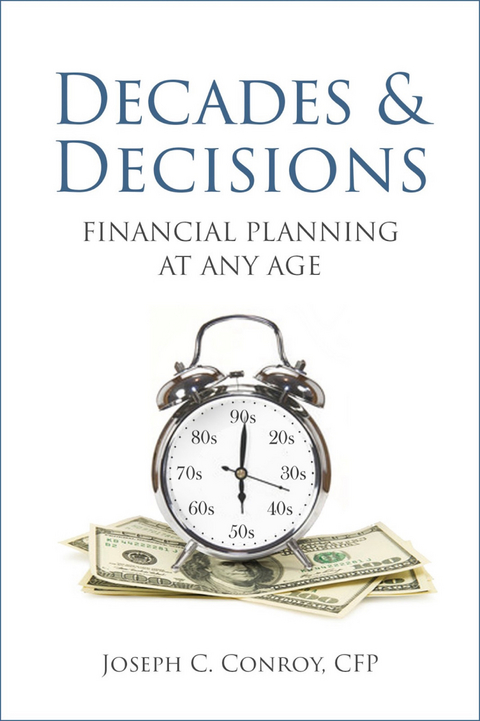
Decades & Decisions: Financial Planning At Any Age (eBook)
220 Seiten
Bookbaby (Verlag)
978-1-5439-3651-3 (ISBN)
Most books offering financial planning advice focus on specific issues. Joseph C. Conroy's book takes a different, more useful approach. Each chapter focuses on a different decade of an investor's life, highlighting the important financial-planning decisions that are most likely to occur during those years. For instance, the chapter on The Early 50s addresses these issues creating a budget that helps you pay for your child or children's college; understanding the implications of 401(k)/retirement plan loans; and facing career realities. In addition, Joe explains his Buckets strategy, which he has used with hundreds of investors to help them better prepare for their retirement. This new approach helps investors better evaluate where they are in their financial planning life and how best to use their resources to build toward retirement and other key financial milestones. Joe colors practical, actionable financial advice with stories about clients who have faced the same issues he is writing about, giving readers not just a checklist of good financial advice, but sound reasoning behind such actions. As a result, readers of this book are more likely to understand the why's and how's of financial planning better.
Your 20s
Goals for this decade:
- Network like you are looking for a job, always.
- Find a job that fits you best.
- Build a workable budget that is easy to maintain.
- Begin saving and investing.
- Start your get out of debt plan.
Whether you are in your 20s or someone who takes pride in reading this book from front to back, each chapter has important information. For the over 20s group, this chapter may elicit a lot of should haves and could haves. No problem. We live and we learn.
For you readers in your 20s, sections here may sound like what your parents or others have been telling you. Perhaps you have overlooked that the frequency of these messages may be a sign that they are worth more consideration. The old saying is that wisdom is lost on youth.
But let me give you one more reason to read on: I wish I had paid attention to these ideas when I was in my 20s. I also hear from clients all the time that they wish they had done these things in their 20s.
No second chances
So if the following information sounds like an older person telling you what to do, consider these the words of an older person who wishes he could go back and take more of this advice.
You are probably eager and excited to take on the world. You are ready to grab life by the horns and make your mark. You are going to make a difference.
If you’re like many people in your 20s, however, you may have underwhelming job prospects, possibly serious, or even crippling school debt, and no clue how personal finances work.
Now is the time to get a handle on all three. The sooner you understand and acknowledge these realities, the sooner you can start the journey to building wealth.
Graduation is only the beginning
I am going to gear this section to people who have graduated from college because they often face the biggest struggles. The information contained in this chapter can apply to anyone in his or her 20s. Perhaps you couldn’t afford college and you have a job. No problem: this information can still help you.
Perhaps going to college is in your future. This information may color that choice and better prepare you to address the realities of that decision, whenever you choose it.
We will go through the major financial topics I find people struggle with in their 20s. Finding the right job, learning how to maintain a budget and starting to save your money are among the most important things you can do to help improve your future financial situation.
Priming the pump
At this stage of your financial life, the questions are not usually about how to invest your millions. Rather the questions are how to get started on the path to accumulate millions.
This decade in people’s financial life will have the largest impact on the future trajectory of their financial situation. Knowing what to do and why to do it may pay handsomely down the road.
You can wait until you are older and play catch up later in life or take the easy path by starting early. Starting earlier can make it easier to create a successful financial future.
So let’s get started.
Network and find a job
Assuming you graduated from college, which more and more people in their 20s are doing, it’s time to find a job. Whether you are a Liberal Arts major or earn a degree in Engineering, finding a job can be challenging in today’s economy. Actually, this reality is true in any economy.
Let me tell you the story about a client of mine. John graduated from a college with a Business Management degree. After graduation he went to work on updating his resume and perusing jobs on Monster.com, Craigslist, and other popular job sites. Like most graduates, he was proud of his college accomplishments and his 3.2 GPA. He was mildly involved in extracurricular activities at his large school, which has a big alumni network.
His father, also a client, was a successful businessman who knew many other successful business women and men. With the father’s connections, you would expect he would have no trouble finding a job, right? Did John tap his father’s Rolodex? (If you really are in your 20s, ask Siri or Alexa what a Rolodex is.) No, he did not. And why not? The answer is simple and not that surprising—pride.
Looking for work
You see, John did not want to go the easy and profitable route by having his father assist in making connections and finding his place of employment. Instead, John wanted to forge his own path. His parents had always helped him do things and now John wanted to prove to everyone that he could find a good job on his own. More importantly, he needed to prove to himself that he could find a good job on his own.
John woke up every morning and hit the Internet hard. He sent out a dozen resumes a day. He received zero calls in return. “How could this be?” he asked himself. “I graduated from a big, well-known college with a practical degree and a good GPA. It must be the economy.”
This lesson is number one about finances and life in general: you don’t get bonus points for making things in your life more difficult than they need to be; you actually lose—time, energy, possibilities.
When looking for a job and jumpstarting your career, use any and all advantages available to you. The right start to a career doesn’t always lead to a prosperous future, but it sure helps.
Explore all the opportunities available to you for your career. More opportunities in your career will likely lead to more opportunities to grow your financial assets.
Using your connections
Use existing connections and form new ones to find your path to financial success.
What should John have done instead of attempting to blaze his own trail? He should have talked to every person with whom his father could connect him. He also should have talked to everyone he could have connected with outside of his father’s network—from his professors to his classmates, to guest speakers, and anyone else with whom he came in contact. He should have started a lifelong, never-ending habit of building a personal network of people.
If you get nothing else out of this chapter, this lesson can improve your life by several multiples: always network like you are looking for a job, even if you are happily employed.
Let’s have lunch
Get out and have lunch with as many professionals in as many fields as you can find. Once you do find a job, force yourself to continue this habit and maintain a large network of people who are your fans. This deep network will help you uncover opportunities and advance your personal goals, whatever they are, much more effectively and efficiently than trying to do it on your own. If it takes a village to raise a child, then it takes a city to develop you into the next big thing or medium thing or whatever you want to be.
Now you realize how important it is to talk to the people close to you—friends, parents, siblings, church acquaintances, anyone who will take your phone call, email, LinkedIn contact request or offer for coffee.
These discussions can start easily. Begin by asking for help. Everyone but a jerk is willing to help. So I guess don’t call jerks because they won’t be of help to you anyway.
The phone can be your friend
Here’s what that phone call should sound like:
“Hi, this is John. How are you (childhood neighbor who is a manager at a local business you are interested in)? As you may have heard I recently graduated from Whatever College and I was wondering if you would be available to grab coffee sometime that is convenient for you? I would love to hear about what you do and any career advice you could offer me.”
You didn’t ask for a job, and you shouldn’t. What you did is ask him to sit down and talk about himself and his accomplishments for probably 15 minutes. Who wouldn’t want to give his personal highlight reel over a cup of coffee? Everyone would like to talk about himself for a while.
Listen and learn
By making this invitation, you are exceeding the effort of at least 90% of recent college graduates in meeting people and creating connections. After actively listening to this person talk about his background and what he does, you might realize that it is something you are wildly interested in and you have just gained some clarity into what you want to do for your career. More importantly, you might realize his job sounds like the worst job in the world and you wouldn’t want to waste one minute there. Either way you have gained insight to help you narrow your focus. If you were really successful, you found a way to ask for a connection with a decision maker at his company. Or maybe he will share with you the name of a friend of his who is looking for someone just like you.
Remember, these connections can lead to more opportunities. More opportunities lead to more money. I work with several multi-millionaires whose strongest skill is developing connections with people and advancing their careers.
Try to reciprocate
Before the meeting ends, ask if you can do anything to support him. You might find out about a job opportunity that’s the perfect fit for a friend or fellow graduate. You might learn he needs people to help with a charity event in a few weeks. Whatever it is, welcome it, and do it. Nothing reflects worse on a person than making a commitment and not following through. Remember, these are important friendship and networking seeds. This budding relationship could blossom into a beautiful...
| Erscheint lt. Verlag | 24.5.2018 |
|---|---|
| Sprache | englisch |
| Themenwelt | Sachbuch/Ratgeber ► Beruf / Finanzen / Recht / Wirtschaft ► Geld / Bank / Börse |
| ISBN-10 | 1-5439-3651-2 / 1543936512 |
| ISBN-13 | 978-1-5439-3651-3 / 9781543936513 |
| Informationen gemäß Produktsicherheitsverordnung (GPSR) | |
| Haben Sie eine Frage zum Produkt? |
 EPUB (Adobe DRM)
Größe: 1,5 MB
Kopierschutz: Adobe-DRM
Adobe-DRM ist ein Kopierschutz, der das eBook vor Mißbrauch schützen soll. Dabei wird das eBook bereits beim Download auf Ihre persönliche Adobe-ID autorisiert. Lesen können Sie das eBook dann nur auf den Geräten, welche ebenfalls auf Ihre Adobe-ID registriert sind.
Details zum Adobe-DRM
Dateiformat: EPUB (Electronic Publication)
EPUB ist ein offener Standard für eBooks und eignet sich besonders zur Darstellung von Belletristik und Sachbüchern. Der Fließtext wird dynamisch an die Display- und Schriftgröße angepasst. Auch für mobile Lesegeräte ist EPUB daher gut geeignet.
Systemvoraussetzungen:
PC/Mac: Mit einem PC oder Mac können Sie dieses eBook lesen. Sie benötigen eine
eReader: Dieses eBook kann mit (fast) allen eBook-Readern gelesen werden. Mit dem amazon-Kindle ist es aber nicht kompatibel.
Smartphone/Tablet: Egal ob Apple oder Android, dieses eBook können Sie lesen. Sie benötigen eine
Geräteliste und zusätzliche Hinweise
Buying eBooks from abroad
For tax law reasons we can sell eBooks just within Germany and Switzerland. Regrettably we cannot fulfill eBook-orders from other countries.
aus dem Bereich