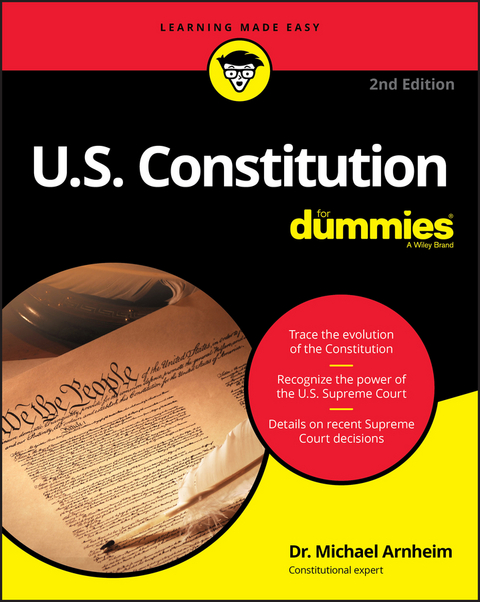
U.S. Constitution For Dummies (eBook)
John Wiley & Sons (Verlag)
978-1-119-38736-7 (ISBN)
Your complete guide to understanding the U.S. Constitution.
Want to make sense of the U.S. Constitution? This new edition walks you through this revered document, explaining how the articles and amendments came to be and how they have guided legislators, judges, and presidents-and sparked ongoing debates along the way. You'll get the lowdown on all the big issues-from separation of church and state to impeachment to civil rights-that continue to affect Americans' daily lives. Plus, you'll find out about U.S. Constitution concepts and their origins, the different approaches to interpretation, and how the document has changed over the past 200+ years.
Inside, you'll find fresh examples of Supreme Court Rulings such as same sex marriage and Healthcare Acts such as Obamacare. Explore hot topics like what it takes to be elected Commander in Chief, the functions of the House and Senate, how Supreme Court justices are appointed, and so much more.
- Trace the evolution of the Constitution
- Recognize the power of the U.S. Supreme Court
- Get details on recent Supreme Court decisions
- Find new examples of the Bill of Rights
Constitutional issues are dominating the news-and now you can join the discussion with the help of U.S. Constitution For Dummies.
As a lawyer who consults with various U.S. firms on constitutional issues and as author of a text on British constitutional law, Dr. Michael Arnheim is uniquely qualified to present an unbiased view of the U.S. Constitution, what it says, what it means, and how it's been interpreted in a variety of situations.
As a lawyer who consults with various U.S. firms on constitutional issues and as author of a text on British constitutional law, Dr. Michael Arnheim is uniquely qualified to present an unbiased view of the U.S. Constitution, what it says, what it means, and how it's been interpreted in a variety of situations.
Introduction 1
Part 1: Getting Started with the U.S Constitution 5
Chapter 1: Identifying the Main Principles and Controversies of the Constitution 7
Chapter 2: Probing Underlying Concepts: Big Thinkers, Big Thoughts 17
Chapter 3: Untangling Some Confusion and Ambiguities 31
Chapter 4: Catching a Bird's-Eye View of the Constitution 43
Chapter 5: Changing the Constitution by Amendment and Interpretation 53
Part 2: We the People: How the United States Is Governed 65
Chapter 6: Scrutinizing Sovereignty: Who Rules America? 67
Chapter 7: Defining Federalism 79
Chapter 8: Separation of Powers: Checking and Balancing 89
Chapter 9: Doing Business: The Commerce Clause 107
Part 3: Assessing the Three Engines of Government: The President, Congress, and the Judiciary 117
Chapter 10: Examining the Role of the President 119
Chapter 11: Giving Everyone a Voice: The House of Representatives and the Senate 143
Chapter 12: "Saying What the Law Is": The Judicial System 163
Chapter 13: You're Fired! Investigating the Impeachment Process 181
Part 4: Guaranteeing Important Rights: The Bill of Rights 195
Chapter 14: The First Amendment: Freedom of Religion, Speech, and Assembly 197
Chapter 15: The Second Amendment: Bearing Arms 211
Chapter 16: The Third and Fourth Amendments: Protecting Citizens from Government Forces 223
Chapter 17: Taking the Fifth -- and a Bit of the Fourteenth 239
Chapter 18: Regulating Crime and Punishment: The Sixth through Eighth Amendments 257
Chapter 19: Analyzing an "Inkblot" and a "Truism": The Ninth and Tenth Amendments 275
Part 5: Addressing Liberties and Modifying the Government: More Amendments 287
Chapter 20: States' Rights, Elections, and Slavery: The Eleventh through Thirteenth Amendments 289
Chapter 21: The Fourteenth Amendment: Ensuring Equal Protection 303
Chapter 22: Starts, Stops, and Clarifications: Amendments since 1870 319
Part 6: The Part of Tens 337
Chapter 23: Ten Landmark Constitutional Cases 339
Chapter 24: Ten Influential Supreme Court Justices 353
Chapter 25: Two Sides of Five Constitutional Conundrums 365
Appendix: Constitution of the United States of America 379
Index 403
Chapter 1
Identifying the Main Principles and Controversies of the Constitution
IN THIS CHAPTER
Understanding what a constitution is
Finding out who created the U.S. Constitution, and why
Breaking down the Constitution’s chief tenets
Introducing some constitutional problems
Most of the stuff written about the Constitution is boring and hard to understand. But it doesn’t have to be. And frankly, it shouldn’t be, because the Constitution is pretty important — yes, important to you in your daily life.
In this book, I do my best to explain the Constitution in simple language. And in this chapter, I offer a broad introduction to the Constitution: what it is, who created it, the principles it does and doesn’t discuss, and the areas of controversy that keep it in the headlines even today.
Defining “Constitution”
First, what exactly is a constitution? Okay, here goes. A constitution is a sort of super-law that regulates the way a country or state is run. How helpful is that as a definition? Not very? So let’s be more specific, and this time let’s focus specifically on the Constitution of the United States.
The U.S. Constitution is the supreme law of the nation controlling the following main features (plus a few more):
- The functions and powers of the different branches of the government: the President, the Congress, and the courts
- The way in which the President and the Congress are elected and how federal judges are appointed
- The way government officials — including the President and the judges — can be fired
- The relationship between the federal government and the states
- Your rights as a citizen or inhabitant of the United States
The word “constitution” can mean either the physical paper document or constitutional law as defined by the U.S. Supreme Court, which includes a number of features that don’t actually appear in the document, such as the rights to privacy, abortion, and gay marriage. These additional features are mainly a product of the so-called “living constitution” approach to the Constitution (as a document), which believes that the Constitution needs to be constantly reinterpreted to take account of changes in prevailing social, political, and moral values. On the other hand, strict constructionists, textualists, and originalists interpret the Constitution (as a document) sticking closely to the perceived original meaning of the words in question. I discuss the different approaches to constitutional interpretation in Chapter 3.
Knowing When and Why the Constitution Was Created
The Constitution emerged from a meeting called the Philadelphia Convention, which took place in 1787. (That meeting has since come to be known also as the Constitutional Convention.) The Convention was held because the Articles of Confederation — the document that had been serving as the country’s first governing constitution — were considered to be weak and problematic (see Chapter 2). The stated goal of the Convention was to revise the Articles of Confederation, but the outcome was much more than a mere revision: It was a new form of government. See Figure 1-1 for a look at a scene from the Convention.
Source: Howard Chandler — The Indian Reporter
FIGURE 1-1: George Washington presiding over the Constitutional Convention, 1787.
The 55 delegates to the Philadelphia Convention came to be known as the Framers of the Constitution. They represented 12 of the 13 states (Rhode Island didn’t send a delegate), and they included some familiar names, such as George Washington, Alexander Hamilton, and James Madison.
The Convention lasted from May 25 to September 17, 1787. In the end, only 39 of the 55 delegates actually signed the Constitution. Three delegates refused to sign it, and the rest had left the Convention before the signing took place.
For the Constitution to take effect, it had to be ratified — or confirmed — by nine states. Special conventions were summoned in each state, and the Delaware, New Jersey, and Georgia conventions ratified the Constitution unanimously. But some of the other states saw a pretty fierce battle for ratification. In New York, for example, the Constitution was ratified only by 30 votes to 27.
Ratification was achieved in 1788, and the Constitution took effect with the swearing in of President George Washington and Vice President John Adams on April 30, 1789.
DISTINGUISHING THE FOUNDERS FROM THE FRAMERS
The term Founding Fathers was (probably) coined by President Warren G. Harding about 100 years ago. Founding Fathers, or simply Founders, refers to the political leaders of the struggle for American independence against Britain. It includes the American leaders in the Revolutionary War, the signatories of the Declaration of Independence, and also the Framers of the Constitution (or simply, Framers).
The Founders include George Washington, Benjamin Franklin, Alexander Hamilton, John Jay, John Adams, Thomas Jefferson, James Madison, James Monroe, Patrick Henry, and Tom Paine.
The term Founding Fathers overlaps somewhat with the term Framers of the Constitution, but the two terms are not identical in meaning. The term Founders is much broader than the term Framers because it covers all the leaders in the fight for American independence, including all the delegates to the Philadelphia Convention who drafted the Constitution. So all the Framers were Founders, but not all the Founders were Framers!
Thomas Jefferson, for example, drafted the Declaration of Independence and was one of the leading Founders of the United States. But he was not involved in the drafting of the Constitution because he was on official business in France at the time. So Jefferson was a very prominent Founder, but he was not a Framer.
Summarizing the Main Principles of the Constitution
In broad strokes, here are the principles you find in the Constitution:
- Liberty: The Framers of the Constitution aimed to establish a form of government that gave the people as much individual freedom as possible, by guaranteeing them
- Religious freedom
- Freedom of speech
- Freedom to defend themselves with arms
- Federalism: The United States started out as 13 separate British colonies, which banded together to throw off the British yoke. At first, in 1777, the colonies formed a loose alliance under the so-called Articles of Confederation (not to be confused with the similarly named Confederacy proclaimed by the seceding southern states in the 1860s). But the need for a stronger central government resulted in the drafting of the U.S. Constitution, which was ratified in its original, unamended form in 1788. The Constitution established a federal system of government, which gave the central or federal government certain clearly defined and limited powers, reserving the remaining powers to the states or to the people.
- Separation of powers: The Framers of the Constitution were very anxious to prevent any one person or institution from becoming too powerful. So the Constitution keeps the three branches of government separate. These branches are the Executive (the President), Legislative (Congress), and Judicial (the law courts). But a system of “checks and balances” cuts across this separation. So, for example, Congress passes laws, but the President can veto them. Similarly, the President has the power to appoint Cabinet officers and federal judges, but his appointments are subject to the “advice and consent” of the Senate. And the Supreme Court can check any perceived abuse of the power of Congress by striking down laws that the Court rules are unconstitutional.
- Due process: “Due process of law” is one of the main buzz phrases of the Constitution — according to the Supreme Court. You may assume that this phrase would refer simply to procedure, or how things should be done, like whether or not you are allowed a jury trial. But the Supreme Court has widened its interpretation of the phrase greatly to include substantive due process, or what rights the Constitution actually confers or protects. As a result, the Court has interpreted the Constitution as guaranteeing a bunch of controversial “fundamental rights,” including
- An expansion of the rights of those suspected or accused of crimes
- An expansion of minority rights
- Privacy
- Abortion
Here are some of the principles you may assume are addressed in the Constitution, but aren’t:
- Democracy: The words democracy and democratic don’t figure anywhere in the text of the Constitution. In its original form, the Constitution was not democratic, and the House of Representatives was the only directly elected part of the federal government. The Constitution became democratic as a result of the rise of President Andrew Jackson’s Democratic Party in the 1830s (see Chapter 6).
- Equality: Equality was also not one of the principles of the Constitution in its original form.
- Slavery formed an integral...
| Erscheint lt. Verlag | 15.5.2018 |
|---|---|
| Sprache | englisch |
| Themenwelt | Sachbuch/Ratgeber ► Geschichte / Politik ► Allgemeines / Lexika |
| Geisteswissenschaften ► Geschichte | |
| Schlagworte | about the constitution • Bill of rights • Civil Rights • civil rights book</p> • civil rights guide • Constitution • Constitutional Amendments • constitutional law • constitutional rights • constitution book • constitution guide • Constitution History • Constitution of the United States • First Amendment • Geschichte • History • <p>U.S. Constitution • Second Amendment • The Constitution • The Constitution of the United States • United States • Unites States Constitution • U.S. • USA • US Constitution • Verfassung • what are my constitutional rights • what is the constitution |
| ISBN-10 | 1-119-38736-1 / 1119387361 |
| ISBN-13 | 978-1-119-38736-7 / 9781119387367 |
| Informationen gemäß Produktsicherheitsverordnung (GPSR) | |
| Haben Sie eine Frage zum Produkt? |
 EPUB (Adobe DRM)
Kopierschutz: Adobe-DRM
Adobe-DRM ist ein Kopierschutz, der das eBook vor Mißbrauch schützen soll. Dabei wird das eBook bereits beim Download auf Ihre persönliche Adobe-ID autorisiert. Lesen können Sie das eBook dann nur auf den Geräten, welche ebenfalls auf Ihre Adobe-ID registriert sind.
Details zum Adobe-DRM
Dateiformat: EPUB (Electronic Publication)
EPUB ist ein offener Standard für eBooks und eignet sich besonders zur Darstellung von Belletristik und Sachbüchern. Der Fließtext wird dynamisch an die Display- und Schriftgröße angepasst. Auch für mobile Lesegeräte ist EPUB daher gut geeignet.
Systemvoraussetzungen:
PC/Mac: Mit einem PC oder Mac können Sie dieses eBook lesen. Sie benötigen eine
eReader: Dieses eBook kann mit (fast) allen eBook-Readern gelesen werden. Mit dem amazon-Kindle ist es aber nicht kompatibel.
Smartphone/Tablet: Egal ob Apple oder Android, dieses eBook können Sie lesen. Sie benötigen eine
Geräteliste und zusätzliche Hinweise
Buying eBooks from abroad
For tax law reasons we can sell eBooks just within Germany and Switzerland. Regrettably we cannot fulfill eBook-orders from other countries.
aus dem Bereich