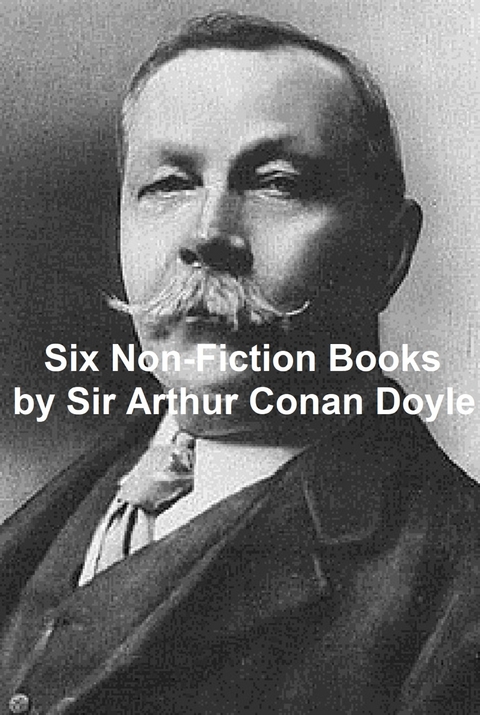
Six Non-Fiction Books (eBook)
1380 Seiten
Seltzer Books (Verlag)
978-1-4553-9157-8 (ISBN)
This book-collection file includes six books. Three are on war -- The Great Boer War, The War in South Africa, and A Visit to Three Fronts, June 1916. Two are on Spiritualism -- The New Revelation and The Vital Message. And one on Medicine -- Round the Red Lamp: Facts and Fancies of the Medical Life. According to Wikipedia: 'Sir Arthur Ignatius Conan Doyle, DL (22 May 1859 - 7 July 1930) was an author most noted for his stories about the detective Sherlock Holmes, which are generally considered a major innovation in the field of crime fiction, and for the adventures of Professor Challenger. He was a prolific writer whose other works include science fiction stories, historical novels, plays and romances, poetry, and non-fiction.'
This book-collection file includes six books. Three are on war -- The Great Boer War, The War in South Africa, and A Visit to Three Fronts, June 1916. Two are on Spiritualism -- The New Revelation and The Vital Message. And one on Medicine -- Round the Red Lamp: Facts and Fancies of the Medical Life. According to Wikipedia: "e;Sir Arthur Ignatius Conan Doyle, DL (22 May 1859 - 7 July 1930) was an author most noted for his stories about the detective Sherlock Holmes, which are generally considered a major innovation in the field of crime fiction, and for the adventures of Professor Challenger. He was a prolific writer whose other works include science fiction stories, historical novels, plays and romances, poetry, and non-fiction."e;
CHAPTER VII THE BATTLE OF LADYSMITH
Sir George White had now reunited his force, and found himself in command of a formidable little army some twelve thousand in number. His cavalry included the 5th Lancers, the 5th Dragoons, part of the 18th and the whole of the 19th Hussars, the Natal Carabineers, the Border Rifles, some mounted infantry, and the Imperial Light Horse. Among his infantry were the Royal Irish Fusiliers, the Dublin Fusiliers, and the King's Royal Rifles, fresh from the ascent of Talana Hill, the Gordons, the Manchesters, and the Devons who had been blooded at Elandslaagte, the Leicesters, the Liverpools, the 2nd battalion of the King's Royal Rifles, the 2nd Rifle Brigade, and the Gloucesters, who had been so roughly treated at Rietfontein. He bad six batteries of excellent field artillery -- the 13th, 21st, 42nd, 53rd, 67th, 69th, and No.10 Mountain Battery of screw guns. No general could have asked for a more compact and workmanlike little force.
It had been recognised by the British General from the beginning that his tactics must be defensive, since he was largely outnumbered and since also any considerable mishap to his force would expose the whole colony of Natal to destruction. The actions of Elandslaagte and Rietfontein were forced upon him in order to disengage his compromised detachment, but now there was no longer any reason why he should assume the offensive. He knew that away out on the Atlantic a trail of transports which already extended from the Channel to Cape de Verde were hourly drawing nearer to him with the army corps from England. In a fortnight or less the first of them would be at Durban. It was his game, therefore, to keep his army intact, and to let those throbbing engines and whirling propellers do the work of the empire. Had he entrenched himself up to his nose and waited, it would have paid him best in the end.
But so tame and inglorious a policy is impossible to a fighting soldier. He could not with his splendid force permit himself to be shut in without an action. What policy demands honour may forbid. On October 27th there were already Boers and rumours of Boers on every side of him. Joubert with his main body was moving across from Dundee. The Freestaters were to the north and west. Their combined numbers were uncertain, but at least it was already proved that they were far more numerous and also more formidable than had been anticipated. We had had a taste of their artillery also, and the pleasant delusion that it would be a mere useless encumbrance to a Boer force had vanished for ever. It was a grave thing to leave the town in order to give battle, for the mobile enemy might swing round and seize it behind us. Nevertheless White determined to make the venture.
On the 29th the enemy were visibly converging upon the town. From a high hill within rifleshot of the houses a watcher could see no fewer than six Boer camps to the east and north. French, with his cavalry, pushed out feelers, and coasted along the edge of the advancing host. His report warned White that if he would strike before all the scattered bands were united he must do so at once. The wounded were sent down to Pietermaritzburg, and it would bear explanation why the non-combatants did not accompany them. On the evening of the same day Joubert in person was said to be only six miles off, and a party of his men cut the water supply of the town. The Klip, however, a fair-sized river, runs through Ladysmith, so that there was no danger of thirst. The British had inflated and sent up a balloon, to the amazement of the back-veldt Boers; its report confirmed the fact that the enemy was in force in front of and around them.
On the night of the 29th General White detached two of his best regiments, the Irish Fusiliers and the Gloucesters, with No.10 Mountain Battery, to advance under cover of the darkness and to seize and hold a long ridge called Nicholson's Nek, which lay about six miles to the north of Ladysmith. Having determined to give battle on the next day, his object was to protect his left wing against those Freestaters who were still moving from the north and west, and also to keep a pass open by which his cavalry might pursue the Boer fugitives in case of a British victory. This small detached column numbered about a thousand men -- whose fate will be afterwards narrated.
At five o'clock on the morning of the 30th the Boers, who had already developed a perfect genius for hauling heavy cannon up the most difficult heights, opened fire from one of the hills which lie to the north of the town. Before the shot was fired, the forces of the British had already streamed out of Ladysmith to test the strength of the invaders.
White's army was divided into three columns. On the extreme left, quite isolated from the others, was the small Nicholson's Nek detachment under the command of Colonel Carleton of the Fusiliers (one of three gallant brothers each of whom commands a British regiment). With him was Major Adye of the staff. On the right British flank Colonel Grimwood commanded a brigade composed of the 1st and 2nd battalions of the King's Royal Rifles, the Leicesters, the Liverpools, and the Royal Dublin Fusiliers. In the centre Colonel Ian Hamilton commanded the Devons, the Gordons, the Manchesters, and the 2nd battalion of the Rifle Brigade, which marched direct into the battle from the train which had brought them from Durban. Six batteries of artillery were massed in the centre under Colonel Downing. French with the cavalry and mounted infantry was on the extreme right, but found little opportunity for the use of the mounted arm that day.
The Boer position, so far as it could be seen, was a formidable one. Their centre lay upon one of the spurs of Signal Hill, about three miles from the town. Here they had two forty-pounders and three other lighter guns, but their artillery strength developed both in numbers and in weight of metal as the day wore on. Of their dispositions little could be seen. An observer looking westward might discern with his glass sprays of mounted riflemen galloping here and there over the downs, and possibly small groups where the gunners stood by their guns, or the leaders gazed down at that town which they were destined to have in view for such a weary while. On the dun-coloured plains before the town, the long thin lines, with an occasional shifting sparkle of steel, showed where Hamilton's and Grimwood's infantry were advancing. In the clear cold air of an African morning every detail could be seen, down to the distant smoke of a train toiling up the heavy grades which lead from Frere over the Colenso Bridge to Ladysmith.
The scrambling, inconsequential, unsatisfactory action which ensued is as difficult to describe as it must have been to direct. The Boer front covered some seven or eight miles, with kopjes, like chains of fortresses, between. They formed a huge semicircle of which our advance was the chord, and they were able from this position to pour in a converging artillery fire which grew steadily hotter as the day advanced. In the early part of the day our forty-two guns, working furiously, though with a want of accuracy which may be due to those errors of refraction which are said to be common in the limpid air of the veldt, preserved their superiority. There appears to have been a want of concentration about our fire, and at some periods of the action each particular battery was firing at some different point of the Boer half-circle. Sometimes for an hour on end the Boer reply would die away altogether, only to break out with augmented violence, and with an accuracy which increased our respect for their training. Huge shells -- the largest that ever burst upon a battlefield -- hurled from distances which were unattainable by our fifteen-pounders, enveloped our batteries in smoke and flame. One enormous Creusot gun on Pepworth Hill threw a 96-pound shell a distance of four miles, and several 40-pound howitzers outweighted our field guns. And on the same day on which we were so roughly taught how large the guns were which labour and good will could haul on to the field of battle, we learned also that our enemy -- to the disgrace of our Board of Ordnance be it recorded -- was more in touch with modern invention than we were, and could show us not only the largest, but also the smallest, shell which had yet been used. Would that it had been our officials instead of our gunners who heard the devilish little one-pound shells of the Vickers-Maxim automatic gun, exploding with a continuous string of crackings and bangings, like a huge cracker, in their faces and about their ears!
Up to seven o'clock our infantry had shown no disposition to press the attack, for with so huge a position in front of them, and so many hills which were held by the enemy, it was difficult to know what line of advance should be taken, or whether the attack should not be converted into a mere reconnaissance. Shortly after that hour, however, the Boers decided the question by themselves developing a vigorous movement upon Grimwood and the right flank. With field guns, Maxims, and rifle fire, they closed rapidly in upon him. The centre column was drafted off, regiment by regiment, to reinforce the right. The Gordons, Devons, Manchesters, and three batteries were sent over to Grimwood's relief, and the 5th Lancers, acting as infantry, assisted him to hold on.
At nine o'clock there was a lull, but it was evident that fresh commandoes and fresh guns were...
| Erscheint lt. Verlag | 1.3.2018 |
|---|---|
| Sprache | englisch |
| Themenwelt | Sachbuch/Ratgeber ► Geschichte / Politik ► Allgemeines / Lexika |
| Geschichte ► Teilgebiete der Geschichte ► Militärgeschichte | |
| ISBN-10 | 1-4553-9157-3 / 1455391573 |
| ISBN-13 | 978-1-4553-9157-8 / 9781455391578 |
| Informationen gemäß Produktsicherheitsverordnung (GPSR) | |
| Haben Sie eine Frage zum Produkt? |
 EPUB (Adobe DRM)
Größe: 1,4 MB
Kopierschutz: Adobe-DRM
Adobe-DRM ist ein Kopierschutz, der das eBook vor Mißbrauch schützen soll. Dabei wird das eBook bereits beim Download auf Ihre persönliche Adobe-ID autorisiert. Lesen können Sie das eBook dann nur auf den Geräten, welche ebenfalls auf Ihre Adobe-ID registriert sind.
Details zum Adobe-DRM
Dateiformat: EPUB (Electronic Publication)
EPUB ist ein offener Standard für eBooks und eignet sich besonders zur Darstellung von Belletristik und Sachbüchern. Der Fließtext wird dynamisch an die Display- und Schriftgröße angepasst. Auch für mobile Lesegeräte ist EPUB daher gut geeignet.
Systemvoraussetzungen:
PC/Mac: Mit einem PC oder Mac können Sie dieses eBook lesen. Sie benötigen eine
eReader: Dieses eBook kann mit (fast) allen eBook-Readern gelesen werden. Mit dem amazon-Kindle ist es aber nicht kompatibel.
Smartphone/Tablet: Egal ob Apple oder Android, dieses eBook können Sie lesen. Sie benötigen eine
Geräteliste und zusätzliche Hinweise
Buying eBooks from abroad
For tax law reasons we can sell eBooks just within Germany and Switzerland. Regrettably we cannot fulfill eBook-orders from other countries.
EPUB (Ohne DRM)Digital Rights Management: ohne DRM
Dieses eBook enthält kein DRM oder Kopierschutz. Eine Weitergabe an Dritte ist jedoch rechtlich nicht zulässig, weil Sie beim Kauf nur die Rechte an der persönlichen Nutzung erwerben.
Dateiformat: EPUB (Electronic Publication)
EPUB ist ein offener Standard für eBooks und eignet sich besonders zur Darstellung von Belletristik und Sachbüchern. Der Fließtext wird dynamisch an die Display- und Schriftgröße angepasst. Auch für mobile Lesegeräte ist EPUB daher gut geeignet.
Systemvoraussetzungen:
PC/Mac: Mit einem PC oder Mac können Sie dieses eBook lesen. Sie benötigen dafür die kostenlose Software Adobe Digital Editions.
eReader: Dieses eBook kann mit (fast) allen eBook-Readern gelesen werden. Mit dem amazon-Kindle ist es aber nicht kompatibel.
Smartphone/Tablet: Egal ob Apple oder Android, dieses eBook können Sie lesen. Sie benötigen dafür eine kostenlose App.
Geräteliste und zusätzliche Hinweise
Buying eBooks from abroad
For tax law reasons we can sell eBooks just within Germany and Switzerland. Regrettably we cannot fulfill eBook-orders from other countries.
aus dem Bereich