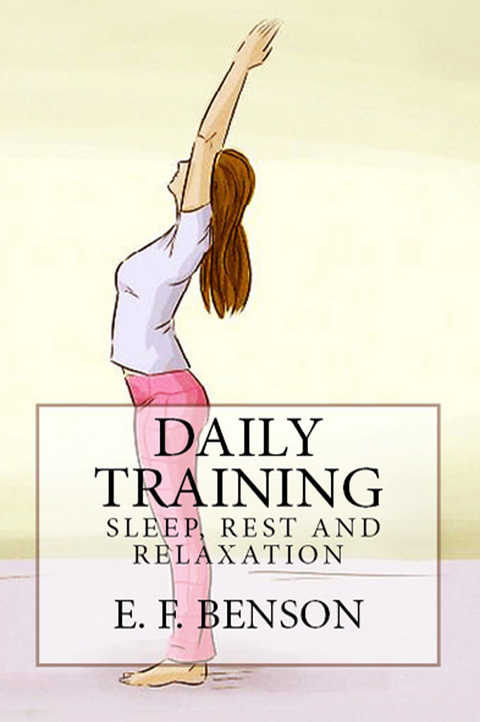
Daily Training (eBook)
125 Seiten
Cheapest Books (Verlag)
978-605-2259-75-7 (ISBN)
The following pages contain certain rules and suggestions concerning health, and certain simple and sensible ways in which it may, we hope, be acquired and maintained at a very small expense of time and self-denial, by a large number of people who are naturally accustomed to feel not very well. The book is founded on notes made by its two authors who, though they lead for the most part very different lives, are agreed on certain broad principles of health herein set forth.
One of them, for instance, eats largely of flesh-foods every day, the other has scarcely touched meat for years. But both are accustomed to feel extremely well and to undertake considerable exertion either of mind or body without experiencing any fatigue. One of them takes regular exercise, that is to say he plays an out-door game on most days of his life, while the other who abstains from flesh-foods has little practice of the sort. He will take no out-of-door exercise for several days, work very hard, and find himself perfectly fit for some severe physical test at the end. But they are both agreed that if the one abandoned flesh-foods (which he does not propose to do) he would cease to require regular exercise, and that if the other took flesh-foods (which he does not propose to do) he would not only be very ill, but would also require regular exercise.
One again is seldom seen without some appliance of tobacco in his mouth, because he finds it agreeable and after an experiment of abstinence from it found that it did not make any difference, as far as he could make out, in his general health. The other never smokes at all. One again takes a cold bath in the morning, the other a hot one followed by cold sponging.
But both are absolutely in accord on far more main points than those on which their practice, at any rate, differs, and they have found it perfectly easy to write this book together without wrangling, on which account they wish to express a pious hope that the very fact that they differ in so many things may have saved them from dogmatism. For it has helped them to realize that even when they are agreed on any point it would be a sheer stupidity to hint that they were therefore right, and in consequence they only put forward the points on which they are agreed as suggestions, hoping that others after trial may also agree with them.
For universal laws on an empirical matter like health are rare, and the constitutions of men are various. One man's meat, in fact, is literally another man's poison. But in the main the two authors are agreed. They believe that the majority of mankind habitually eat too much and habitually take too much stimulating food and drink. They believe also that most people who do so do not take enough exercise, and that either an increase of exercise or a decrease of stimulant is needed.
They believe that the best sorts of exercise are not those of slow pushing movements such as are made in the use of dumb-bells, but full brisk extended movements, with much use of the breathing apparatus and the large muscle areas of the body. Similarly they are in accord as regards present systems of training which tend to treat an entire crew or team as if they were identical specimens, not as widely different specimens; in every day life also they hold that because a certain mode of diet and work suits A, it will not necessarily suit B and C, though B and C might do worse than try it.
The following pages contain certain rules and suggestions concerning health, and certain simple and sensible ways in which it may, we hope, be acquired and maintained at a very small expense of time and self-denial, by a large number of people who are naturally accustomed to feel not very well. The book is founded on notes made by its two authors who, though they lead for the most part very different lives, are agreed on certain broad principles of health herein set forth. One of them, for instance, eats largely of flesh-foods every day, the other has scarcely touched meat for years. But both are accustomed to feel extremely well and to undertake considerable exertion either of mind or body without experiencing any fatigue. One of them takes regular exercise, that is to say he plays an out-door game on most days of his life, while the other who abstains from flesh-foods has little practice of the sort. He will take no out-of-door exercise for several days, work very hard, and find himself perfectly fit for some severe physical test at the end. But they are both agreed that if the one abandoned flesh-foods (which he does not propose to do) he would cease to require regular exercise, and that if the other took flesh-foods (which he does not propose to do) he would not only be very ill, but would also require regular exercise. One again is seldom seen without some appliance of tobacco in his mouth, because he finds it agreeable and after an experiment of abstinence from it found that it did not make any difference, as far as he could make out, in his general health. The other never smokes at all. One again takes a cold bath in the morning, the other a hot one followed by cold sponging. But both are absolutely in accord on far more main points than those on which their practice, at any rate, differs, and they have found it perfectly easy to write this book together without wrangling, on which account they wish to express a pious hope that the very fact that they differ in so many things may have saved them from dogmatism. For it has helped them to realize that even when they are agreed on any point it would be a sheer stupidity to hint that they were therefore right, and in consequence they only put forward the points on which they are agreed as suggestions, hoping that others after trial may also agree with them. For universal laws on an empirical matter like health are rare, and the constitutions of men are various. One man's meat, in fact, is literally another man's poison. But in the main the two authors are agreed. They believe that the majority of mankind habitually eat too much and habitually take too much stimulating food and drink. They believe also that most people who do so do not take enough exercise, and that either an increase of exercise or a decrease of stimulant is needed. They believe that the best sorts of exercise are not those of slow pushing movements such as are made in the use of dumb-bells, but full brisk extended movements, with much use of the breathing apparatus and the large muscle areas of the body. Similarly they are in accord as regards present systems of training which tend to treat an entire crew or team as if they were identical specimens, not as widely different specimens; in every day life also they hold that because a certain mode of diet and work suits A, it will not necessarily suit B and C, though B and C might do worse than try it.
CHAPTER II. FALLACIES AND DEFECTS IN PRESENT SYSTEMS OF TRAINING.
Without for the moment taking into consideration those millions of London who stifle in crowded slums, on insufficient or unsuitable food, and many of whom have inherited from birth some taint of constitution, and concerning ourselves for the moment only with those within whose reach, broadly speaking, are all the expedients known for insuring health, we should find it curious and probably depressing to ascertain, if we could, what proportion felt well, given they had no definite cause of ill-health which it was out of their power to remove. Many would put down their comparatively lower level of health while living in London to the fact that they were working hard. This, if true, is a sad and sobering reflection, since it would seem to imply that Nature had not designed the average healthy individual to work hard; and though it is probably infinitely better that people should work hard, and feel slightly below par all the time, than that they should devote their whole time to keeping well, yet it would be unsatisfactory if we were forced to believe that continued hard work cannot be compatible with continued good health. Many again would say that they never feel well without exercise, and that it is impossible to get exercise in London. That they can get sufficient exercise anywhere, with a very small expense of time, we hope to show in a later chapter; but, in the meantime, have such tried deliberately and unswervingly to eat far less than they feel inclined, or to use some sort of definite selection in the matter of what they eat? Others again would (quite rightly) put down their slight but chronic indisposition to an absence of air; such perhaps do not know what an immensely increased supply of air everyone can get by always keeping bedroom windows wide open.
Now to many such the idea of using training as a means of merely keeping well is probably novel. They are accustomed to feel slightly unwell—that perhaps is too strong a term—when they are in a town and at work, and having always felt thus have acquiesced in what we may call a vicious habit. But they have always understood training to mean a régime of fixed exercise (founded on beefsteaks), which is as impossible for them as it would also be unsuitable for them; or, in a modified form, twenty minutes or half an hour with dumb-bells every morning and evening. Many have probably tried dumb-bells; some, no doubt, reap considerable benefit from their use, but not a few, and both the present writers are among them, after giving them a good trial, loathe the sight of them. And numbers, in such a case, have abandoned themselves, with more or less content, to continuing to feel slightly below par, and praying for the holidays.
Now the use of dumb-bells and developers is becoming something of a fetish, of a cherished idol, and, backed as it is by well-known names, is a formidable-looking god to throw stones at. But there seem to the present writers to be many grave objections to such systems as are constantly followed, whether they are used by athletes or by the much larger class of those who merely wish to get exercise from them. The primâ facie objection in the case of both is their extreme monotony. It is necessary apparently to raise the arms slowly in turn (bending the elbow till the dumb-bell is level with the shoulder) upwards of a hundred times or more: it is necessary to do the same again with the backs of the hands out, to extend the arms from the shoulder outwards, from the shoulder upwards, to bend the wrists to and fro (still with these infernal implements grasped in the hands), to make motions as if drawing water first on one side and then on the other, to hit out, with the weight in the hands, at an imaginary foe; in fact to push, raise, or pull this weight in practically every direction that it will go, a vast number of times. “Developers” have, as a rule, the same defects; the movements are slow, and a continued effort against permanent resistance, while the greater part of the exercise which they give is not for the greater muscles. Then follow—we are intentionally vague, and wish to show only the general lines of many systems—exercises for the muscles of the stomach and of the legs. For the breathing muscles of the chest, there are also exercises which not being concerned for the most part with these dead-weights we have found generally excellent. The masters of such systems also, as a rule, advocate practising in front of a looking-glass, stripped as far as may be, in order to observe the play of the muscles. This also is admirable advice.
Now it will be noticed at once with regard to these exercises that by far the majority of them are for the arms, and that even when, as in certain of them, the object is to develop the breathing muscles, the hands still hold the dumb-bells. In other words, something like three-quarters of the ordinary dumb-bell exercises, as advised and practised, are exercises in which the stress of the movements lies on muscles of the wrist and fore-arm, biceps, triceps, and deltoid (the shoulder muscle). What is the result if the instructions are conscientiously observed? That the muscles of the arms get developed ludicrously out of proportion to the rest of the body, for no purpose as far as we can see except that of lifting and holding weights. The far larger and more important thigh muscles and calf muscles, the great muscles of the trunk and chest, have perhaps in some of these systems no more work to do, when added together, than the muscles of the arm alone. For certain games it is of course necessary to have considerable power in the arm, yet (even for games) it is of far more importance to have the larger muscles adequately developed. But granted (with certain important reservations to be stated hereafter) that such exercises are good for certain games, we contend that they are, if not harmful, at any rate most ill-adapted for the proper development of the whole body, and for supplying exercise to those who need it, particularly in town life, for the sake of health. Certain muscles, those of the shoulder and arm, are exercised out of all proportion, whereas the larger body muscles, those in fact which are particularly needed for the correct and healthful carriage of the body, so as to provide the heart and the organs of breathing and digestion with free room to work in, are left comparatively neglected. Indeed, as far as health goes, it would be probably better for the man who has to sit at a desk for six or seven hours a day to sit upright only, and take no exercise at all, than to go religiously through his course before coming to his office, and then do his work in the cramped and huddled position which is natural to many people. But, and this is an even more serious charge, some exercises recommended in certain systems, pursued no doubt by people who for years have been in search of strength, advocate exercises which are positively risky, with regard to strain on certain parts of the body, exercises in fact which might tend to increase the strength of a strong man, but would be almost dangerous for a less strongly-developed one. Again, and this objection applies to athletes even more than to the ordinary man in search of health by means of daily exercise, are not these slow movements of dumb-bells and slow steady resistance against india-rubber productive of quite the wrong sort of strength? No doubt the incessant raising of a dumb-bell above the head, a heavy pushing stroke, will tend to enable the pusher to raise greater and greater weights above the head, but does the ordinary man, does the athlete himself desire to get strength of that kind? For the ordinary man, in the first place, does the development of fore-arm, biceps, or triceps tend in any way to increase his health, except inasmuch as the exertion thus put forth certainly enlarges some few muscles and tends to produce action of the skin by reason of heat? As far as muscular development goes he would do far better to exercise the larger muscle-areas, and for the other, a Turkish bath will give him the equivalent of a week’s exercising. The fallacy that lies at the bottom of this dumb-bell and “developer” work, in fact, is that large and prominent muscles imply not only strength but health. That the use of muscles tends to both is undeniable, but for purposes of health the muscles employed are mainly the unimportant ones, while for purposes of strength, valuable chiefly to those who wish to employ muscles with a view to excellence in athletics, the strength obtained is wholly the wrong sort of strength.
It is here that the dumb-bell and developer system goes utterly and hopelessly astray. Used as an adjunct, it will assist a weak muscle to arrive at a certain girth and bulk, but considered as a cause of any successful stroke at a game, it is much more an enemy than a friend. For at all games, with a possible exception perhaps in the case of rowing, as far as strength comes into the question, it comes in as a motor-power to produce speed, whereas dumb-bell exercises have for their object, as a whole, the slow pushing of gradually increased weights. A modicum of strength is of course necessary to propel anything anywhere, but the main thing, the thing to be acquired, is speed in the muscle, in order to impart velocity to the object. And the muscles of those whose sole training is dumb-bell exercise are admirably unfitted to impart it. The weights they can lift are no doubt prodigious, but we doubt whether any man reared entirely on dumb-bells (and the more he had of that diet, the better for our point) could hit a ball over the...
| Erscheint lt. Verlag | 24.11.2024 |
|---|---|
| Sprache | englisch |
| Themenwelt | Sachbuch/Ratgeber ► Beruf / Finanzen / Recht / Wirtschaft ► Bewerbung / Karriere |
| Sachbuch/Ratgeber ► Gesundheit / Leben / Psychologie ► Entspannung / Meditation / Yoga | |
| Sachbuch/Ratgeber ► Gesundheit / Leben / Psychologie ► Lebenshilfe / Lebensführung | |
| Sachbuch/Ratgeber ► Sport ► Fitness / Aerobic / Bodybuilding | |
| Schlagworte | Daily Meditation • Daily Training • E. F. Benson • self-help books • Success in Life |
| ISBN-10 | 605-2259-75-2 / 6052259752 |
| ISBN-13 | 978-605-2259-75-7 / 9786052259757 |
| Informationen gemäß Produktsicherheitsverordnung (GPSR) | |
| Haben Sie eine Frage zum Produkt? |
 EPUB (Ohne DRM)
Digital Rights Management: ohne DRM
Dieses eBook enthält kein DRM oder Kopierschutz. Eine Weitergabe an Dritte ist jedoch rechtlich nicht zulässig, weil Sie beim Kauf nur die Rechte an der persönlichen Nutzung erwerben.
Dateiformat: EPUB (Electronic Publication)
EPUB ist ein offener Standard für eBooks und eignet sich besonders zur Darstellung von Belletristik und Sachbüchern. Der Fließtext wird dynamisch an die Display- und Schriftgröße angepasst. Auch für mobile Lesegeräte ist EPUB daher gut geeignet.
Systemvoraussetzungen:
PC/Mac: Mit einem PC oder Mac können Sie dieses eBook lesen. Sie benötigen dafür die kostenlose Software Adobe Digital Editions.
eReader: Dieses eBook kann mit (fast) allen eBook-Readern gelesen werden. Mit dem amazon-Kindle ist es aber nicht kompatibel.
Smartphone/Tablet: Egal ob Apple oder Android, dieses eBook können Sie lesen. Sie benötigen dafür eine kostenlose App.
Geräteliste und zusätzliche Hinweise
Buying eBooks from abroad
For tax law reasons we can sell eBooks just within Germany and Switzerland. Regrettably we cannot fulfill eBook-orders from other countries.
aus dem Bereich