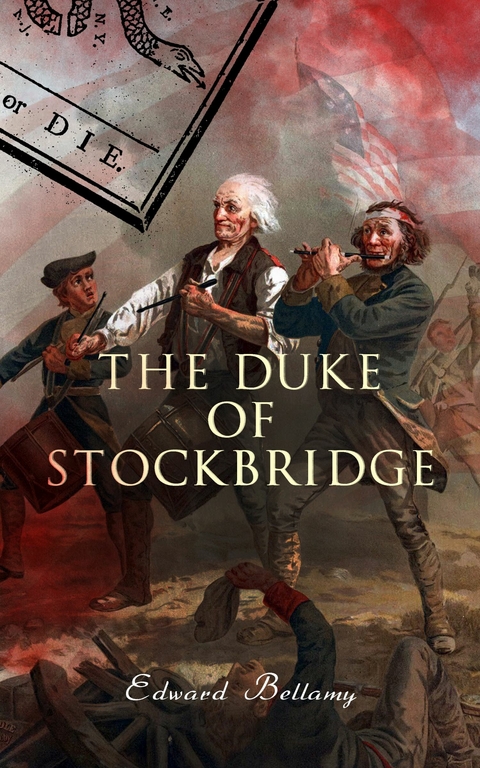
The Duke of Stockbridge (eBook)
277 Seiten
e-artnow (Verlag)
978-80-268-9314-1 (ISBN)
Edward Bellamy (1850-1898) was an American author and socialist, most famous for his utopian novel, Looking Backward, a tale set in the distant future of the year 2000. Bellamy's vision of a harmonious future world inspired the formation of at least 165 'Nationalist Clubs' dedicated to the propagation of Bellamy's political ideas and working to make them a practical reality.
Edward Bellamy (1850-1898) was an American author and socialist, most famous for his utopian novel, Looking Backward, a tale set in the distant future of the year 2000. Bellamy's vision of a harmonious future world inspired the formation of at least 165 "Nationalist Clubs" dedicated to the propagation of Bellamy's political ideas and working to make them a practical reality.
Chapter Second.
Nine Years After
Early one evening in the very last of August, 1786, only three years after the close of the Revolutionary war, a dozen or twenty men and boys, farmers and laborers, are gathered, according to custom, in the big barroom of Stockbridge tavern. The great open fireplace of course shows no cheery blaze of logs at this season, and the only light is the dim and yellow illumination diffused by two or three homemade tallow candles stuck about the bar, which runs along half of one side of the apartment. The dim glimmer of some pewter mugs standing on a shelf behind the bar is the only spot of reflected light in the room, whose time-stained, unpainted woodwork, dingy plastering, and low ceiling, thrown into shadows by the rude and massive crossbeams, seems capable of swallowing up without a sign ten times the illumination actually provided. The faces of four or five men, standing near the bar, or lounging on it, are quite plainly visible, and the forms of half a dozen more who are seated on a long settle placed against the opposite wall, are more dimly to be seen, while in the back part of the room, leaning against the posts or walls, or lounging in the open doorway, a dozen or more figures loom indistinctly out of the darkness.
The tavern, it must be remembered, as a convivial resort, is the social antipodes of the back room of Squire Edwards' "store." If you would consort with silk-stockinged, wigged, and silver shoe-buckled gentlemen, you must just step over there, for at the tavern are only to be found the hewers of wood and drawers of water, mechanics, farm-laborers, and farmers. Ezra Phelps and Israel Goodrich, the former the owner of the new gristmill at "Mill Hollow," a mile west of the village, the other a substantial farmer, with their corduroy coats and knee-breeches, blue woolen hose and steel shoe buckles, are the most socially considerable and respectably attired persons present.
Perhaps about half the men and boys are barefooted, according to the economical custom of a time when shoes in summer are regarded as luxuries not necessities. The costume of most is limited to shirt and trousers, the material for which their own hands or those of their women-folk have sheared, spun, woven and dyed. Some of the better dressed wear trousers of blue and white striped stuff, of the kind now-a-days exclusively used for bed-ticking. The leathern breeches which a few years before were universal are still worn by a few in spite of their discomfort in summer.
Behind the bar sits Widow Bingham, the landlady, a buxom, middle-aged woman, whose sharp black eyes have lost none of their snap, whether she is entertaining a customer with a little pleasant gossip, or exploring the murky recesses of the room about the door, where she well knows sundry old customers are lurking, made cowards of by consciousness of long unsettled scores upon her slate. And whenever she looks with special fixity into the darkness there is soon a scuttling of somebody out of doors.
She pays little or no attention to the conversation of the men around the bar. Being largely political, it might be expected to have the less interest for one of the domestic sex, and moreover it is the same old story she has been obliged to hear over and over every evening, with little variation, for a year or two past.
For in those days, throughout Massachusetts, at home, at the tavern, in the field, on the road, in the street, as they rose up, and as they sat down, men talked of nothing but the hard times, the limited markets, and low prices for farm produce, the extortions and multiplying numbers of the lawyers and sheriffs, the oppressions of creditors, the enormous, grinding taxes, the last sheriff's sale, and who would be sold out next, the last batch of debtors taken to jail, and who would go next, the utter dearth of money of any sort, the impossibility of getting work, the gloomy and hopeless prospect for the coming winter, and in general the wretched failure of the triumph and independence of the colonies to bring about the public and private prosperity so confidently expected.
The air of the room is thick with smoke, for most of the men are smoking clay or corncob pipes, but the smoke is scarcely recognizable as that of tobacco, so largely is that expensive weed mixed with dried sweet-fern and other herbs, for the sake of economy. Of the score or two persons present, only two, Israel Goodrich and Ezra Phelps, are actually drinking anything. Not certainly that they are the only ones disposed to drink, as the thirsty looks that follow the mugs to their lips, sufficiently testify, but because they alone have credit at the bar. Ezra furnishes Mrs. Bingham with meal from his mill, and drinks against the credit thus created, while Israel furnishes the landlady with potatoes on the same understanding. There being practically almost no money in circulation, most kinds of trade are dependent on such arrangements of barter. Meshech Little, the carpenter, who lies dead-drunk on the floor, his clothing covered with the sand, which it has gathered up while he was being unceremoniously rolled out of the way, is a victim of one of these arrangements, having just taken his pay in rum for a little job of tinkering about the tavern.
"Meshech hain't hed a steady job sence the new meetin-haouse wuz done las' year, an I s'pose the critter feels kinder diskerridged like," said Abner Rathbun, regarding the prostrate figure sympathetically. Abner has grown an inch and broadened proportionally, since Squire Woodbridge made him file leader of the minute men by virtue of his six feet three, and as he stands with his back to the bar, resting his elbows on it, the room would not be high enough for his head, but that he stands between the cross-beams.
"I s'pose Meshech's fam'ly 'll hev to go ontew the taown," observed Israel Goodrich. "They say ez the poorhouse be twicet ez full ez't orter be, naow."
"It'll hev more intew it fore 't hez less," said Abner grimly.
"Got no work, Abner? I hearn ye wuz up Lenox way a lookin fer suthin to dew," inquired Peleg Bidwell, a lank, loose-jointed farmer, who was leaning against a post in the middle of the room, just on the edge of the circle of candlelight.
"A feller ez goes arter work goes on a fool's errant," responded Abner, dejectedly. "There ain' no work nowhar, an a feller might jess ez well sit down to hum an wait till the sheriff comes arter him."
"The only work as pays now-a-days is pickin the bones o' the people. Why don't ye turn lawyer or depity sheriff, an take to that, Abner?" said Paul Hubbard, an undersized man with a dark face, and thin, sneering lips.
He had been a lieutenant in the Continental army, and used rather better language than the country folk ordinarily, which, as well as a cynical wit which agreed with the embittered popular temper, gave him considerable influence. Since the war he had been foreman of Colonel William's iron-works at West Stockbridge. There was great distress among the workmen on account of the stoppage of the works by reason of the hard times, but Hubbard, as well as most of the men, still remained in West Stockbridge, simply because there was no encouragement to go elsewhere.
"Wat I can't make aout is that the lawyers an sheriffs sh'd git so dern fat a pickin our bones, seein ez ther's sech a dern leatle meat ontew us," said Abner.
"There's as much meat on squirrels as bears if you have enough of em," replied Hubbard. "They pick clean, ye see, an take all we've got, an every little helps."
"Yas," said Abner, "they do pick darned clean, but that ain't the wust on't, fer they sends our bones tew rot in jail arter they've got all the meat orf."
"'Twas ony yesdy Iry Seymour sole out Zadkiel Poor, ez lives long side o' me, an tuk Zadkiel daown tew Barrington jail fer the res' what the sale didn't fetch," said Israel Goodrich. "Zadkiel he's been kinder ailin like fer a spell back, an his wife, she says ez haow he can't live a month daown tew the jail, an wen Iry tuk Zadkiel orf, she tuk on reel bad. I declare for't, it seemed kinder tough."
"I hearn ez they be tew new fellers a studyin law intew Squire Sedgwick's office," said Obadiah Weeks, a gawky youth of perhaps twenty, evidently anxious to buy a standing among the adult circle of talkers by contributing an item of information.
Abner groaned. "Great Crypus! More blood-suckers. Why, they be ten lawyers in Stockbridge taown a'ready, an they warn't but one wen I wuz a boy, an thar wuz more settlers 'n they be naow."
"Wal, I guess they'll git nuff to dew," said Ezra Phelps. "I hearn as haow they's seven hundred cases on the docket o' the Common Pleas, nex' week, mos' on em fer debt."
"I hearn as two hundred on em be from Stockbridge an the iron-works," added Israel. "I declare for't Zadkiel 'll hev plenty o' kumpny daown tew jail, by the time them suits be all tried."
"By gosh, what be we a comin tew?" groaned Abner. "It doos seem zif we all on us mout z'well move daown tew the jail to onc't, an hev done with 't. We're baown to come to 't fuss or las'."
Presently Peleg Bidwell said, "My sister Keziah's son, by her fuss husban's been daown tew Bosting, an I hearn say ez haow he says ez the folks daown East mos'ly all hez furniter from Lunnon, and the women wears them air Leghorn hats as cos ten shillin lawful, let alone prunelly shoes an satin stockins, an he says as there ain't a ship goes out o' Bosting harbor ez don' take more'n five thousan paound o' lawful money outer the kentry. I callate," pursued Peleg, "that's jess what's tew the bottom o' the trouble. It's all long o' the rich folks a sendin money out o' the kentry...
| Erscheint lt. Verlag | 27.4.2018 |
|---|---|
| Verlagsort | Prague |
| Sprache | englisch |
| Themenwelt | Literatur ► Historische Romane |
| Sachbuch/Ratgeber ► Geschichte / Politik ► Neuzeit bis 1918 | |
| Geisteswissenschaften ► Geschichte ► Regional- / Ländergeschichte | |
| Schlagworte | 18th-century New England • all the light we cannot see • American frontier novel • before we were yours • beneath a scarlet sky • Colonial America atmosphere • Edward Bellamy novel • Game of Thrones • historical american fiction • Ken Follett • New England historical fiction • Outlander • patriotic themes • Revolutionary War Setting • Robert Graves • Rural community dynamics • Say Goodbye for Now • Small-town tavern • The Buried Book • The Handmaid's Tale |
| ISBN-10 | 80-268-9314-X / 802689314X |
| ISBN-13 | 978-80-268-9314-1 / 9788026893141 |
| Informationen gemäß Produktsicherheitsverordnung (GPSR) | |
| Haben Sie eine Frage zum Produkt? |
 EPUB (Wasserzeichen)
DRM: Digitales Wasserzeichen
Dieses eBook enthält ein digitales Wasserzeichen und ist damit für Sie personalisiert. Bei einer missbräuchlichen Weitergabe des eBooks an Dritte ist eine Rückverfolgung an die Quelle möglich.
Dateiformat: EPUB (Electronic Publication)
EPUB ist ein offener Standard für eBooks und eignet sich besonders zur Darstellung von Belletristik und Sachbüchern. Der Fließtext wird dynamisch an die Display- und Schriftgröße angepasst. Auch für mobile Lesegeräte ist EPUB daher gut geeignet.
Systemvoraussetzungen:
PC/Mac: Mit einem PC oder Mac können Sie dieses eBook lesen. Sie benötigen dafür die kostenlose Software Adobe Digital Editions.
eReader: Dieses eBook kann mit (fast) allen eBook-Readern gelesen werden. Mit dem amazon-Kindle ist es aber nicht kompatibel.
Smartphone/Tablet: Egal ob Apple oder Android, dieses eBook können Sie lesen. Sie benötigen dafür eine kostenlose App.
Geräteliste und zusätzliche Hinweise
Buying eBooks from abroad
For tax law reasons we can sell eBooks just within Germany and Switzerland. Regrettably we cannot fulfill eBook-orders from other countries.
aus dem Bereich