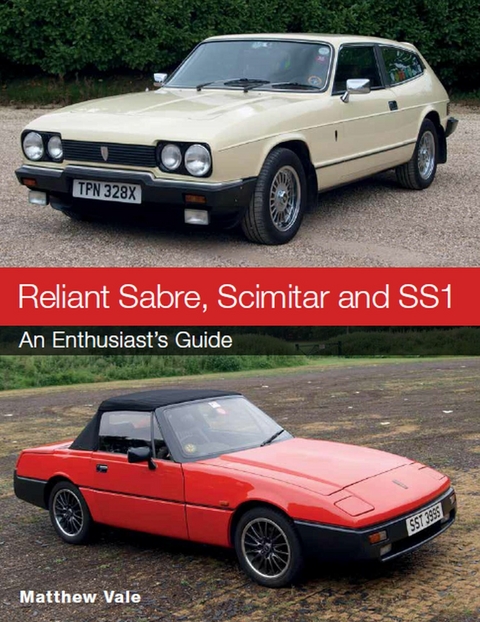
Reliant Sabre, Scimitar and SS1 (eBook)
213 Seiten
Crowood (Verlag)
978-1-78500-422-3 (ISBN)

Matthew Vale has recently retired from working in the IT industry, and has been writing books on classic cars and motorbikes since 2004. For this book he has carried out extensive research into the cars, and interviewed a range of owners to gain first-hand impressions of the cars. This is his thirteenth book for Crowood.
Reliant produced a range of sports cars from the 1960s to the 1990s which complemented their well-established three-wheeled cars. Starting with a design for Israel's Autocars in 1961, Reliant went on to produce many successful cars, including the Sabre, a raw two-seat sports car; the Scimitar GT, a solid GT car; the Scimitar GTE, a market-defining sporting estate car; and the SS1, a small two-seat sports car. Reliant Sabre, Scimitar and SS1- An Enthusiast's Guide explores the history, design and development of the Reliant sports cars. Beginning with the Autocars Sabra, the Sabre, Scimitar, Scimitar GTE and SS1 are each explored in depth. This book includes full technical specifications for every major model owner's experiences and advice for buying and owning.
CHAPTER 2
RELIANT’S FIRST SPORTS CARS:
THE AUTOCARS SABRA (1961), RELIANT SABRE FOUR (1961–1963) AND THE SABRE SIX (1962–1964)
AUTOCARS SABRA
The Sabra was Israel’s first sports car. Produced by Reliant and Autocars, it wasx aimed at the US market.
Reliant’s first sports car came into being as a result of the company’s collaboration with Autocars of Israel. After getting the Carmel and Sussita saloons into production, through the provision of knock-down kits (NDK) and production technology from Reliant, Autocars cast around for a project to produce a flagship model that would complement its existing range and spearhead an assault on the lucrative US market. In January 1960, Autocar’s Managing Director Yitzhak Shubinsky visited the Sports and Racing Car Show in London. There, he saw a chassis designed by British engineer Leslie Ballamy for either a Ford or BMC engine, as well as a proprietary glass-fibre body produced by Ashley Laminates for the Ford 90-inch (228cm) wheelbase chassis. The Ballamy chassis had a 90-inch (228cm) wheelbase, was a ladder type and featured Ballamy’s own design of leading-arm independent front suspension, a live rear axle and transverse elliptical springs front and rear. It had been designed to fit the many proprietary glass-fibre body shells that were available at the time. Shubinsky decided that the combination of the Ballamy chassis and the Ashley body should form the basis of the design for a sports car that Reliant would produce for Autocars. He bought the rights to use both the Ballamy chassis and the Ashley body shell; as part of the deal, Autocars would be supplied with body moulds from Ashley and various chassis components from Ballamy.
Design
Reliant took on the Autocars project, developing a production-ready car from the bare bones of the Ashley body and the Ballamy chassis design. This would become the Sabra. It was designed to be produced initially in NDK form, with kits being shipped to Autocars for assembly, and Autocars taking over production of the chassis and body as soon as possible. Its target market was the USA and the date set for delivery of the first models was an optimistic early 1961, when the car was due to be exhibited at the New York Motor Show in April. Reliant’s task was essentially to adapt the Ashley body to the Ballamy chassis, sort out the running gear so that it worked to an acceptable standard and was easy to produce, and deliver a complete, properly integrated vehicle from the assortment of unrelated parts that Autocars had presented. The first job was to re-engineer the Ballamy chassis and its suspension. Unfortunately, as part of the deal with Autocars, Ballamy had already supplied a large number of chassis and suspension components. As far as possible, in order to keep the budget under control, these had to be reused, which resulted in some engineering compromises. Ballamy’s chassis was a robust and substantial ladder type, with two parallel longitudinal box sections joined with box-section cross-members. However, there were other elements of the design that were more dubious.
For a start, both the front and rear suspension had to be completely re-engineered. On the original design, the front leading-arm suspension was sprung with a single transverse leaf spring; when the prototype was constructed by Reliant, it was revealed that the arc of the movement of the leading arm was significantly different from that followed by the transverse spring, resulting in the spring breaking almost immediately. Ballamy claimed that Reliant had built the prototype wrongly – it does seem rather unlikely that someone with Ballamy’s experience could have designed something so wrong – but Reliant quickly replaced the transverse spring with a combined spring and damper unit on each side. The bottom mounts of the spring and damper units were positioned on the front of the trailing arm, and their top mount positioned on a revamped upright sprouting from the front of the chassis member. Rubber bushes in the top and bottom shock-absorber mounts allowed for the slight arc of movement from the leading arm.
The prototype Sabra still exists and is owned by Tony and Jaki Heath of the RSSOC.
The Sabra and Sabre Four’s front suspension was a leading-arm set-up with coil over dampers.
At the rear, the Ballamy design had the live rear axle mounted on top of the chassis and sprung by an underslung transverse leaf spring, which also located the side-to-side orientation of the axle using spring shackles. Fore and aft axle location was catered for by a pair of parallel trailing links on each side, fixed at their front to the chassis and splaying out 15 degrees to fix above and below the axle, just inboard of the hubs. Reliant modified the arrangement to gain more positive axle location and better suspension control, while still using existing components, and the rear of the chassis was redesigned with the longitudinal members stepped up to enable the axle to fit underneath.
As on the front suspension, a combined spring and damper unit was fitted to replace the leaf spring, and the top fore and aft link on each side was reversed to run from the axle to the rear of the chassis, to give positive fore and aft location. Finally, the original chassis also had a pair of fabricated outriggers on each side to carry the body shell; these were replaced by Reliant with a single centrally mounted outrigger on each side to suit the modified Ashley body shell.
The pair of large front over-riders, designed to protect the long bonnet nose, made a distinctive feature on the Sabra.
The body moulds supplied from Ashley provided the outer shell and bulkhead, with no floor. It would have been too time-consuming and expensive to redesign the complete body shell to produce a set of mouldings that could be bonded together to give a one-piece item, so the Reliant design used marine plywood panels for the floorpan. These were then bonded to the outer body shell. With the body and chassis sorted and the two parts integrated, the Ford Consul 4-cylinder 1703cc engine was retained but was mated to a four-speed ZF manual gearbox, which drove Reliant’s own live rear axle.
The original intent of the project was for Reliant to productionize the design, then for Autocars to start to produce the cars in Israel. However, in order to achieve the twin targets of appearing at the 1961 New York Motor Show and getting cars to Autocars’ US dealers in time, the first 100 complete cars were produced by Reliant and then exported directly from the UK to the USA. Production of left-hand-drive cars began in Israel later in 1961, and continued in small numbers through to 1968, when a total of approximately 171 cars were completed.
With the cars being built at Tamworth, Reliant decided that production for the UK market was feasible. Two right-hand-drive units – numbers 92 and 93 – were duly built and then displayed, as Sabres rather than Sabras, on the Reliant stand at the October 1961 Earls Court Motor Show. The cars were then road-registered in the UK (as 7946 WD and 7947 WD) and used as press cars, featuring in a number of road tests and assessments in the UK motoring press.
Chassis Design and Development
Although the Ballamy-designed chassis was extensively reworked by Reliant, it retained the overall ladder-frame layout, with its two box-section longitudinal main rails joined by cross-members and the leading-arm front suspension. At the front, the main rails terminated in a pair of uprights to support the suspension mounts, and carried a smaller rectangular front extension, while at the rear the two main rails swept up to pass over the top of the axle and were attached to a lighter rear extension that carried the rear of the body and the fuel tank. The main box-section rails were 5.5 inches (14cm) deep and 2.5 inches (6.35cm) wide, and were constructed from 16-gauge sheet steel. There were two square box-section transverse cross-members in the middle of the chassis, which tied the main rails together. One was below the gearbox tail and the second was positioned where the main rails swept up to go over the axle, with a cut-out to clear the propellor shaft, and three smaller members to form and reinforce the rear box section. At the front of the chassis, forwards of the engine, the main rails were braced with a low mounted tubular cross-member. At the front of each main rail above the tubular cross-member, there was a fabricated upright that carried the top mount of the combined spring and damper unit. A pair of tubular cross-members joined and braced the middle and top of the uprights, and each upright also sported a steel box-section forward extension, which carried the radiator mount halfway along its length. At their forward end, the extensions were joined with another tubular cross-member, and carried the bracketry for the bonnet hinge. As the engine was set well back in the chassis, an open-backed fabricated box was welded to the two upright tubular cross-members to carry a Wilmot Breedon electric cooling fan.
The Sabra evolved into Reliant’s Sabre – this is Chris Gallacher’s Sabre Six.
The chassis of the Sabra and the Sabre was a solid affair. The engine was sited behind the front axle line and the leading-arm front suspension was probably unique.
At the rear of the chassis, the main rails were terminated just after the second large cross-member with steel box-section uprights, angled backwards at about 15 degrees to the vertical. This raised the height of the chassis rear to allow the axle to sit below it. An ‘L’-section steel plate acted as a cross-member between the tops of the uprights,...
| Erscheint lt. Verlag | 21.5.2018 |
|---|---|
| Verlagsort | London |
| Sprache | englisch |
| Themenwelt | Natur / Technik ► Fahrzeuge / Flugzeuge / Schiffe ► Allgemeines / Lexika |
| Natur / Technik ► Fahrzeuge / Flugzeuge / Schiffe ► Auto / Motorrad | |
| Geisteswissenschaften ► Geschichte | |
| Geisteswissenschaften ► Psychologie | |
| Schlagworte | Essex V6 • Middlebridge • Reliant Robin • Robin • RSSOC • three-wheeler |
| ISBN-10 | 1-78500-422-0 / 1785004220 |
| ISBN-13 | 978-1-78500-422-3 / 9781785004223 |
| Informationen gemäß Produktsicherheitsverordnung (GPSR) | |
| Haben Sie eine Frage zum Produkt? |
 EPUB (Adobe DRM)
Kopierschutz: Adobe-DRM
Adobe-DRM ist ein Kopierschutz, der das eBook vor Mißbrauch schützen soll. Dabei wird das eBook bereits beim Download auf Ihre persönliche Adobe-ID autorisiert. Lesen können Sie das eBook dann nur auf den Geräten, welche ebenfalls auf Ihre Adobe-ID registriert sind.
Details zum Adobe-DRM
Dateiformat: EPUB (Electronic Publication)
EPUB ist ein offener Standard für eBooks und eignet sich besonders zur Darstellung von Belletristik und Sachbüchern. Der Fließtext wird dynamisch an die Display- und Schriftgröße angepasst. Auch für mobile Lesegeräte ist EPUB daher gut geeignet.
Systemvoraussetzungen:
PC/Mac: Mit einem PC oder Mac können Sie dieses eBook lesen. Sie benötigen eine
eReader: Dieses eBook kann mit (fast) allen eBook-Readern gelesen werden. Mit dem amazon-Kindle ist es aber nicht kompatibel.
Smartphone/Tablet: Egal ob Apple oder Android, dieses eBook können Sie lesen. Sie benötigen eine
Geräteliste und zusätzliche Hinweise
Buying eBooks from abroad
For tax law reasons we can sell eBooks just within Germany and Switzerland. Regrettably we cannot fulfill eBook-orders from other countries.
aus dem Bereich