Mineral Nutrition History (eBook)
100 Seiten
First Edition Design Publishing (Verlag)
978-1-5069-0459-7 (ISBN)
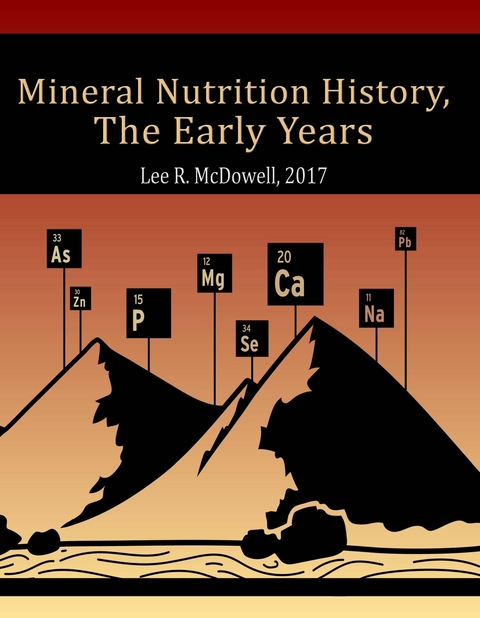
Seven minerals have been known since antiquity, some going back since 6000 B.C. Many years passed before the concept of essential nutrients developed. It was more of a trial and error method that various peoples gradually learned that certain diseases were associated in some way with diet and that specific foods were helpful in their treatments. It was not until the last half of the 19th century there was a realization that food was made up of classes of nutrients, which included an ill-defined supply of inorganic salts. Mineral Nutrition, The Early Years, contains 16 chapters of historical information related to deficiency and toxicity of mineral elements. The first chapter is an introduction dealing with historical considerations, classification, distribution, developing the science of nutrition, general mineral functions, methods of analyses, requirements, bioavailability, status detection and incidence of mineral deficiencies and toxicities. Chapters 2 through 13 emphasize historical discovery and development of 14 elements but also includes information on chemical properties, functions, sources and deficiencies and toxicities in humans and animals. Chapters 14 and 15 deal with history of the minerals more commonly associated with a toxicity (fluorine, arsenic, cadmium, lead, mercury, aluminum and molybdenum). Chapter 16 is history of the "e;newer trace elements"e;. Each chapter is followed by appropriate references. The chapters are illustrated with over 150 photos of mineral deficiencies and toxicities. Many of these photos are considered the classical descriptions of mineral deficiencies and toxicities for humans and animals. It is hoped that this book will be useful for teaching the importance of minerals and how discoveries were made. This publication can serve as an authoritative reference book for use by research and extension specialists, in the human, animal, poultry, and veterinary sciences fields and for feed manufacturers, teachers, students, and others. This book emphasizing history is a second publication on history of nutrients. The first book was published by the present author in 2013 and is titled Vitamin History, The Early Years.
Chapter 1
General Introduction
I. Introduction
Seven minerals have been known since antiquity, some minerals are traced back to 6000 B.C. Gold and silver were well known in ancient civilizations. Prior to regular chemists, there were alchemists. Attempts were made by alchemists to change lead, iron and other metals into gold.
All forms of living matter require inorganic elements, or minerals for their normal life processes. All animal and human tissues and all feeds contain inorganic or mineral elements in widely varying amounts and proportions. Some confusion exists in use of the terms “minerals” and “elements” in nutrition and feeding. In practical nutrition, the term “mineral” is generally used to denote all the mineral inorganic elements. However, not all the elements are minerals (i.e. carbon, hydrogen, oxygen, and nitrogen), and minerals frequently found as salts (e.g., carbonates, oxides and sulfates) can be a combination of different inorganic elements. For the purpose of this book, the terms “mineral,” “element,” and mineral element” are used interchangeably.
The mineral elements are solid, crystalline, chemical elements, which cannot be decomposed or synthesized by ordinary chemical reactions. These inorganic elements constitute the ash that remains after ignition of organic matter. The common method of determining the total mineral or inorganic content of feeds consists merely of measuring the total ash remaining after high-temperature burning of the organic matter. This analysis is of little value either for expressing mineral requirements or for indicating the useful mineral content of foods, for two basic reasons. In the first place, body requirements are specific for certain inorganic elements. Secondly, ash may not be a measure of total inorganic matter present, because some organic carbon may be bound as carbonate and some inorganic elements, such as sulfur, selenium, iodine, fluorine, and even sodium and chlorine may be lost during combustion. In practice, the most important reason for the determination of total ash in a food is to permit calculation of the nitrogen-free extract by difference, as required in the proximate analysis of foodstuffs. Also, the ash analysis can be used in forages to estimate the amount of dust and soil that has been harvested with the feed.
II. Classification of Minerals
Minerals are classified in a number of ways, with some classification schemes having a place in understanding their requirements and/or nutritional roles. Minerals that are needed in relatively large amounts are referred to as major or macrominerals. Others that are needed in very small amounts are referred to as trace minerals or microminerals. These terms do not imply any lesser role for the trace minerals. Rather, they represent quantity designations based on the amounts required in the diet and their generally low or “trace” concentrations in tissues. The major minerals are required in concentrations of greater than 100 ppm (parts per million) and often as a percentage of the diet (or g per kg), while trace elements are required at less than 100 ppm and are expressed as ppm and sometimes as ppb (parts per billion). Thirty elements are known to be required by at least some animal species (Table 1.1). Seven elements are macrominerals and 23 can be referred to as microminerals or trace elements.
The listing of some of the trace elements as essential is difficult and sometimes tentative. An essential element is one that is required to support adequate growth, reproduction, and health throughout the life cycle, when all other nutrients are optimal.
Essentiality is less certain when there is only a small change in the rate of growth, when the environment is suboptimal, or when there is a microbial infection (O’Dell and Sunde, 1997). Observed improvements in performance upon supplementation with a mineral may be due to changes in the intestinal microflora, to a pharmacologic effect, or to interactions with other elements.
The proof that each element is essential rests upon experiments with one or more species. In these experiments, clinical signs produced by diets adequate in all nutrients, except the mineral in question, have been prevented or overcome by adding that mineral to the diets. All the elements mentioned have not been tested with all species, but it is highly probably that there are few exceptions to the need for all of them by all higher animals. There is no disagreement concerning the essentiality of the trace elements chromium, cobalt, copper, iodine, iron, manganese, molybdenum, selenium, and zinc although not all would present practical nutritional supplemental problems for livestock or humans.
Whether an element is considered essential would depend on the criteria used. A viewpoint in human nutrition is that nutritional requirements should include consideration of the total health effects of nutrients, not just their roles in preventing deficiency pathology (Nielsen, 1996). Therefore, the terms “beneficial elements” and “apparent beneficial intake (ABI)” are in use. In humans, for example, the ABI for maximal benefit of fluorine relates to its proven benefits for dental health and its suggested role in maintaining bone integrity. The ABI seems more appropriate for the elements with beneficial, if not essential, actions that can be extrapolated from animals to humans; these elements include, in addition to fluorine, arsenic, lithium, nickel, silicon, and vanadium.
The more recently discovered trace elements since 1970 are referred to as “new trace elements.” These newer trace minerals are elements with an established or highly suspected requirement for one or more species, and include aluminum, arsenic, boron, bromine, fluorine, germanium, lithium, nickel, lead, rubidium, silicon, tin, and vanadium. The essentiality of these last 13 elements is based on growth and other effects with animals under highly specialized conditions, such as improved procedures for purification of diets and use of metal-free plastic isolator systems for raising animals. Furthermore, more precise and accurate methods of determining minute quantities of trace elements have been developed. Although markedly different in their chemistry, mode of action, and effective levels, the newer essential trace elements have in common the facts that they were first known for their toxic effects and that induction of a dietary deficiency is often difficult.
An additional 20 to 30 trace elements occur regularly in feeds and tissue, and it is unknown whether they serve some useful purpose or are merely incidental contaminants. It is likely using advanced methodology that some of these elements one day will be considered essential. It is also possible that some of the more tentatively established essential elements may be declared non-essential with further studies.
Eight mineral elements can also be classified as cations, including calcium, magnesium, potassium, sodium, iron, manganese, copper, and zinc. Six other elements are either anions or are usually found in anionic groupings. These are chloride (Cl⁻), iodine (I⁻), phosphate (PO4), molybdate (MoO), selenite (SeO) and sulfate SO. Likewise, they can be classified on the basis of valence number and on their group position in the periodic chart of the elements. These classifications can be useful because they describe physical and chemical attributes of importance in nutrition (Miller, 1979). For example, the monovalent cations, potassium and sodium have a very high absorption percentage and major interrelationships exist between them. In contrast, the absorption percentage of the divalent cations (calcium, magnesium and zinc) is much lower.
Numerous factors may alter the availability of the essential anions and cations. The most soluble and absorbable form of any of the elements should be the simple ionic state of the atom or ionic group of atoms (for example, as Ca⁺⁺, Mg⁺⁺, Mn⁺⁺). However, many electronegative compounds in nature are looking for a cation with which it can share its electrons, thereby forming a stable compound (Leeson and Summers, 2001). Often the resultant compound is highly insoluble in water but nevertheless dissociates to a sufficient extent in the intestinal tract to allow absorption of the essential cations. This is influenced by the gastric acidity of hydrochloric acid in the stomach, which converts the cations temporarily into chloride salts, which allows good absorption from the intestinal tract. Therefore, even manganese oxide, copper sulfide, or zinc oxide, which are highly insoluble chemical compounds, are converted to manganese chloride, copper chloride, or zinc chloride which are forms more easily absorbed.
III. Mineral Distribution in Body
It should be noted that 96% of body weight consists of the four organically bound elements (carbon, hydrogen, oxygen, and nitrogen). The principal cations and anions together account for 3.5% of body weight, the remainder comprising additional elements (Table...
| Erscheint lt. Verlag | 15.10.2017 |
|---|---|
| Sprache | englisch |
| Themenwelt | Sachbuch/Ratgeber ► Gesundheit / Leben / Psychologie ► Ernährung / Diät / Fasten |
| Medizin / Pharmazie ► Allgemeines / Lexika | |
| Medizin / Pharmazie ► Gesundheitsfachberufe ► Diätassistenz / Ernährungsberatung | |
| ISBN-10 | 1-5069-0459-9 / 1506904599 |
| ISBN-13 | 978-1-5069-0459-7 / 9781506904597 |
| Informationen gemäß Produktsicherheitsverordnung (GPSR) | |
| Haben Sie eine Frage zum Produkt? |
 EPUB (Wasserzeichen)
Größe: 3,8 MB
DRM: Digitales Wasserzeichen
Dieses eBook enthält ein digitales Wasserzeichen und ist damit für Sie personalisiert. Bei einer missbräuchlichen Weitergabe des eBooks an Dritte ist eine Rückverfolgung an die Quelle möglich.
Dateiformat: EPUB (Electronic Publication)
EPUB ist ein offener Standard für eBooks und eignet sich besonders zur Darstellung von Belletristik und Sachbüchern. Der Fließtext wird dynamisch an die Display- und Schriftgröße angepasst. Auch für mobile Lesegeräte ist EPUB daher gut geeignet.
Systemvoraussetzungen:
PC/Mac: Mit einem PC oder Mac können Sie dieses eBook lesen. Sie benötigen dafür die kostenlose Software Adobe Digital Editions.
eReader: Dieses eBook kann mit (fast) allen eBook-Readern gelesen werden. Mit dem amazon-Kindle ist es aber nicht kompatibel.
Smartphone/Tablet: Egal ob Apple oder Android, dieses eBook können Sie lesen. Sie benötigen dafür eine kostenlose App.
Geräteliste und zusätzliche Hinweise
Buying eBooks from abroad
For tax law reasons we can sell eBooks just within Germany and Switzerland. Regrettably we cannot fulfill eBook-orders from other countries.
aus dem Bereich