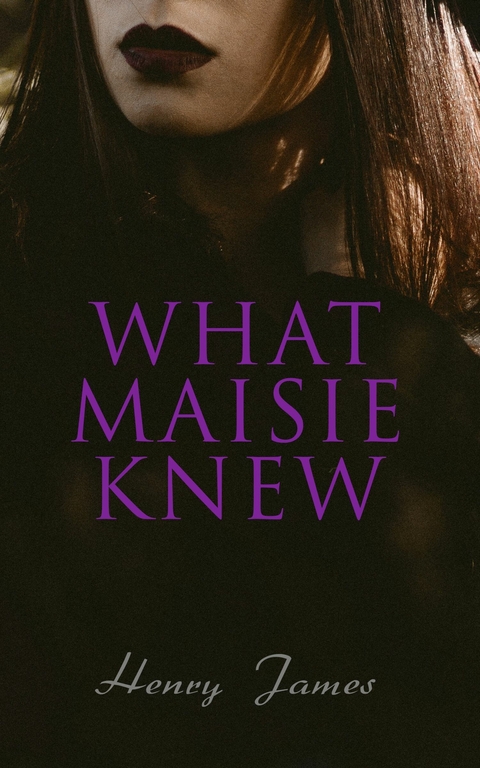
What Maisie Knew (eBook)
256 Seiten
e-artnow (Verlag)
978-80-268-8813-0 (ISBN)
Henry James (1843-1916) was an American-British writer who spent most of his writing career in Britain. James is regarded as one of the key figures of 19th-century literary realism. He is best known for a number of novels dealing with the social and marital interplay between émigré Americans, English people, and continental Europeans - examples of such novels include The Portrait of a Lady, The Ambassadors, and The Wings of the Dove.
Henry James (1843-1916) was an American-British writer who spent most of his writing career in Britain. James is regarded as one of the key figures of 19th-century literary realism. He is best known for a number of novels dealing with the social and marital interplay between émigré Americans, English people, and continental Europeans – examples of such novels include The Portrait of a Lady, The Ambassadors, and The Wings of the Dove.
VII
It quite fell in with this intensity that one day, on returning from a walk with the housemaid, Maisie should have found her in the hall, seated on the stool usually occupied by the telegraph-boys who haunted Beale Farange’s door and kicked their heels while, in his room, answers to their missives took form with the aid of smoke-puffs and growls. It had seemed to her on their parting that Mrs. Wix had reached the last limits of the squeeze, but she now felt those limits to be transcended and that the duration of her visitor’s hug was a direct reply to Miss Overmore’s veto. She understood in a flash how the visit had come to be possible — that Mrs. Wix, watching her chance, must have slipped in under protection of the fact that papa, always tormented in spite of arguments with the idea of a school, had, for a three days’ excursion to Brighton, absolutely insisted on the attendance of her adversary. It was true that when Maisie explained their absence and their important motive Mrs. Wix wore an expression so peculiar that it could only have had its origin in surprise. This contradiction indeed peeped out only to vanish, for at the very moment that, in the spirit of it, she threw herself afresh upon her young friend a hansom crested with neat luggage rattled up to the door and Miss Overmore bounded out. The shock of her encounter with Mrs. Wix was less violent than Maisie had feared on seeing her and didn’t at all interfere with the sociable tone in which, under her rival’s eyes, she explained to her little charge that she had returned, for a particular reason, a day sooner than she first intended. She had left papa — in such nice lodgings — at Brighton; but he would come back to his dear little home on the morrow. As for Mrs. Wix, papa’s companion supplied Maisie in later converse with the right word for the attitude of this personage: Mrs. Wix “stood up” to her in a manner that the child herself felt at the time to be astonishing. This occurred indeed after Miss Overmore had so far raised her interdict as to make a move to the dining-room, where, in the absence of any suggestion of sitting down, it was scarcely more than natural that even poor Mrs. Wix should stand up. Maisie at once enquired if at Brighton, this time, anything had come of the possibility of a school; to which, much to her surprise, Miss Overmore, who had always grandly repudiated it, replied after an instant, but quite as if Mrs. Wix were not there:
“It may be, darling, that something WILL come. The objection, I must tell you, has been quite removed.”
At this it was still more startling to hear Mrs. Wix speak out with great firmness. “I don’t think, if you’ll allow me to say so, that there’s any arrangement by which the objection CAN be ‘removed.’ What has brought me here today is that I’ve a message for Maisie from dear Mrs. Farange.”
The child’s heart gave a great thump. “Oh mamma’s come back?”
“Not yet, sweet love, but she’s coming,” said Mrs. Wix, “and she has — most thoughtfully, you know — sent me on to prepare you.”
“To prepare her for what, pray?” asked Miss Overmore, whose first smoothness began, with this news, to be ruffled.
Mrs. Wix quietly applied her straighteners to Miss Overmore’s flushed beauty. “Well, miss, for a very important communication.”
“Can’t dear Mrs. Farange, as you so oddly call her, make her communications directly? Can’t she take the trouble to write to her only daughter?” the younger lady demanded. “Maisie herself will tell you that it’s months and months since she has had so much as a word from her.”
“Oh but I’ve written to mamma!” cried the child as if this would do quite as well.
“That makes her treatment of you all the greater scandal,” the governess in possession promptly declared.
“Mrs. Farange is too well aware,” said Mrs. Wix with sustained spirit, “of what becomes of her letters in this house.”
Maisie’s sense of fairness hereupon interposed for her visitor. “You know, Miss Overmore, that papa doesn’t like everything of mamma’s.”
“No one likes, my dear, to be made the subject of such language as your mother’s letters contain. They were not fit for the innocent child to see,” Miss Overmore observed to Mrs. Wix.
“Then I don’t know what you complain of, and she’s better without them. It serves every purpose that I’m in Mrs. Farange’s confidence.”
Miss Overmore gave a scornful laugh. “Then you must be mixed up with some extraordinary proceedings!”
“None so extraordinary,” cried Mrs. Wix, turning very pale, “as to say horrible things about the mother to the face of the helpless daughter!”
“Things not a bit more horrible, I think,” Miss Overmore returned, “than those you, madam, appear to have come here to say about the father!”
Mrs. Wix looked for a moment hard at Maisie, and then, turning again to this witness, spoke with a trembling voice. “I came to say nothing about him, and you must excuse Mrs. Farange and me if we’re not so above all reproach as the companion of his travels.”
The young woman thus described stared at the apparent breadth of the description — she needed a moment to take it in. Maisie, however, gazing solemnly from one of the disputants to the other, noted that her answer, when it came, perched upon smiling lips. “It will do quite as well, no doubt, if you come up to the requirements of the companion of Mrs. Farange’s!”
Mrs. Wix broke into a queer laugh; it sounded to Maisie an unsuccessful imitation of a neigh. “That’s just what I’m here to make known — how perfectly the poor lady comes up to them herself.” She held up her head at the child. “You must take your mamma’s message, Maisie, and you must feel that her wishing me to come to you with it this way is a great proof of interest and affection. She sends you her particular love and announces to you that she’s engaged to be married to Sir Claude.”
“Sir Claude?” Maisie wonderingly echoed. But while Mrs. Wix explained that this gentleman was a dear friend of Mrs. Farange’s, who had been of great assistance to her in getting to Florence and in making herself comfortable there for the winter, she was not too violently shaken to perceive her old friend’s enjoyment of the effect of this news on Miss Overmore. That young lady opened her eyes very wide; she immediately remarked that Mrs. Farange’s marriage would of course put an end to any further pretension to take her daughter back. Mrs. Wix enquired with astonishment why it should do anything of the sort, and Miss Overmore gave as an instant reason that it was clearly but another dodge in a system of dodges. She wanted to get out of the bargain: why else had she now left Maisie on her father’s hands weeks and weeks beyond the time about which she had originally made such a fuss? It was vain for Mrs. Wix to represent — as she speciously proceeded to do — that all this time would be made up as soon as Mrs. Farange returned: she, Miss Overmore, knew nothing, thank heaven, about her confederate, but was very sure any person capable of forming that sort of relation with the lady in Florence would easily agree to object to the presence in his house of the fruit of a union that his dignity must ignore. It was a game like another, and Mrs. Wix’s visit was clearly the first move in it. Maisie found in this exchange of asperities a fresh incitement to the unformulated fatalism in which her sense of her own career had long since taken refuge; and it was the beginning for her of a deeper prevision that, in spite of Miss Overmore’s brilliancy and Mrs. Wix’s passion, she should live to see a change in the nature of the struggle she appeared to have come into the world to produce. It would still be essentially a struggle, but its object would now be NOT to receive her.
Mrs. Wix, after Miss Overmore’s last demonstration, addressed herself wholly to the little girl, and, drawing from the pocket of her dingy old pelisse a small flat parcel, removed its envelope and wished to know if THAT looked like a gentleman who wouldn’t be nice to everybody — let alone to a person he would be so sure to find so nice. Mrs. Farange, in the candour of new-found happiness, had enclosed a “cabinet” photograph of Sir Claude, and Maisie lost herself in admiration of the fair smooth face, the regular features, the kind eyes, the amiable air, the general glossiness and smartness of her prospective stepfather — only vaguely puzzled to suppose herself now with two fathers at once. Her researches had hitherto indicated that to incur a second parent of the same sex you had usually to lose the first. “ISN’T he sympathetic?” asked Mrs. Wix, who had clearly, on the strength of his charming portrait, made up her mind that Sir Claude promised her a future. “You can see, I hope,” she added with much expression, “that HE’S a perfect gentleman!” Maisie had never before heard the word “sympathetic” applied to anybody’s face; she heard it with pleasure and from that moment it agreeably remained with her. She testified moreover to the force of her own perception in a small soft sigh of response to the pleasant eyes that seemed to seek her acquaintance, to speak to her directly. “He’s quite lovely!” she declared to Mrs. Wix. Then eagerly, irrepressibly, as she still held the photograph and Sir Claude continued to fraternise, “Oh can’t I keep it?” she broke out. No sooner had she done so than she looked up from it at Miss Overmore: this was with the sudden instinct of appealing to the authority that had long...
| Erscheint lt. Verlag | 29.3.2018 |
|---|---|
| Verlagsort | Prague |
| Sprache | englisch |
| Themenwelt | Literatur ► Romane / Erzählungen |
| Sachbuch/Ratgeber ► Geschichte / Politik ► Politik / Gesellschaft | |
| Sozialwissenschaften ► Politik / Verwaltung | |
| Schlagworte | American author • beneath a scarlet sky • child custody • divorced parents • emotional abuse • family dysfunction • Great Expectations • Jane Austen • Jane Eyre • Little Women • moral decay • Parental betrayal • parental neglect • psychological drama • say you're sorry • The Handmaid’s Tale • the keeper of lost things • Thomas Hardy • Victorian Era • While You Were Mine |
| ISBN-10 | 80-268-8813-8 / 8026888138 |
| ISBN-13 | 978-80-268-8813-0 / 9788026888130 |
| Informationen gemäß Produktsicherheitsverordnung (GPSR) | |
| Haben Sie eine Frage zum Produkt? |
 EPUB (Wasserzeichen)
DRM: Digitales Wasserzeichen
Dieses eBook enthält ein digitales Wasserzeichen und ist damit für Sie personalisiert. Bei einer missbräuchlichen Weitergabe des eBooks an Dritte ist eine Rückverfolgung an die Quelle möglich.
Dateiformat: EPUB (Electronic Publication)
EPUB ist ein offener Standard für eBooks und eignet sich besonders zur Darstellung von Belletristik und Sachbüchern. Der Fließtext wird dynamisch an die Display- und Schriftgröße angepasst. Auch für mobile Lesegeräte ist EPUB daher gut geeignet.
Systemvoraussetzungen:
PC/Mac: Mit einem PC oder Mac können Sie dieses eBook lesen. Sie benötigen dafür die kostenlose Software Adobe Digital Editions.
eReader: Dieses eBook kann mit (fast) allen eBook-Readern gelesen werden. Mit dem amazon-Kindle ist es aber nicht kompatibel.
Smartphone/Tablet: Egal ob Apple oder Android, dieses eBook können Sie lesen. Sie benötigen dafür eine kostenlose App.
Geräteliste und zusätzliche Hinweise
Buying eBooks from abroad
For tax law reasons we can sell eBooks just within Germany and Switzerland. Regrettably we cannot fulfill eBook-orders from other countries.
aus dem Bereich