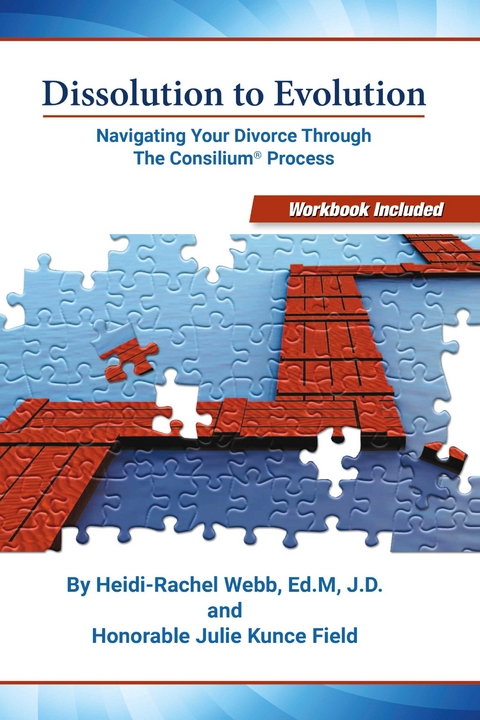
Dissolution to Evolution (eBook)
150 Seiten
Bookbaby (Verlag)
978-1-5439-2312-4 (ISBN)
Dissolution to Evolution is a book and a workbook that describes and details the Consilium Process, a new paradigm developed to help people who are thinking about divorce, to simultaneously create a parallel path of personal growth. Education about the law is combined with compassion for the social and emotional consequences of divorce. By merging the usually compartmentalized silos of law and psychology, family outcomes are optimized. A better understanding of the legal process and child-centered thinking disrupts the myth of "e;winners and losers"e; and leads to healthier restructured families. The book highlights and details common, relatable scenarios, presents thoughtful options and constructs optimal outcomes. Various legal processes are described, building an understanding of options and giving agency to those undergoing divorce. The inclusion of a workbook helps people structure and pre-think their process. At a time when raw emotion often prevails, the workbook acts as a personal guide helping to create a personal roadmap built on a foundation of logic.
“Two roads diverged in a yellow wood…” - Robert Frost
Considering another model for Litigation “Lite”
Molly and John
Initial Meeting
Molly was tentative as she approached my door. I was surprised by her appearance. Her white hair was neatly cropped, almost severely so. She wore a crisply ironed Peter Pan collared shirt, a pink cashmere sweater, a navy blue pleated skirt and penny loafers that were in good condition but looked like they were from the 1960’s. She was prim and proper and chose her words carefully.
In her mid-70s, Molly was in the throes of reevaluating her marriage. She was struggling to understand the spoken and unspoken contracts she had made with her husband, and whether, if and why she wanted to stay in her marriage. She was seeing me at the urging of her therapist as she’d been talking to her about divorce for many years, but didn’t really have any idea what the reality of that path would look like for her.
In our first conversation, Molly told me that although she wouldn’t say she loved John, they had two children and forty-five years of married life behind them. He also had Stage Two cancer and despite the anger she felt toward him, she also felt loyalty if not affection. Much as she felt disconnected from John, she didn’t like the idea of living alone, having long drawn out separation and/or divorce negotiations with him while he was sick, and risking the children feeling that she was heartless to divorce their father at this point in his life, when he was gravely ill.
From our Intake Form, I already knew her age, that she had been married for just over forty-five years, and that she and her husband had survived financial difficulties. They had raised their children in a wealthy Boston suburb, and were now living in a modest home in a working-class town. Her husband had received a large inheritance, but now none of it was left.
Why, now, had she sought out my services? She told me she was just on a fact- gathering mission. What would her life look like if she were to pursue a divorce? Could she afford a divorce? Would she be able to keep her house and maintain her lifestyle? Each of those concerns was punctuated by a story about how unhappy she was, how much her husband drank and how controlling he was. She told me that for many years, they’d been living parallel lives--hers focused primarily around the church and his focused primarily around a group of retired friends. Although it was true that she was unhappily married, more than a divorce, she was looking for leverage within their marriage. She wanted to understand their finances and she craved more independence, even in her home. She wanted to be able to stand up for herself and tell her husband that she knew her rights, and that if things didn’t change, she was prepared to act to exact what she knew she was entitled to.
Finances and personalities
Molly told me that John had made some bad investment decisions. She also shared that she didn’t know much about what had happened, as he was very “private” about anything having to do with money. As we talked more, it seemed to me that “secretive” would have been a more accurate word. Molly knew as little about their household money as she did about their larger investment picture. She had always received an “allowance” from John, enough to buy groceries and purchase herself clothing from time to time.
Molly struck me as someone who was frozen in time; everything from her style of dress to her style of speech screamed 1950’s. John and Molly had grown up in privileged households, attended prep schools and elite colleges, but none of that translated into their ability to have a partnership of mutual respect, nor could she remember a time when it ever had.
According to Molly, John was very proud. Although he’d been unemployed for the past fifteen years, he refused to ask friends or family for help of any kind. He arranged his days around socializing--at a coffee shop, with his bicycling group, and at his social club. He had begun to drink, and his addiction was taking a toll on his body. At a recent visit to the doctor, following a fall while inebriated, his doctor had told him he had to stop drinking. Unfortunately, John ignored this advice. Because John did not typically welcome Molly’s presence at his medical appointments, she didn’t have a true understanding of his cancer prognosis.
As we talked more, Molly’s fear of John became apparent. His verbal abuse was constant, and when I asked her if she feared for her physical safety, she burst into tears. She told me that a few years ago John had grabbed her by the neck and threatened to kill her. She attributed his behavior to stress, and it was at that point she insisted that in order to contain their living expenses, they needed to sell their house and downsize. Before she knew it, John came home telling her he’d put an offer in on a house in a community about an hour from where they were then living. Molly was shocked.
Molly had taken two strong stances in her marriage: (1) by saying they needed to move, and (2) that she would not simply be “transplanted” by John. After doing that, they were then able to negotiate, and with the assistance of a loan from Molly’s mother, they purchased a new home much closer to their old one.
Since they moved (two years before she sought my counsel), they were living parallel lives. They slept in separate bedrooms and conducted their lives independently of one another. She had her own car and she drove to see friends and her mother, to church, and for shopping. They no longer shared meals, and communicated only in their bi-weekly marital counseling session.
Molly and John had been seeing the same marriage counselor for more than fifteen years. When I later spoke with their counselor, he described himself as the dialysis machine of their marriage, and said Molly was now questioning the wisdom of sustaining the marriage. She was tired of living in an oppressive household, and of living with someone who clearly did not want her input into his life.
To divorce or not to divorce
Molly concluded that if the power imbalance in her marriage could be altered, and she could feel some self-respect, she might be able to stay in her marriage. Knowing she had more control over her own choices, both financial and personal, would give her new confidence and agency. Once she knew fact from fiction, John’s threats wouldn’t have the same impact on her, and his words would no longer intimidate her. Knowing that if John faltered she would have the strength of the law behind her gave Molly a sense of confidence and strength. Even her body language spoke to that: her backbone straightened and her shoulders relaxed.
We talked about the difference between creating a Post-Nuptial Agreement, and having a divorce. We also talked about using their couples counseling as a forum for discussing finances, to broach the subject safely before discussing the details of their finances. And we talked about creating an estate plan, as a way for her both to gain a better picture of their current finances, and to simultaneously create Wills. That day, when she stood up to leave my office, she told me that now that she was equipped with the information she needed, she felt empowered to return home and have a very overdue conversation with her husband.
Determining the right path forward
Molly was at a juncture in her life that required her to carefully contrast the differences between her marriage’s contribution to her current state of unhappiness and what impact a divorce would have on her life during the next many years.
Of utmost concern to me was John’s history of verbal and physical abuse, and his heavy drinking. Molly assured me that except in the one instance she’d described to me, John had never physically abused her. In fact, she told me that he usually drank himself to sleep, and was more slovenly and uninspired than anything else. She told me that she did not live in fear of him and that she did not want to pursue a restraining order, even if they were to divorce. Her sentences were marked by alternating descriptions of anger at, and pity for John. Despite my usual skepticism about Molly’s statements that John had never lifted a hand to her other than that one time she had described, I also considered that because she’d been in couples therapy with him for the past fifteen years, I could trust the therapist’s assessment of whether there was any ongoing physical violence. I certainly wanted the therapist’s assurance that, by living with John, Molly was not in any ongoing physical danger. If we could ascertain that she would be safe, I would then be comfortable working with her to assure that reinforcements were in place, both in terms of her therapist’s awareness, and the creation of a safety plan for her in the event John did become violent.
Divorce or no divorce, John’s illness demanded that Molly become informed about their finances. As women outlive men by a wide margin, more often than not at some point in their lives they become primarily responsible for the management of their own finances. Molly would not be the first woman to have that role thrust upon her without any preparation. However, knowing what she now knew, she understood the importance of creating an estate plan and how important it would be for her to have a working understanding of their finances; the lawyer creating the plan would be the one insisting on the disclosure, not Molly. Perhaps instead of seeing Molly as invading his sense of privacy, John could be led to...
| Erscheint lt. Verlag | 26.2.2018 |
|---|---|
| Sprache | englisch |
| Themenwelt | Sachbuch/Ratgeber ► Gesundheit / Leben / Psychologie ► Partnerschaft / Sexualität |
| ISBN-10 | 1-5439-2312-7 / 1543923127 |
| ISBN-13 | 978-1-5439-2312-4 / 9781543923124 |
| Informationen gemäß Produktsicherheitsverordnung (GPSR) | |
| Haben Sie eine Frage zum Produkt? |
 EPUB (Adobe DRM)
Größe: 1,2 MB
Kopierschutz: Adobe-DRM
Adobe-DRM ist ein Kopierschutz, der das eBook vor Mißbrauch schützen soll. Dabei wird das eBook bereits beim Download auf Ihre persönliche Adobe-ID autorisiert. Lesen können Sie das eBook dann nur auf den Geräten, welche ebenfalls auf Ihre Adobe-ID registriert sind.
Details zum Adobe-DRM
Dateiformat: EPUB (Electronic Publication)
EPUB ist ein offener Standard für eBooks und eignet sich besonders zur Darstellung von Belletristik und Sachbüchern. Der Fließtext wird dynamisch an die Display- und Schriftgröße angepasst. Auch für mobile Lesegeräte ist EPUB daher gut geeignet.
Systemvoraussetzungen:
PC/Mac: Mit einem PC oder Mac können Sie dieses eBook lesen. Sie benötigen eine
eReader: Dieses eBook kann mit (fast) allen eBook-Readern gelesen werden. Mit dem amazon-Kindle ist es aber nicht kompatibel.
Smartphone/Tablet: Egal ob Apple oder Android, dieses eBook können Sie lesen. Sie benötigen eine
Geräteliste und zusätzliche Hinweise
Buying eBooks from abroad
For tax law reasons we can sell eBooks just within Germany and Switzerland. Regrettably we cannot fulfill eBook-orders from other countries.
aus dem Bereich