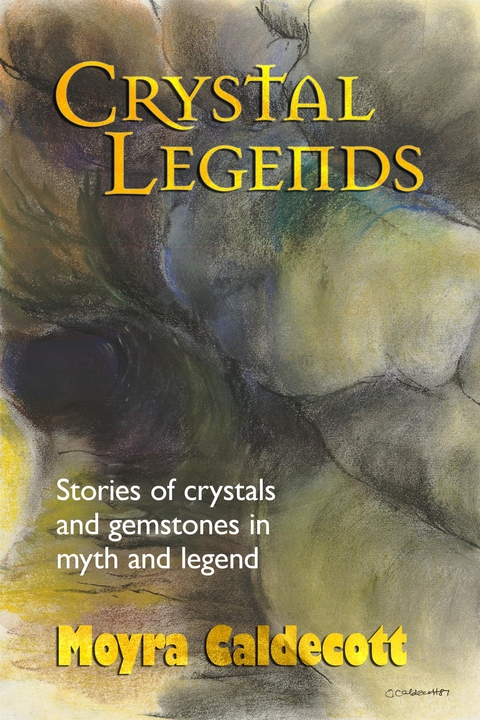
Crystal Legends (eBook)
224 Seiten
Mushroom eBooks (Verlag)
978-1-84319-338-8 (ISBN)
Crystals and gemstones have been a source of fascination since Neolithic times; they endure when the bones of those they have adorned have turned to dust. Such was the profundity of crystal lore that ancient peoples incorporated crystals and gemstones as dynamic and potent symbols in their legends and myths.
In Crystal Legends Moyra Caldecott approaches crystals from a new angle, retelling the stories drawn from world mythology that show the significance of crystals and precious stones as symbolic icons in a variety of traditions. She gives in-depth commentaries on their esoteric meaning and their significance for us today.
From Buddhist and biblical texts, European and Egyptian tales, Arthurian and Atlantean legends, this fascinating collection will appeal to anyone with an interest in the power of crystals and the eternal journey of the soul towards enlightenment.
Crystals and gemstones have been a source of fascination since Neolithic times; they endure when the bones of those they have adorned have turned to dust. Such was the profundity of crystal lore that ancient peoples incorporated crystals and gemstones as dynamic and potent symbols in their legends and myths.In Crystal Legends Moyra Caldecott approaches crystals from a new angle, retelling the stories drawn from world mythology that show the significance of crystals and precious stones as symbolic icons in a variety of traditions. She gives in-depth commentaries on their esoteric meaning and their significance for us today.From Buddhist and biblical texts, European and Egyptian tales, Arthurian and Atlantean legends, this fascinating collection will appeal to anyone with an interest in the power of crystals and the eternal journey of the soul towards enlightenment.
Chapter 1
The Championship of Ireland and the Crystal Bird
(Western Europe: Celtic)
Everyone knew that Bricriu was a troublemaker, and no one wanted to have anything to do with him. Nevertheless he managed to persuade the three greatest heroes of Ireland and all their friends, relatives, and companions to come together at his house for a feast by dint of promising them worse trouble if they refused. His unwilling guests finally agreed to come on condition that he himself was not present. He agreed — but built himself a chamber above the hall where he could observe all that went on.
Before the guests entered the hall, however, Bricriu, as host and provider of the meat and mead, greeted them. While doing so he managed to have a private word with each of the three greatest heroes, Cuchulain, Conall Cernach, and Laegaire Buadach, mentioning to each that when it was time to serve the meat he was to claim the champion’s portion because he, and none other, was the greatest hero of Ireland. He further compounded the mischief by telling each of the three heroes’ wives privately that she, wife of the greatest hero of Ireland, should enter the feast hall ahead of all the other women. He then retired to his private room to watch the fun.
The strife he caused between the three heroes and the three wives spilled over well beyond the feast and occupied the Irish for quite a while thereafter. Rather than have the three heroes destroy each other and all around them over the matter, they were persuaded to submit to tests of strength and courage set by neutral arbitrators.
Watched over and egged on by their excited supporters, the three performed prodigious feats. In every one Cuchulain outdid the others. They fought giants and magical Druid cats; they fought fearsome spectres and armies of fierce warriors; but no matter how clear it was that Cuchulain outstripped the others, Conall and Laegaire would not admit that he was champion. They claimed something was wrong with the test and that Cuchulain had won unfairly.
At one point the whole crowd arrived at Cruachan, the stronghold of Ailell and Maeve, king and queen of Connaught. They demanded that King Ailell name the greatest hero once and for all.
Ailell was worried and spoke to his wife, complaining that he was in a very difficult position, for if he named one hero over the others, the other two and all their rowdy companions would go berserk and destroy everything in sight.
Queen Maeve suggested a clever solution that would at least save their own property.
One by one she called the three heroes to a private audience. She told Laegaire Buadach that he should have the hero’s portion at the great feast of Conchubar, the High King. All he had to do was to produce a token she would give him that would leave no doubt as to who she thought the champion was. She gave him a bronze chalice with a bird of silver at the bottom. To Conall she gave the same speech and a chalice of silver with a bird of red gold at the bottom. Lastly she called Cuchulain to her side and presented him with a chalice of red gold with a bird of precious crystal in the bottom.
All three and their entourage of supporters then set off for the stronghold of Conchubar, the High King. On the way the contention continued and many a dangerous and skilful feat was performed to try to prove which one was the greatest hero of them all.
At last, at the court of Conchubar, the welcome feast was set.
Laegaire produced his chalice of bronze and proudly showed the bird of white silver at the bottom, saying that it had been given by Ailell and Maeve as token that he was the greatest champion of Ireland.
Conall laughed and stood up brandishing his chalice of silver, with the bird of red gold in the bottom.
“This was given me by Ailell and Maeve,” he cried, “Judge for yourselves how much more they valued me than Laegaire Buadach.”
Then Cuchulain strode across the room and slapped his chalice down in front of Conchubar.
Smiling, the king raised it above his head so that all could see the glowing vessel of red gold and, inside, the bird of precious crystal.
“Cheat!” Conall and Laegaire shouted. “He bribed them for the better cup.”
Conchubar raised his strong right arm to prevent the fight that was about to break out and declared there would be one last and convincing test that would prove which one had the greatest courage and was therefore worthy to eat the champion’s portion.
While they were waiting for the test to be devised an ugly, brutish man entered the hall and jeered at the heroes of Ireland, declaring that none of them would dare to meet his challenge.
“What challenge is that, you oaf?” Conall said, scarcely bothering to stop drinking long enough to say the words.
“To chop off my head,” the man replied.
“That I will gladly do!” shouted Conall, laughing. “Just hand me your axe.”
“The full challenge is that you cut off my head today, but I cut off your head tomorrow.”
There was much shouting and jollity at this absurdity, and Conall took the axe from the man, swung it, and chopped off his head. He soon sobered up, however, when the man picked up his head and replaced it on his body, reclaimed his axe, and walked out of the hall.
The next day when he returned for the completion of the challenge Conall was nowhere to be found. Laegaire was accosted by the oaf and, against his better judgement, shamed into accepting the challenge to prove that he was a greater hero than Conall.
He swung his axe. The man picked up his head and left the hall. The next day when he returned Laegaire was also missing.
The man then turned his attention to Cuchulain — and for honour’s sake Cuchulain had to take up the challenge.
The next day when the man returned Cuchulain was waiting for him. He did not flinch once, though the man swung the axe three times, each time hitting his neck with the blunt edge of the weapon.
Then was the matter settled. The oaf revealed himself a master of Druid magic sent to test the three heroes.
To Cuchulain at last was given the champion’s portion, and he quaffed his wine from the chalice of the crystal bird.
Comment
Bricriu the troublemaker represents that part of ourselves which, no matter how noble we are, tempts us to mischief, tests our credentials, shows up any flaws in our personalities. When I first began to read Celtic legends I was sometimes impatient with their unquestioning belief that the man who can kill the most people was accepted as the greatest hero. It was only when I began to put the lists of killings into the background as one does with something that is monotonous and boring that I began to notice other, more interesting things in the legends. True, the hero in the Irish heroic tales is still the man who can fight and kill more than anyone else, but in this story he is teased and mocked. He may have brawn, but has he got brain? How easily Bricriu stirs up the strife between them; how quickly they fall for his tricks. Violent and argumentative, they swagger around Ireland, each refusing to accept the result of any of the tests, wreaking havoc wherever they go, egged on by their supporters.
The fact that there are three of them is interesting. Among the Celts three is the most potent and significant of numbers. There are three aspects of the Goddess; there are three crystal trees at the entrance to the Otherworld; there are three brothers or three sisters in almost every “fairy” story... It is said that the Irish took so readily to Christianity when the first missionaries came to them because they understood the concept of the Trinity so easily.
Here there are three heroes and it seems as though the problem of which one is the greatest will never be resolved. There is no doubt they are each capable of fighting and killing as well as the others, but the final test comes and only one of them can face being killed with unflinching courage. That is being killed not in the heat of battle but as a deliberate and sober fulfilment of a promise. The mysterious god who challenges the hero to cut off his head one day and then submit himself to having his own head severed the next, is a key concept in Celtic myth. In the Arthurian legends we have Gawain and the Green Knight. In this story a wild man enters the court of Conchubar, the High King. A “wild man’? Is he the nature god, the Green Knight, the earth itself? Is he asking for a blood sacrifice for the good of the earth? In ancient Celtic times the noblest of the heroes would offer himself as a sacrifice that the earth would burgeon in the spring. What we may be witnessing here is the choosing of the sacrifice — not an idle argument among the heroes as to which one is the greatest. Two of them back out at the last moment. Only Cuchulain is prepared to go the whole way, and bends his head in noble submission. Three times the ceremonial axe touches the back of his neck. He is given three chances to withdraw. He does not.
In a sense we already know which one is chosen when Cuchulain is given the chalice with the crystal bird. He has drawn “the long straw”. The others have been honoured with silver and gold. They are heroic figures of the material world. But the third chalice, the one that becomes the possession of the real and ultimate hero, carries the symbol of the spiritual world. In Celtic legend birds are almost always associated with the Otherworld. We have Rhiannon’s magic birds in the Welsh legends; the two birds that swoop over the lake and entice Cuchulain away to Fand’s beautiful spirit-world; the swans that so frequently prove to be...
| Erscheint lt. Verlag | 1.4.2005 |
|---|---|
| Sprache | englisch |
| Themenwelt | Literatur ► Romane / Erzählungen |
| Sachbuch/Ratgeber ► Gesundheit / Leben / Psychologie ► Alternative Heilverfahren | |
| Sachbuch/Ratgeber ► Gesundheit / Leben / Psychologie ► Esoterik / Spiritualität | |
| Sachbuch/Ratgeber ► Gesundheit / Leben / Psychologie ► Lebenshilfe / Lebensführung | |
| Sozialwissenschaften ► Soziologie ► Allgemeines / Lexika | |
| ISBN-10 | 1-84319-338-8 / 1843193388 |
| ISBN-13 | 978-1-84319-338-8 / 9781843193388 |
| Informationen gemäß Produktsicherheitsverordnung (GPSR) | |
| Haben Sie eine Frage zum Produkt? |
 EPUB (Ohne DRM)
Digital Rights Management: ohne DRM
Dieses eBook enthält kein DRM oder Kopierschutz. Eine Weitergabe an Dritte ist jedoch rechtlich nicht zulässig, weil Sie beim Kauf nur die Rechte an der persönlichen Nutzung erwerben.
Dateiformat: EPUB (Electronic Publication)
EPUB ist ein offener Standard für eBooks und eignet sich besonders zur Darstellung von Belletristik und Sachbüchern. Der Fließtext wird dynamisch an die Display- und Schriftgröße angepasst. Auch für mobile Lesegeräte ist EPUB daher gut geeignet.
Systemvoraussetzungen:
PC/Mac: Mit einem PC oder Mac können Sie dieses eBook lesen. Sie benötigen dafür die kostenlose Software Adobe Digital Editions.
eReader: Dieses eBook kann mit (fast) allen eBook-Readern gelesen werden. Mit dem amazon-Kindle ist es aber nicht kompatibel.
Smartphone/Tablet: Egal ob Apple oder Android, dieses eBook können Sie lesen. Sie benötigen dafür eine kostenlose App.
Geräteliste und zusätzliche Hinweise
Buying eBooks from abroad
For tax law reasons we can sell eBooks just within Germany and Switzerland. Regrettably we cannot fulfill eBook-orders from other countries.
aus dem Bereich