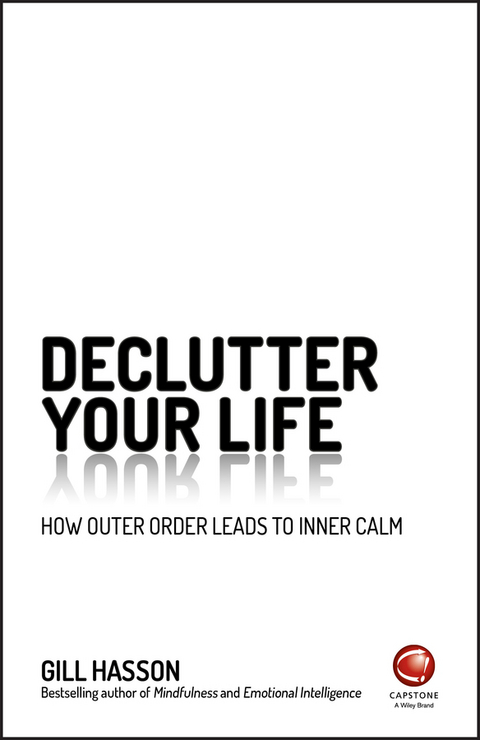
You have too many commitments in your life and too much stuff in your home, It's no wonder you feel overwhelmed and stressed out, You don't need to just throw out a few bits and bobs; you need to declutter your life!
Our homes and workspace are a mirror of what's happening inside us, Declutter Your Life explains how you can change your relationship with the things you own, Instead of being weighed down with objects and possessions that keeps you stuck in the past, you can learn to think about your things in a new light; in a way that's constructive and helpful to you,
There are plenty of ideas, advice, tips and techniques to help you, You'll discover how outer order leads to inner calm, Declutter Your Life explains how the principles and steps taken to clear and simplify your living space can improve not just your home but also other aspects of your life; your work, relationships and general wellbeing,
An ordered environment leads to ordered thinking, When you stop allowing your life to revolve around things that don't matter, you instantly gain the time, space and energy to focus on the things that do, Declutter Your Life will help you to:
- Let go of guilt and get rid of the emotional baggage that keeps you stuck in the past
- Feel less overwhelmed and stressed
- Clear out your unnecessary commitments
- Simplify and improve your work life
- Declutter your relationships
Simple living doesn't end at home, Declutter Your Life shows you how to reclaim your space, your time and your mind to achieve the life you want to live,
Gill Hasson is a careers coach with over 20 years experience in the areas of personal & career development, She is also a freelance tutor/ teacher in mental health issues for mental health organisations and delivers training for adult education organizations, voluntary and business organizations and the public sector, She is the bestselling author of many Capstone titles, including Mindfulness and Emotional Intelligence,
Take back your space, your time and your mind to live your authentic life. You have too many commitments in your life and too much stuff in your home. It's no wonder you feel overwhelmed and stressed out. You don't need to just throw out a few bits and bobs; you need to declutter your life! Our homes and workspace are a mirror of what's happening inside us, Declutter Your Life explains how you can change your relationship with the things you own. Instead of being weighed down with objects and possessions that keeps you stuck in the past, you can learn to think about your things in a new light; in a way that's constructive and helpful to you. There are plenty of ideas, advice, tips and techniques to help you. You'll discover how outer order leads to inner calm. Declutter Your Life explains how the principles and steps taken to clear and simplify your living space can improve not just your home but also other aspects of your life; your work, relationships and general wellbeing. An ordered environment leads to ordered thinking. When you stop allowing your life to revolve around things that don't matter, you instantly gain the time, space and energy to focus on the things that do. Declutter Your Life will help you to: Let go of guilt and get rid of the emotional baggage that keeps you stuck in the past Feel less overwhelmed and stressed Clear out your unnecessary commitments Simplify and improve your work life Declutter your relationships Simple living doesn't end at home. Declutter Your Life shows you how to reclaim your space, your time and your mind to achieve the life you want to live.
Gill Hasson is a careers coach with over 20 years experience in the areas of personal & career development. She is also a freelance tutor/ teacher in mental health issues for mental health organisations and delivers training for adult education organizations, voluntary and business organizations and the public sector. She is the bestselling author of many Capstone titles, including Mindfulness and Emotional Intelligence.
Introduction 1
Part 1: Declutter Your Home 7
1 How Do You Accumulate so Much? 9
2 Why Can't You Clear It All Out? 19
3 Think Differently 27
4 Declutter Your Home 43
5 Keep Your Home Free of Clutter 73
Part 2: Declutter Your Life 83
6 Declutter Your Commitments 85
7 Declutter Your Friendships 103
8 Declutter Your Work 119
9 Declutter Information 133
About the Author 143
Useful Websites 145
3
Think Differently
To change skins, evolve into new cycles, I feel one has to learn to discard. If one changes internally, one should not continue to live with the same objects. They reflect one's mind and the psyche of yesterday.
Anais Nin
To clear out clutter successfully requires new ways of thinking and doing. But before you can start doing anything, you need to start thinking differently. The key to successful decluttering is to change your mindset; to let go of the underlying beliefs and instead take on new, more helpful ways of thinking about things.
When it comes to decluttering, you may have come across the idea of only keeping things that actually bring you joy. Everything else you just get rid of – simple. And it would be simple if emotion didn't play a role.
Emotions can complicate the clutter-clearing process. Too often, guilt gets in the way. We keep things because we’d feel guilty if we got rid of them. The things we spent money on and have hardly used or worn. We already feel guilty about that – we don't want to compound the guilt by throwing it out!
But those clothes you’ve hardly worn, books you never read, toys that are rarely played with, unused kitchen utensils or gym equipment; they’re all sunk costs. You’ve already spent the money. Keeping something you spent £20 or £200 on a while back doesn't bring the money back. The money has gone. So, since you can't get back the time or all the money that you spent on something, it's better only to consider what benefit that thing is to you now.
Whether you’ve already kept it for a month, year or even half a lifetime, realize that, at the time, you made the right choice; you sincerely thought you would wear it, read it, use it. That was then. Holding onto it just ties you to the past. Live in the present!
Changing your mind
Perhaps, though, you think that changing your mind about something implies that you were wrong to buy it in the first place. And being wrong is often seen as a sign of weakness. But whether it's a juicer, gym equipment, a leather jacket or sparkly shoes you no longer want, all that's happened is that you feel differently about it now. That's OK. You’re allowed to change your mind! You do it every day, possibly more than you realize. It could’ve been this morning when you decided to eat toast instead of cereal. You decided to wear a shirt but then you changed your mind and put on a t-shirt. Perhaps it was last night; rather than going out to the pub, you chose to stay in and watch a film instead.
Did you feel guilty about changing your mind? Did you feel you’d done something ‘wrong?’ It's unlikely. But when it comes to deciding that, actually, you don't want to keep that picture or those candle holders and you don't, after all, need those shot glasses or that spiralizer, you struggle to change course. That bread machine, for example, that you bought so that you could bake bread every day. The reality is no, you are not going to become an artisan baker in the foreseeable future. So let it go; both the fantasy and the bread maker!
That patterned duvet cover from university days in Halls that you’ve never used since? Know that you loved it then – it served a purpose – but now that time has gone. Instead of feeling guilty about letting go of something, see yourself as flexible and able to adapt.
Think differently about thinking differently; rather than feeling bad about having changed your mind about some of your stuff, feel good; simply see yourself as having made a new decision.
If you can change your mind, you can change your life.
William James
It's the same with the things you no longer want or never liked that were given to you as gifts. Maybe you tell yourself it’d be wrong to throw something out. You don't want to hurt the gift giver's feelings. But your friends and family gave you the gifts to make you happy, not to make you feel guilty, didn't they? Don't let gifts become burdens. Try and separate your feelings about the person from the gift itself; you can still like the person but dislike the gift they gave you.
What about inherited clutter? Have you ever thought, ‘They’d be disappointed and upset if they knew I’d let that go. I have to hold onto it.’ But you’re not responsible for other people's clutter. Of course, keep any inherited items you love or find useful, but anything else, if you don't like it, for whatever reason, let it go.
Remember, you’re just letting go of the item, you’re not letting go of the person or every memory of them.
Of course, we all have things that help us feel connected to a person or occasion and bring back happy memories, but you really don't need a lot of things to remind you of another person or a meaningful time in your life. The embroidered place mats your much-loved great aunt gave you, your children's first pair of shoes, the photos, the pair of champagne glasses from your wedding, the outfits you wore for special occasions; most everything we own has some memory attached to it. We’d never throw anything out if we kept everything because of the memories.
Take a mindful approach; be aware that holding on to so many things just because they remind you of the past encourages you to look back at what was, instead of living more fully in the present and looking forward to the future. Still hanging on to school, college or university assignments? Why? Those days have gone.
You can always keep a few favourite things from the past, just be selective about what you keep to remind you of people, places and experiences.
Rethinking guilt
Still think you’ll feel guilty if you clear things out and let them go? Fine. But your guilt is misplaced. As someone once said: guilt is good for you, provided it lasts no longer than five minutes and it brings about a change in behaviour. Like all emotions, guilt has a positive purpose. The purpose of guilt is to prompt you to put right a wrong. When it comes to decluttering, it's helpful to think differently about what you’re doing ‘wrong’; you refocus the guilt so that it serves you well.
Imagine if someone had something you needed. They could easily give it or sell it to you, but they don't. They never use it themselves, they don't need it and they don't love it. They just hold onto it, never giving you or anyone else an opportunity to make use of it or enjoy it.
When you hold onto something that you don't need, don't use or don't like, you’re withholding it from someone who does need it, could use it and/or would love it. And that's not right. That's wrong. If you think of it in terms of withholding something that could benefit someone else, that's not legitimate guilt, it's misplaced guilt. So, instead of feeling guilty for letting go of stuff, feel guilty for not letting go. Sell it or give it away. If you aren't using it, it is a greater waste to keep it when someone else could use it or enjoy it. So see letting go as an opportunity to benefit someone else.
Whether you give it away or sell it, tell yourself, ‘This belongs in someone else's life.’ Let someone else use or enjoy the things you no longer use or need.
Organizations like Freecycle aim to keep useful stuff out of landfill. Your things are actually as good as landfill in your home if you are not using them or you don't like them. If anything is unwanted and worthless to you then it's trash, junk, rubbish. Why keep rubbish in your home? Why would you want your home to be as bad as the bin?
One person's trash is another person's treasure. In the past couple of years, through Freecycle (www.freecycle.org), I’ve given away stuff that myself or my family no longer want, like or need. Lego, for example, that our three sons loved and gave them hours and hours of pleasure; one box of Lego was collected by a woman who sent it to her son working for a children's charity in Rwanda, the other box we gave to someone who took it to a local play centre for children with special needs.
A collection of Simpsons comics went to a chap who told me, ‘My son will be so thrilled when he comes home from school to find I’ve got these for him.’ A didgeridoo that was a gift from a friend went to someone who, in his email asking if he could collect it, wrote ‘This would make a great addition to my collection of weird and wonderful wooden objects. I would also love to be able to play it one day. That and the banjo, that is.’ The young woman who asked for the camera I no longer wanted told me she was going to give it as a gift to a friend.
When I cleared out the shed, a spare pair of wellington boots and a garden chair were picked up by someone who’d recently acquired an allotment. Several children's spades went to a woman whose kids recently lost their spades: they’d been stolen from the park sandpit. The pop-up tent that one son bought for Glastonbury one year was collected by someone else who was off to Glastonbury the following year. The...
| Erscheint lt. Verlag | 6.12.2017 |
|---|---|
| Sprache | englisch |
| Themenwelt | Sachbuch/Ratgeber ► Beruf / Finanzen / Recht / Wirtschaft ► Bewerbung / Karriere |
| Sachbuch/Ratgeber ► Gesundheit / Leben / Psychologie ► Lebenshilfe / Lebensführung | |
| Schlagworte | achieving calm • Achieving goals • Business & Management • Business Self-Help • clarifying goals • decluttering techniques • decluttering tips • decluttering your mind • decluttering your schedule • Declutter Your Life: How outer order leads to inner calm • doing without • finding clarity • finding time • Gill Hasson </p> • letting go of possessions • life organisation • living simply • <p>decluttering • mental clutter • mental decluttering • mindful decluttering • Minimalism • minimalist living • Motivation • Ratgeber • Ratgeber Wirtschaft • reducing obligations • reducing stress • saying no • Self-Help • simple living • simplifying relationships • Wirtschaft /Ratgeber • Wirtschaft u. Management |
| ISBN-10 | 0-85708-738-X / 085708738X |
| ISBN-13 | 978-0-85708-738-6 / 9780857087386 |
| Informationen gemäß Produktsicherheitsverordnung (GPSR) | |
| Haben Sie eine Frage zum Produkt? |
 EPUB (Adobe DRM)
Kopierschutz: Adobe-DRM
Adobe-DRM ist ein Kopierschutz, der das eBook vor Mißbrauch schützen soll. Dabei wird das eBook bereits beim Download auf Ihre persönliche Adobe-ID autorisiert. Lesen können Sie das eBook dann nur auf den Geräten, welche ebenfalls auf Ihre Adobe-ID registriert sind.
Details zum Adobe-DRM
Dateiformat: EPUB (Electronic Publication)
EPUB ist ein offener Standard für eBooks und eignet sich besonders zur Darstellung von Belletristik und Sachbüchern. Der Fließtext wird dynamisch an die Display- und Schriftgröße angepasst. Auch für mobile Lesegeräte ist EPUB daher gut geeignet.
Systemvoraussetzungen:
PC/Mac: Mit einem PC oder Mac können Sie dieses eBook lesen. Sie benötigen eine
eReader: Dieses eBook kann mit (fast) allen eBook-Readern gelesen werden. Mit dem amazon-Kindle ist es aber nicht kompatibel.
Smartphone/Tablet: Egal ob Apple oder Android, dieses eBook können Sie lesen. Sie benötigen eine
Geräteliste und zusätzliche Hinweise
Buying eBooks from abroad
For tax law reasons we can sell eBooks just within Germany and Switzerland. Regrettably we cannot fulfill eBook-orders from other countries.
aus dem Bereich