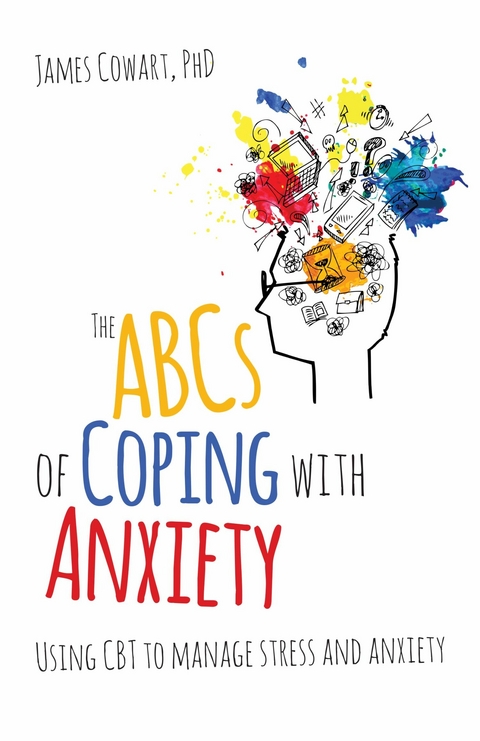
ABCS of Coping with Anxiety (eBook)
160 Seiten
Crown House Publishing (Verlag)
978-1-78583-261-1 (ISBN)
James Cowart is a psychologist with a special interest in providing cognitive behavioural therapy (CBT) to people suffering with anxiety disorders. He has a PhD in Applied Behaviour Analysis and is a member of the American Psychological Association. He specialises in problem-solving formats in family and couples therapy, as well as cognitive behavioural and interpersonal approaches to treat depression and anxiety.
In The ABCS of Coping with Anxiety: Using CBT to Manage Stress and Anxiety, James Cowart offers a concise collection of tried-and-tested strategies from cognitive behavioral therapy (CBT) and makes them accessible to people who are learning to cope with their anxiety on a day-to-day basis. Anxiety is a normal part of our human nature. For spurring you to make decisions or perform, it can actually be helpful. However, an unchecked pattern of intrusive negative thoughts can escalate the severity and persistence of the level of anxiety experienced over time. As this worsens, it is not uncommon to feel an increasing lack of control - ultimately leading to a chain of self-defeating behaviors that may negatively affect all aspects of your daily life. Yet, while it is not possible to directly control our emotions (or what others think or do), it is possible to learn and apply coping skills that can help you face feared situations - rather than escape or avoid them. James Cowart's aim in The ABCS of Coping with Anxiety is to share a toolbox of CBT techniques garnered over 40 years' clinical practice that will enable you to manage your anxiety on a sustainable path toward taking back some of that control. These self-help strategies focus on developing key coping skills designed to reduce fear and anxiety, and are complemented by a user-friendly, step-by-step program of practical exercises that can be personalized to meet each individual's unique needs. Informed by his extensive experience and therapeutic knowledge, and with real-life case studies to guide you along your own journey, James's easy-to-remember ABCS approach is as transformative as it is simple: A is for accepting the thoughts and feelings you can and can't control; B is for breathing slowly and naturally to relieve and relax muscle tension; C is for countering any unrealistic or catastrophic thoughts with truth and logic; and S is for staying with it so you can face your fears and anxieties until they are reduced. Each step is explored in detail in the first four chapters, and further discussion is also dedicated to using the ABCS with different types of anxiety (including social anxiety, specific phobias, panic attacks and obsessive compulsive disorder (OCD)) and coping with related depression, anger and impulsivity. Punctuated with research-informed insight and instruction throughout, The ABCS of Coping with Anxiety offers hope, relief and reassurance in helping you master your anxiety and work toward greater independence. Suitable for those living with anxiety and for the health professionals - including psychiatrists, psychologists, social workers and counsellors - working with them.
“The longest journey begins with a single step.”
ATTRIBUTED TO LAO-TZU, L. GILES (TR.), SAYINGS OF LAO-TZU
Perhaps you have picked up this book because you have not yet found adequate help in dealing with the excessive feelings of stress and anxiety you may be experiencing. My aim in this book is to share with you coping skills that will enable you to manage your excessive stress and anxiety on a day-to-day basis. In my clinical experience, the consequences of untreated problems with anxiety can be devastating. Untreated anxiety problems tend to spread and grow through fear conditioning and eventually can take over a person’s life. As this worsens, it is not uncommon for individuals to begin to experience outbursts of anger and growing depression as well. In an attempt to escape and avoid the stress and misery they are experiencing, an individual may begin to smoke, abuse alcohol, take illegal or prescription drugs or engage in other distracting, but ultimately self-defeating, behavior. These excessive activities may make them feel better, even if only for a few minutes, but will have detrimental long-term consequences. These individuals may eventually suffer from a wide variety of limitations and problems that negatively affect all aspects of their lives. Alternatively, I have seen a great number of people successfully treat their anxiety problems by learning key coping skills from cognitive behavioral therapy (CBT). This form of therapy is based on helping people change their behavior and their thoughts and beliefs. It is this particular form of evidence-based therapy that underpins the ABCS outlined in this book.
So what do we mean by the term anxiety? There are a number of terms we commonly use to describe the nature of an anxiety disorder: e.g., stress, worry, panic and fear. I think of panic as being similar to the height of fear. Anxiety is often less intense than that, but still involves unpleasant feelings of stress and tension throughout the body that can last for a prolonged period of time. Worry refers to the thoughts that pass through our brains that can increase the unpleasant feelings associated with anxiety. You may also have heard people talk about the fight or flight (or fight, flight or freeze) response. This refers to the set of changes that happen within the brain and the body when an animal (or a human) is in real danger. When danger strikes, the brain reacts with automatic stimulation of the amygdala and hypothalamus, which results in adrenaline and other stress hormones being secreted into the bloodstream. The heart rate goes up and bodily functions not needed in an emergency are slowed or stopped (e.g., digestion). All these types of biological changes are designed to help the body deal with a perceived danger by preparing it for confrontation or running away (or freezing and hiding). The freeze element is our biological response when the situation is deemed so dangerous that the first two options will be ineffective. These responses happen automatically and require no conscious thinking. The fight or flight response evolved for good reason: to keep us safe from danger. It may be surprising to learn that anxiety is not necessarily always a problem. The ability to get anxious is a normal part of our human nature. Without this response our distant ancestors who lived in a physically dangerous world would probably not have survived long enough to reproduce. At a young age, they would have impulsively blundered into dangerous situations and perished, and we would not have had the chance to live. Our biological programming evolved to keep us safe.
All animals have this fight or flight response. However, humans can also use language to trigger it. Imagine a small group of early humans approaching a watering hole. A keen-sighted member of the group sees a lion approaching and immediately feels a rush of emotion as his fight or flight response is triggered. Almost as fast, he whispers “lion” to the others. They all feel a similar rush of emotion, before they see the lion, and they all automatically prepare to fight or run away, since hiding won’t work in this situation. The word, and the thought of the lion, is enough to trigger this process, without them needing to see the object of their fear. The individuals in alert groups like this survived long enough to pass their genes on to later humans. The key point is that in humans, language and thoughts can also trigger emotions.
The fight or flight response has evolved to keep us safe, but if it gets triggered in situations where there is no real danger then problems occur. One good way to think of an anxiety disorder is as a pattern of false alarms that persistently trigger our fight or flight response (partially or completely). The false alarms may be in the external environment or within us – in our own thoughts and language. The alarms are false because the individual is in no real, physical danger, but the sense of danger and the feelings of fear and anxiety are completely real.1 To use the lion example, it wouldn’t matter whether we were stood in front of the animal, or whether we had merely heard the word “lion,” the stress response would be as palpable as if we were about to be attacked by it.
Priming us to run away from a lion is clearly a useful function of these anxiety inducing hormones. The problem with anxiety is that human beings can also become anxious in a way that doesn’t serve a useful purpose. Humans have more complex brains than other animals. Our brains mean we are able to think about and imagine lots of possibilities. Presumably, dogs and cats don’t worry a lot about what might happen in the future. Humans can use their more complex brains to think about and plan for the future, which of course can be a very good thing. However, our more complex brains also give us the opportunity to worry and get anxious about things that we have no control over, leading to the serious problems known as anxiety disorders. Learning to accept what we can and cannot control is one of the first steps in overcoming problems with anxiety.
Research presented by the National Institute of Mental Health (NIMH) shows that 18% of adults in the United States experience anxiety disorders each year, and 23% of those cases are considered “severe.” According to some research, of all the adults in the United States who suffer from an anxiety disorder each year, only 13% receive even minimally adequate treatment.2 Globally, problems with anxiety are very common and can be severe. It seems clear that a lot of people who suffer with anxiety problems do not get appropriate treatment. That may not be especially comforting to you as you begin to move forward in coping with your own anxiety, but hopefully in the future the availability of effective treatment will catch up with people’s needs. In 2008, the National Health Service in England began a large initiative to expand the availability of CBT, but unfortunately this is not currently typical of most other countries around the world.3
The primary causes of serious problems with anxiety include: inherited genetic predisposition, negative childhood and adolescent experiences, past emotional traumas and current life stressors. An anxiety disorder is not a sign of “weakness of character” and has nothing to do with an individual’s morality or courage. In fact, these negative cultural myths sometimes prevent individuals from getting the treatment they need. I have worked with many patients who have had to overcome these types of prejudices from bosses, friends and even close family members before they could even begin treatment. This social stigma is another reason why only a small percentage of people with anxiety problems get appropriate treatment.
If for whatever reason you can’t get adequate access to an appropriate therapist, the skills you can learn from this book will form a good basis for you to begin to manage your anxiety. This book attempts to show how a set of easy to remember coping skills can be applied to different anxiety problems. The book is intended to be a teaching tool for individuals suffering from these problems and therefore minimizes excessive technical detail in favor of simplicity. The references within the book are there should you wish to read more about a specific aspect of anxiety, although this volume should equip you with all the basic information you need. If you are reading this as a mental health professional, there is a brief section in the back of the book which outlines how you might find the book useful in your practice. Overall, the book emphasizes the importance of using coping skills to directly face core fears (whether they are fears of imagined catastrophes, humiliating social situations or traumatic memories) and adjust to negative life changes, rather than allowing the anxiety to progress and result in more and more limitations and other related disorders.
Anxiety coping skills can be used with classic anxiety disorders, with common fears and phobias and also in other stressful situations (e.g., the break-up of a relationship, the diagnosis of a frightening medical condition, etc.). This book also teaches other sets of coping skills to help with the related emotional problems that so frequently accompany anxiety disorders: depression and impulsive and angry outbursts. All of the coping skills come from my reading of...
| Erscheint lt. Verlag | 18.10.2017 |
|---|---|
| Verlagsort | London |
| Sprache | englisch |
| Themenwelt | Sachbuch/Ratgeber ► Gesundheit / Leben / Psychologie ► Psychologie |
| Geisteswissenschaften ► Psychologie ► Allgemeine Psychologie | |
| Geisteswissenschaften ► Psychologie ► Angst / Depression / Zwang | |
| Schlagworte | acceptance • accepting thoughts • Anxiety • anxiety and cbt • anxiety and sleep • Anxiety and stress • anxiety therapy • books cbt • breathing and relaxing • build your confidence with cbt • CBT • CBT anxiety • cbt for anxiety • cbt for depression • cbt for stress • cbt help book • cbt in books • cbt relationships • cbt self help books • cbt stress • cbt therapy books • change your thinking • change your thinking sarah edelman • change your way of thinking • changing your thinking with cbt • Cognitive • Cognitive Behavioral Therapy • Cognitive Psychology • cognitive therapy • copeing with depression • coping with anxiety • coping with stress • coping with stress and anxiety • countering unrealistic thoughts • different types of anxiety • dr sarah edelman • Family Therapy • feeling good the new mood therapy • galen alessi • Health • Health and Wellbeing • Illness • manage anxiety • manage stress • mental wellbeing • Mind Over Mood • relieve and relax muscle tension • sarah edelman • self cbt • stop worrying get your life back on track with cbt • Stres • stress and anxiety • stress anxiety |
| ISBN-10 | 1-78583-261-1 / 1785832611 |
| ISBN-13 | 978-1-78583-261-1 / 9781785832611 |
| Informationen gemäß Produktsicherheitsverordnung (GPSR) | |
| Haben Sie eine Frage zum Produkt? |
 EPUB (Wasserzeichen)
DRM: Digitales Wasserzeichen
Dieses eBook enthält ein digitales Wasserzeichen und ist damit für Sie personalisiert. Bei einer missbräuchlichen Weitergabe des eBooks an Dritte ist eine Rückverfolgung an die Quelle möglich.
Dateiformat: EPUB (Electronic Publication)
EPUB ist ein offener Standard für eBooks und eignet sich besonders zur Darstellung von Belletristik und Sachbüchern. Der Fließtext wird dynamisch an die Display- und Schriftgröße angepasst. Auch für mobile Lesegeräte ist EPUB daher gut geeignet.
Systemvoraussetzungen:
PC/Mac: Mit einem PC oder Mac können Sie dieses eBook lesen. Sie benötigen dafür die kostenlose Software Adobe Digital Editions.
eReader: Dieses eBook kann mit (fast) allen eBook-Readern gelesen werden. Mit dem amazon-Kindle ist es aber nicht kompatibel.
Smartphone/Tablet: Egal ob Apple oder Android, dieses eBook können Sie lesen. Sie benötigen dafür eine kostenlose App.
Geräteliste und zusätzliche Hinweise
Buying eBooks from abroad
For tax law reasons we can sell eBooks just within Germany and Switzerland. Regrettably we cannot fulfill eBook-orders from other countries.
aus dem Bereich