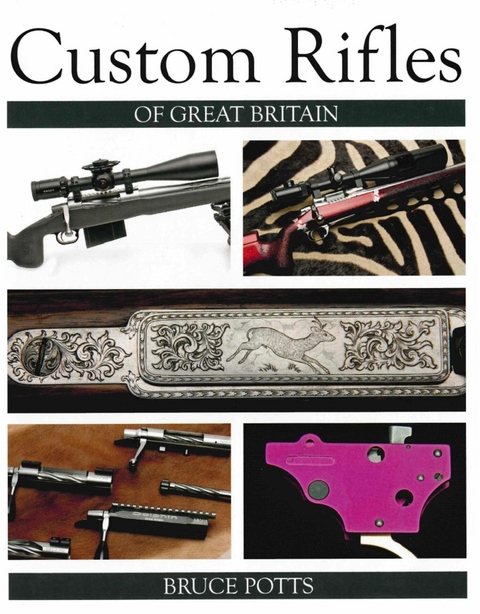
Custom Rifles of Great Britain (eBook)
300 Seiten
Crowood (Verlag)
978-1-78500-259-5 (ISBN)
Bruce Potts has over thirty years' experience as a shooter and wildlife photographer. He writes more than 100 articles a year for publications such as Shooting Times, Shooting Sports and Gun Mart magazines. The subjects covered in his articles range from air rifles, rimfire, centre-fires and reloading, to rifle and product testing and hunting features. Bruce has a passionate interest in custom rifles, in the detailed and thorough testing of rifle ballistics, in deer stalking and in reloading, which has led to the creating of six of his own wildcat cartridge designs. This is Bruce's second book for Crowood, his first being the highly acclaimed Sporting Rifles (2009).
Bruce Potts has over thirty years' experience as a shooter and wildlife photographer. He writes more than 100 articles a year for publications such as Shooting Times, Shooting Sports and Gun Mart magazines. The subjects covered in his articles range from air rifles, rimfire, centre-fires and reloading, to rifle and product testing and hunting features. Bruce has a passionate interest in custom rifles, in the detailed and thorough testing of rifle ballistics, in deer stalking and in reloading, which has led to the creating of six of his own wildcat cartridge designs. This is Bruce's second book for Crowood, his first being the highly acclaimed Sporting Rifles (2009).
Introduction
Ever since man picked up a stone and used it as a weapon, the object has been customized in some way, such as rounding off the edges to make it feel better in the hand or scratching a symbol on it to denote ownership or religious belief. There is an almost inbuilt desire to improve and perpetuate one’s possessions. The weapon is no longer simply a tool for getting the job done but is now cherished and lovingly looked after, and often exhibited to show one’s status in the tribe. How much customizing is up to its owner and the level of adornment usually depends more on the skill or wealth available to achieve the desired outcome. But the desire is the same: whether it be a weapon, knife, car, house or clothes, it always feels good to have something different that no one else owns. That’s the crux of the custom gun ethos, whether it has been built from raw materials to a fully customized state or is limited to a new barrel or a custom stock design. It does not matter: the point is, it’s yours.
Many routes can be taken when following the custom rifle project, which often involves trawling through reams of information to select grades of wood, barrel profiles and action designs. The pleasure can be tempered by the long lead times for work to be completed and, more immediately, a huge dent in your pocket. Regardless of the size of the project, however, it will all be worth it as pride of ownership of the completed rifle as a unique item has its own rewards. Modern day firearms have evolved to such a state that price and quality go hand in hand and the great majority would find that a factory rifle met all their hunting or target shooting needs. There may be a time, however, when doubts start to form and the ‘what if’ questions come to mind. A Ford Focus, for example, will get you from A to B, but why not make it stand out with a special paint job, magnesium wheels, or perhaps a chipped engine and tuned exhaust note? Life would be boring if we all went around in the same old cars. Guns are exactly the same, but enthusiasts mostly go about individualistic in a more sedate fashion.
Ownership of a custom rifle is not simply about enjoying the look and feel of the rifle. It has to perform perfectly in the field where it belongs.
The author, aged twenty one, with his first custom rifle, a Harry Lawson Cochise thumbhole stocked Sako with Shilen 5.5 profiled varmint barrel in .22-250 cartridge.
I was that young chap who bought a standard rifle off the shelf, though it was actually second-hand because I could not afford any better. It didn’t, however, stop me tinkering with it to improve the balance, looks and accuracy.
For more than three decades I have had the good fortunate to enjoy shooting and writing articles for three British shooting magazines, testing and also owning some fantastic custom rifles. I want to share the process of what to look for when you decide to follow this route. Once you have started it is hard to turn back, but the rewards are worth it.
First you have to look at the whole picture, how much you want to spend and where that money may best be used. Often all that it needs is a new custom barrel to pep up a tired old rifle, but these have shot up in price, especially if a wildcat calibre is ordered. It is not only the raw materials such as the barrel itself, but you need to choose a competent riflesmith to undertake the work. The ancillary kit, such as reloading dies, case forming dies and custom-ordered chamber reamers, add to the expense. You should also consider the overall time of construction and the higher degree of skill involved. Not everything, though, may go to plan. You have to think of a rifle as a finely tuned instrument: all the parts must play in harmony together to achieve the perfect ensemble. Often you can replace one part only to find it has a negative effect on the rifle’s performance, so you need to change another to get it back on song.
Replacing the stock can instantly transform the rifle’s appearance into that of a custom item. This can also be the cheapest option if an aftermarket synthetic stock or laminate is used. These are often a ‘drop-in’ item, so bedding is not necessarily needed and this is something you can achieve yourself. But beauty can be skin deep as rifles are fickle mistresses. Unless the unity between the barrel and action in the stock and bedding is perfect all that lovely new wood is of no benefit.
Custom rifles often grow with the owner. Unless you are careful, what started as a re-barrel job can soon involve a custom stock, new trigger and fancy chequering. Even then sensible choices are necessary to achieve the perfect rifle, which is what this book is about. Chapter by chapter we will look at the individual parts of the custom rifle, laying out the choices and pitfalls you need to be aware of before you embark on a journey towards your dream rifle.
There are three major types of custom rifle:
Factory custom. A special edition or limited run of a particular rifle issued with upgraded finish, engraving or select woodwork.
Semi-custom. Probably the most popular and cost-effective way to obtain a custom rifle. Here an existing factory rifle can be ‘customized’ by adding aftermarket upgraded parts, such as Match grade trigger units, Select Match grade barrels, blueprinted actions and high-grade wood or synthetic stocks. There are also what may be called ‘semi-custom’ designs, where a rifle manufacturer, such as RPA, Kimber or Lynx, produces a rifle of upgraded quality that can be ordered to a customer’s requirements.
Factory uprated Schultz and Larsen in 300 Blackout; (middle) Lynx semi- custom; (bottom) Norman Clark full custom .35 Whelen AK rifle.
Full-blown custom. As the name suggests this is a rifle designed from the floor up exactly to the customer’s requirements, utilizing the very best precision parts and highest quality to produce a one-off rifle.
There are many excellent custom riflesmiths in Britain and as a nation we have an incredible depth of knowledge and talent at our disposal. Custom rifles have changed a lot in the last century, from refashioned military rifles taken into the game fields to fully blown, computer-designed and engineered modern marvels. The skill remains the same, but the design and individual tastes have changed across the generations.
Classic rifles that use the ubiquitous military Mauser 98 action are still perhaps the epitome of a true British custom rifle, with meticulous attention to detail and long man-hours required to build what can only be described as pure art. These Mauser actions have spawned many of the world’s classic rifles: old Argentine or Oberndorf Mausers are much sought after as the basis of a purely custom creation. We will look at many classic-styled custom rifles made in the old ways and some with a modern twist, but today’s custom rifles are more accessible due to the vast range of aftermarket products, available at reasonable prices, that can be custom combined to achieve your heart’s desire. Again we will look at each item used in the make-up of a custom rifle – action, barrel, stock, trigger, scope mount and accessory choice – and delve into the world of wildcat cartridges and how cartridge choice and precision reloading equipment can extract every last ounce of performance. You may, though, reach the stage in your shooting career when the standard factory rifle just does not satisfy your desires as your tastes evolve alongside a maturing interest in rifles.
In the past most custom rifles centred around the classic English design. This incorporated English or French walnut stocks with vivid figuring, subtle hues, long raked profiles and a shadow-lined cheekpiece with exquisitely executed chequering. Add to this the flawless, deep rich blued metal finish, with perhaps a custom set of scope mounts, and you have a very British custom item admired around the globe. What factory rifles can never achieve is that close tolerance of manufacture that custom rifle builders can obtain. Where the factory rifle ends, the custom rifle begins. A custom rifle builder, for example, is able not only to enhance the look by sculpting the metal but to also apply a variety of finishes such as Teflon, classic blue, Duracoat or glass peened. In my opinion, however, custom perfection lies under the skin as a precision riflesmith has the knowledge to achieve a perfect fit for better handling and accuracy.
Whereas a factory rifle’s trigger may be heavy or have creep in the travel, or it exhibits a bedding area that is sloppy and bolt movement is stiff, a good custom riflesmith can reprofile the bolt and hone the finish to ensure that there is total contact on the lugs. The trigger can be replaced for a benchrest quality item, or honed to the perfect trigger setting and the action bedded into the woodwork or synthetic stock option so that it fits like a glove, using the finest bedding compound and aluminium pillars to achieve stability between the metal and woodwork for consistent accuracy. There are also a myriad of small details that contribute to a rifle’s overall finish and fit. These may only be apparent to the skilled eye of riflesmiths themselves, but they become manifest in the overall handling of the finished rifle.
Some people seek pure accuracy in a custom rifle and will demand perfection in this way without worrying about the looks. Here deep bluing and exotic woods count for nothing and all the custom work goes into achieving perfection in the fine tolerances between metalwork and an exact barrel...
| Erscheint lt. Verlag | 31.3.2017 |
|---|---|
| Verlagsort | London |
| Sprache | englisch |
| Themenwelt | Sachbuch/Ratgeber ► Freizeit / Hobby ► Angeln / Jagd |
| Sachbuch/Ratgeber ► Sport | |
| Schlagworte | action • Barrel • chamber • gunsmith • Sights • Stock • Trigger |
| ISBN-10 | 1-78500-259-7 / 1785002597 |
| ISBN-13 | 978-1-78500-259-5 / 9781785002595 |
| Informationen gemäß Produktsicherheitsverordnung (GPSR) | |
| Haben Sie eine Frage zum Produkt? |
 EPUB (Wasserzeichen)
DRM: Digitales Wasserzeichen
Dieses eBook enthält ein digitales Wasserzeichen und ist damit für Sie personalisiert. Bei einer missbräuchlichen Weitergabe des eBooks an Dritte ist eine Rückverfolgung an die Quelle möglich.
Dateiformat: EPUB (Electronic Publication)
EPUB ist ein offener Standard für eBooks und eignet sich besonders zur Darstellung von Belletristik und Sachbüchern. Der Fließtext wird dynamisch an die Display- und Schriftgröße angepasst. Auch für mobile Lesegeräte ist EPUB daher gut geeignet.
Systemvoraussetzungen:
PC/Mac: Mit einem PC oder Mac können Sie dieses eBook lesen. Sie benötigen dafür die kostenlose Software Adobe Digital Editions.
eReader: Dieses eBook kann mit (fast) allen eBook-Readern gelesen werden. Mit dem amazon-Kindle ist es aber nicht kompatibel.
Smartphone/Tablet: Egal ob Apple oder Android, dieses eBook können Sie lesen. Sie benötigen dafür eine kostenlose App.
Geräteliste und zusätzliche Hinweise
Buying eBooks from abroad
For tax law reasons we can sell eBooks just within Germany and Switzerland. Regrettably we cannot fulfill eBook-orders from other countries.
aus dem Bereich