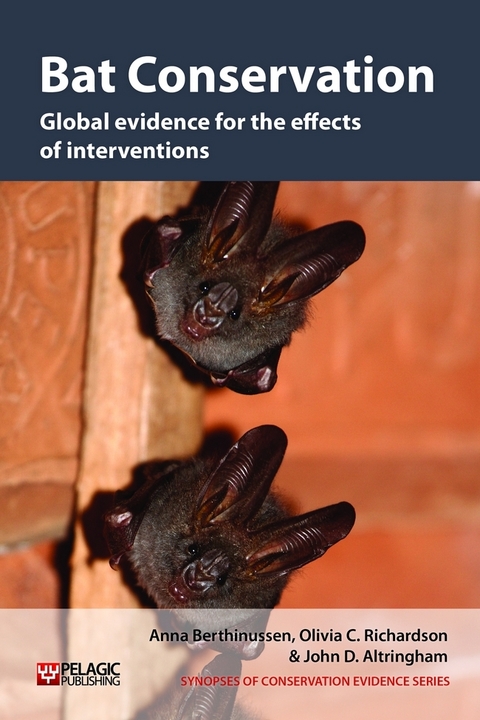
Bat Conservation (eBook)
Pelagic Publishing (Verlag)
978-1-907807-91-6 (ISBN)
This book brings together scientific evidence and experience relevant to the practical conservation of bats. The authors have developed a global list of interventions that could benefit bats. For each intervention, the book summarises studies captured by the Conservation Evidence project.
This book brings together scientific evidence and experience relevant to the practical conservation of bats. The authors worked with an international group of bat experts and conservationists to develop a global list of interventions that could benefit bats.For each intervention, the book summarises studies captured by the Conservation Evidence project, where that intervention has been tested and its effects on bats quantified. The result is a thorough guide to what is known, or not known, about the effectiveness of bat conservation actions throughout the world.Bat Conservation is the fifth in a series of Synopses that will cover different species groups and habitats, gradually building into a comprehensive summary of evidence on the effects of conservation interventions for all biodiversity throughout the world.By making evidence accessible in this way, we hope to enable a change in the practice of conservation, so it can become more evidence-based. We also aim to highlight where there are gaps in knowledge.Evidence from all around the world is included. If there appears to be a bias towards evidence from northern European or North American temperate environments, this reflects a current bias in the published research that is available to us. Conservation interventions are grouped primarily according to the relevant direct threats, as defined in the International Union for the Conservation of Nature (IUCN) s Unified Classification of Direct Threats (www.iucnredlist.org/technical-documents/classification-schemes).
lt;p>Anna Berthinussen is a post-doctorate researcher at the University of Leeds, currently working on a Defra-funded study of the interactions between bats and roads. She holds degrees in bat ecology and conservation (PhD) and Zoology (BSc), both from the University of Leeds. She has published several scientific papers and contributed to book chapters on bats, and has a keen interest in wildlife conservation.
Olivia Richardson is a conservation ecologist who has recently been working as a Research Assistant and an ecological consultant. She holds degrees in Biodiversity and Conservation (MSc) and Biology (BSc with Honours), both from the University of Leeds. She is a former British Ecological Society Education, Training and Careers committee member and Undergraduate Fellow alumni. Her
research interests include bat conservation, urban ecology, citizen science and applied ecology and its translation into policy and practice.
John Altringham is Professor of Animal Ecology & Conservation at the University of Leeds. He works primarily on the ecology and conservation of bats, but has broad interests in conservation. In the past he has studied animals as diverse as tunas and tarantulas. He is the author of numerous scientific papers and reports, and three books on bats, the most recent being Bats, from evolution to conservation, published by OUP in 2011. He is a scientific advisor to the National Trust and other conservation organisations.
1 Threat: Residential and commercial development
2 Threat: Agriculture
3 Threat: Energy production – wind turbines
4 Threat: Energy production – mining
5 Threat: Transportation and service corridors
6 Threat: Biological resource use
7 Threat: Human disturbance – caving and tourism
8 Threat: Natural system modification – natural fire and fire suppression
9 Threat: Invasive species and disease
10 Threat: Pollution
11 Providing artificial roost structures for bats
12 Education and awareness raising
Index
| Erscheint lt. Verlag | 16.5.2014 |
|---|---|
| Reihe/Serie | Synopses of Conservation Evidence | Synopses of Conservation Evidence |
| Mitarbeit |
Herausgeber (Serie): William J. Sutherland |
| Verlagsort | Exeter |
| Sprache | englisch |
| Themenwelt | Sachbuch/Ratgeber ► Natur / Technik ► Naturführer |
| Naturwissenschaften ► Biologie ► Ökologie / Naturschutz | |
| Naturwissenschaften ► Biologie ► Zoologie | |
| Schlagworte | Bats • Chiroptera • conservation • Ecology • evidence-based • Habitat • habitat loss |
| ISBN-10 | 1-907807-91-8 / 1907807918 |
| ISBN-13 | 978-1-907807-91-6 / 9781907807916 |
| Informationen gemäß Produktsicherheitsverordnung (GPSR) | |
| Haben Sie eine Frage zum Produkt? |
 EPUB (Adobe DRM)
Kopierschutz: Adobe-DRM
Adobe-DRM ist ein Kopierschutz, der das eBook vor Mißbrauch schützen soll. Dabei wird das eBook bereits beim Download auf Ihre persönliche Adobe-ID autorisiert. Lesen können Sie das eBook dann nur auf den Geräten, welche ebenfalls auf Ihre Adobe-ID registriert sind.
Details zum Adobe-DRM
Dateiformat: EPUB (Electronic Publication)
EPUB ist ein offener Standard für eBooks und eignet sich besonders zur Darstellung von Belletristik und Sachbüchern. Der Fließtext wird dynamisch an die Display- und Schriftgröße angepasst. Auch für mobile Lesegeräte ist EPUB daher gut geeignet.
Systemvoraussetzungen:
PC/Mac: Mit einem PC oder Mac können Sie dieses eBook lesen. Sie benötigen eine
eReader: Dieses eBook kann mit (fast) allen eBook-Readern gelesen werden. Mit dem amazon-Kindle ist es aber nicht kompatibel.
Smartphone/Tablet: Egal ob Apple oder Android, dieses eBook können Sie lesen. Sie benötigen eine
Geräteliste und zusätzliche Hinweise
Buying eBooks from abroad
For tax law reasons we can sell eBooks just within Germany and Switzerland. Regrettably we cannot fulfill eBook-orders from other countries.
aus dem Bereich