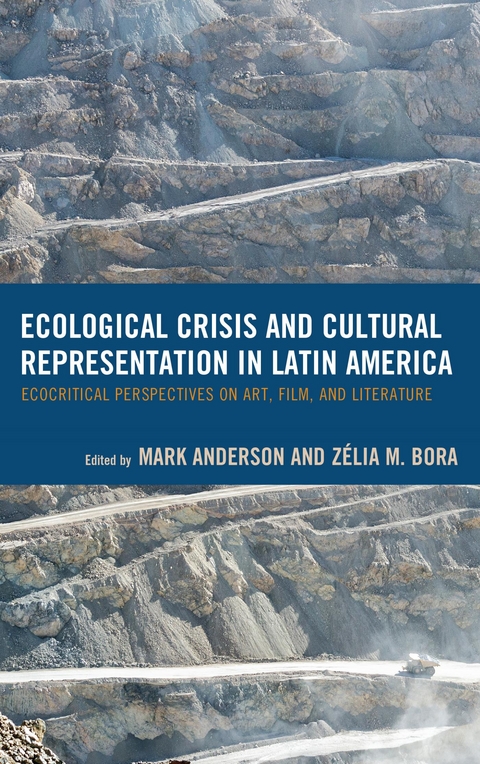
Ecological Crisis and Cultural Representation in Latin America (eBook)
362 Seiten
Rowman & Littlefield (Verlag)
978-1-4985-3096-5 (ISBN)
Worldwide environmental crisis has become increasingly visible over the last few decades as the full scope of anthropogenic climate change manifests itself and large-scale natural resource extraction has expanded into formerly remote areas that seemed beyond the reach of industrialization. Scientists and popular culture alike have turned to the term "e;Anthropocene"e; to capture the global scale of environmental and even geological transformations that humans have carried out over the last two centuries. The chapters in Ecological Crisis and Cultural Representation in Latin America examine the dynamics and interplay between local cultures and the expansion of global capitalism in Latin America, emphasizing the role of art in bearing witness to and generating awareness of environmental and social crises, but also its possibilities for formulating solutions. They take particular care to draw out the ways in which local environmental crises in Latin American nations are witnessed and imagined as part of a global system, focusing on the problems of time, scale, and complexity as key terms in conceiving the dimensions of crisis. At the same time, they question the notion of the Anthropocene as a species-wide "e;human"e; historical project, making visible the coloniality of natural resource extraction in Latin America and its dire effects for local people, cultures, and environments. Taking an ecocritical approach to Latin American cultural production including literature, film, performance, and digital artwork, the chapters in this volume develop a notion of ecological crisis that captures not only its documentary sense in the representation of environmental destruction (the degradation of the oikos), but also the crisis in the modern worldview (logos) that the acknowledgment of crisis provokes. In this sense, crisis is also the promise of a turning point, of the possibilities for change. Latin American representations of ecological crisis thus create the conditions for projects that decolonize environments, developing new, sustainable ways of conceiving of and relating to our world or returning to old ones.
Mark Anderson is associate professor of Latin American literatures and cultures at the University of GeorgiaZélia M. Bora is professor of Brazilian and comparative literature at the Universidade Federal de Paraiba
1. Latin America in the World-Ecology: Origins and Crisis - Sharae Deckard3. Anthropomorphism and Arboricide: The Life and Death of Trees in the American Tropics - Lesley Wylie6. The Grounds of Crisis and the Geopolitics of Depth: Mexico City in the Anthropocene - Mark Anderson8. The Languages of Ecological Crisis in Brazilian Documentary and Fiction - Zélia M. BoraSection III: Decolonial Ecologies11. Ecological Crisis and the Re-enchantment of Nature in Jaime Huenún’s Reducciones - Ida Day13. Hippopotami, Humans, and Habitat: Ecological Crisis and Posthuman Subjectivities in Mempo Giardinelli’s Imposible equilibrio - Diana Dodson Lee15. The Nicaragua Canal and the Shifting Currents of Sandinista Environmental Policy - Adrian Kane16. Tourism, Ecology, and Changing US-Cuban Relations - Marcela Reales Afterword: The Self as Nonhuman Other - Zélia M. Bora
| Erscheint lt. Verlag | 4.10.2016 |
|---|---|
| Reihe/Serie | Ecocritical Theory and Practice |
| Co-Autor | Herman Vladimir Ruiz Abecasis, Adrian Kane, Jeremy Larochelle, Diana Dodson Lee, Diego Mejia-Prado, Kerstin Oloff, Marcela Reales, Maria Victoria Sanchez, Lesley Wylie, Abigail Perez Aguilera, Simao Farias Almeida, Juanita C. Aristizabal, Ana Avalos, Mirian Carballo, Ida Day, Sharae Deckard, Juan Carlos Galeano |
| Sprache | englisch |
| Themenwelt | Sachbuch/Ratgeber ► Natur / Technik ► Natur / Ökologie |
| Geisteswissenschaften ► Sprach- / Literaturwissenschaft ► Anglistik / Amerikanistik | |
| Geisteswissenschaften ► Sprach- / Literaturwissenschaft ► Literaturwissenschaft | |
| Sozialwissenschaften ► Pädagogik | |
| Schlagworte | Cosmopolitics • Cultural representation • Ecocriticism • Ecological Crisis • Environmental Crisis • Environmental Humanities • indigeneity • Latin America • Latin American literature • New Materialism |
| ISBN-10 | 1-4985-3096-6 / 1498530966 |
| ISBN-13 | 978-1-4985-3096-5 / 9781498530965 |
| Informationen gemäß Produktsicherheitsverordnung (GPSR) | |
| Haben Sie eine Frage zum Produkt? |
 EPUB (Adobe DRM)
Kopierschutz: Adobe-DRM
Adobe-DRM ist ein Kopierschutz, der das eBook vor Mißbrauch schützen soll. Dabei wird das eBook bereits beim Download auf Ihre persönliche Adobe-ID autorisiert. Lesen können Sie das eBook dann nur auf den Geräten, welche ebenfalls auf Ihre Adobe-ID registriert sind.
Details zum Adobe-DRM
Dateiformat: EPUB (Electronic Publication)
EPUB ist ein offener Standard für eBooks und eignet sich besonders zur Darstellung von Belletristik und Sachbüchern. Der Fließtext wird dynamisch an die Display- und Schriftgröße angepasst. Auch für mobile Lesegeräte ist EPUB daher gut geeignet.
Systemvoraussetzungen:
PC/Mac: Mit einem PC oder Mac können Sie dieses eBook lesen. Sie benötigen eine
eReader: Dieses eBook kann mit (fast) allen eBook-Readern gelesen werden. Mit dem amazon-Kindle ist es aber nicht kompatibel.
Smartphone/Tablet: Egal ob Apple oder Android, dieses eBook können Sie lesen. Sie benötigen eine
Geräteliste und zusätzliche Hinweise
Buying eBooks from abroad
For tax law reasons we can sell eBooks just within Germany and Switzerland. Regrettably we cannot fulfill eBook-orders from other countries.
aus dem Bereich