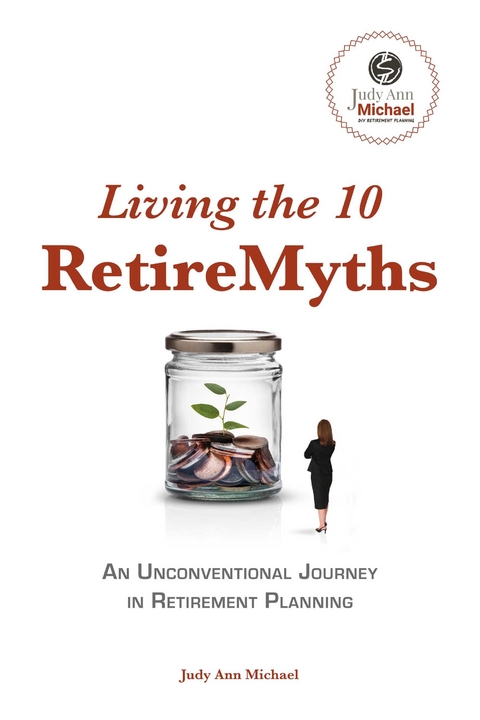
Living the 10 Retiremyths (eBook)
126 Seiten
Bookbaby (Verlag)
978-1-5439-0924-1 (ISBN)
What's a RetireMyth? It's a belief you might hold about life after retirement, only to find out once the party's over that it's not at all what you expected. If you thought you could keep working, win the lottery, depend on your children to support you, or live your current lifestyle on Social Security, you just might be a victim of the RetireMyth. If that's the case, this book was written for you. Over an intense three-year period, Judy Ann Michael watched her career dissolve (taking her six-figure salary with it), lived in a retirement center to help her aging father through an illness, and took a much-needed Pre-Retirement Timeout to re-assess her future. She used her time off to rest, but also took a hard look at her future and what would be required of her, both personally and financially. Like many Baby Boomers and Gen-Xer's facing retirement, she felt uncertain about her financial future. After a failed attempt at starting an internet training business and facing brick walls as she applied for over 75 jobs, Ms. Michael experienced how difficult it was going to be to fund her current six-figure lifestyle and her retirement. Using desperation and determination, she embraced the need for a simpler life, downsizing from an expensive home to a small apartment and ridding herself of over half of what she owned. Simplifying her life turned out to benefit her physical, mental, emotional and financial health and she includes specific steps on how to embrace your own simplified life. She used her 30 years of business acumen to address her finances. After solving complex financial problems for over 50 large organizations, she realized she could use the same approach and create a new personal money management system. Instead of using the outdated model of spending within her means, she reversed the formula to determine how much income she would need to support the simpler lifestyle she chose. Ms. Michael also discovered that employing these new financial systems would only work if she could adopt a new mindset, one that included being clear about what she wanted and using her intention and language to support her goals. Using humor and determination, Ms. Michael chronicles how she survived Living the 10 RetireMyths. She will take you on her personal journey through letting go of her old life and designing a future built to withstand the rigors of impending retirement. In sharing her story, you will learn to take control of your own financial and professional future now, before you become caught up in your own Retiremyth.
Lesson #1:
I Lived the Future
Dad got sick.
It was supposed to be an easy-peasy hip replacement surgery. But nothing is easy when you are 90 years old. Although Dad was in pretty good shape for his advanced years, things went haywire.
Caretaking
In the fall of 2015, I had to find a way to stay employed and travel across the country to care for Dad. I arranged to work remotely from my employer in Seattle and travel to Indiana to care for him. But I won’t lie: the decision and the situation were rough. My sister had been with him during his surgery then he was transferred to a nursing home for rehabilitation before she returned to her home in California. When I arrived a few days after her departure, I found him slumped in his wing chair in the nursing home, looking tired and gray. His care had been sub-standard, and his health had rapidly deteriorated.
Two days after my arrival, he was admitted to the hospital for an additional surgery. Three specialists oversaw his care and discharged him to spend 21 days (the Medicare limit) in another rehabilitation facility. At the end of the 21-day period following the second surgery, I had to make a choice whether to send him back to the substandard nursing home or care for him myself at his apartment with the assistance of four home health nurses. I chose the latter.
He was glad to be back in his home, and I set up his one-bedroom apartment to be a mini medical facility. I shadowed his home care nurses, wore isolation gowns and gloves, and washed my hands 10 times a day. I changed his bed, bought medical supplies, and learned how to use the leased medical equipment, which always seemed to fail at 8 p.m. on a Saturday night. I scheduled more than 50 doctor and medical appointments in one month. I ran all day long. In the back of my mind, I thought of all the people my age who care for their parents in this manner for years at a time. I knew I was lucky that this was a short-term gig. I don’t regret having had to care for him; I know he would have done the same for me.
Daily Living
I was exceptionally grateful that Dad had chosen to downsize years earlier. In 2012, he moved from the three-bedroom family home of 56 years to an apartment in a retirement center that provided independent living and assisted living care. He waited until he was ready to downsize, sold his house, and over the course of a whirlwind week, I helped transition him to the retirement home. He had hired a senior move management company to downsize his home and host an estate sale, which they pulled off with great care and efficiency. Dad loved his new convenient apartment and learned to become part of the retirement community. His adjustment from more than 2,000 square feet to 500 square feet took some time, but he found great ease in his new surroundings.
Dad’s small apartment was my home during his recovery. I slept on his pull-out couch with a three-inch thick mattress for two and a half months, sharing his one-bedroom, one-bathroom apartment. My wardrobe consisted of four shirts, three pairs of leggings, two sweaters, two pairs of shoes, and one dressy outfit. I used the family china cabinet as my dresser to store my underwear and pajamas. My biggest stash was the 20 bottles of supplements I brought with me to ward off any infections and keep up my stamina. And reminiscent of my college days, I bought a small plastic bucket to carry my soap, shampoo, and razor to the shower. I often stared at my belongings, amazed that I could get by on so little, yet not feel deprived.
I had quickly handed off my life in Seattle to dependable friends. I asked one girlfriend to watch my house, mail, and bills, and she informed me if any urgent financial matter arose. My regal standard poodle, Sir Beckett, became a short-term resident of another friend’s family. Frequent phone conversations with my friends helped keep my spirits up. The right people stepped forward at the right time to help manage my life, and I am forever grateful.
I lived life alongside the 80-, 90-, and 100-year-old residents in Dad’s retirement home. I saw that it takes enormous energy just to get dressed, go to doctor appointments, and do a few errands. It seemed an eternity just to walk to the cafeteria for a meal. Family seemed to rarely visit the residents, even though there was great joy when a son, daughter, or grandchildren arrived. The residents themselves formed strong bonds, assisted by the staff members who formed a caring extended family. Dad is still a favorite of the staff members, joking with them and sharing the latest news about the Chicago Bears and Cubbies.
As Dad recovered, I also had to take care of myself. I arose at 6 a.m., prepared breakfast, and took him to his doctor appointments between 8 a.m. and noon, then returned to work remotely from noon until after 6 p.m. I served as an assistant to the home health nurses and learned how to care for and dress deep wounds. I squeezed in time for grocery shopping and other errands during the week and weekends. I was very cognizant of what I ate and got my exercise by running up and down the long halls of the retirement home or by walking around the nearby Kmart parking lot. Sticking to a diet and exercise plan that kept me healthy was vital. I was busy seven days a week.
The Retirement Home
I became friends with my dad’s friends, many of whom he had known since grammar school. Upon his return from the rehabilitation center, two ladies stopped me in the hallway, asking about his recovery. “He’s our poster boy. Not many people ever come back here from the hospital.” Dad’s recovery was a sign of hope that recovery from a devastating illness at an advanced age and return to normal life was a possibility.
I encountered the same two ladies giggling in the hallway one night and took the opportunity to ask them how they liked living in the home. They looked at each other and their moods turned somber. “Just yesterday I was 16 years old and now I am here. What happened to all those years?” she said. I realized that it will only be a matter of time before I am 90 years old, giggling with my girlfriends in the hallway. I hope I still feel like I am 16 years old and enjoy my life at that advanced age.
The retirement home hosted nonstop activities for the residents to enjoy, including special dinners in the cafeteria where community volunteers played live music. Several years ago, one of Dad’s childhood friends joined him for dinner on the night they served a favorite entre, barbequed spareribs. His friend commented that his doctor called with an urgent message to get to the hospital immediately because his bloodwork indicated a serious condition. Dad asked him why he didn’t go to the hospital. His friend responded, “Because it’s Rib Night.”
His friend was admitted to the hospital the next day, slipped into a coma, and died a short time later.
Life, illness, and death were a daily occurrence at the retirement home. I learned to appreciate spending time with my dad and daily conversations about bridge tourneys, puzzles, and sports. The little things made life enjoyable.
Prelude
Time is short. At an advanced age, I discovered it’s not uncommon to never see friends again. An innocent fall or illness may require the resident to go to the hospital. Other residents may not see or hear from that person again, until a note in the hallway appears honoring their passing.
I learned what it was like to have the tables turned, when the child becomes the parent. I had to take the lead and make some hard decisions about my dad’s care, not only on this occasion, but on two previous occurrences also. My sister and I became strong advocates for him, and we went to great lengths to form relationships with his doctors and their staffs to remain well-informed.
My sister and I are committed to caring for my dad, and luckily, he is financially able to support himself. After living in the retirement home, I realized quickly that if I didn’t start to creatively plan for my next few decades, dire aging statistics may catch up with me. I would have to ensure that my wishes were put on paper, my financial life was in order, and I was physically and mentally ready for the next few decades.
Living in this facility on an extended basis inspired me to ask myself, “What kind of life will I be living during my seventies and beyond?” I realized that I would not be able to work full time at that age. I don’t have an extended family to care for me, and if my genetics prove true, I will live to be in my nineties like the four generations before me. (No kidding, I have four generations on my dad’s side that lived to be nearly 100 years old.) It was strikingly apparent that I would have to have the financial means in place to take care of myself and live in an environment that supported me.
I also experienced what it was like to scale down dramatically and live with less. I caught myself looking at my clothing one day, recognizing how small of a wardrobe I had. I survived living with fewer than 20 pieces of clothing and only two pairs of shoes for two and a half months, and I was just fine. In fact, by having less stuff, I could focus on the important things like taking care of my dad and my basic needs.
Between my sister and me, we spent nearly four months living...
| Erscheint lt. Verlag | 1.10.2017 |
|---|---|
| Sprache | englisch |
| Themenwelt | Sachbuch/Ratgeber ► Beruf / Finanzen / Recht / Wirtschaft ► Geld / Bank / Börse |
| ISBN-10 | 1-5439-0924-8 / 1543909248 |
| ISBN-13 | 978-1-5439-0924-1 / 9781543909241 |
| Informationen gemäß Produktsicherheitsverordnung (GPSR) | |
| Haben Sie eine Frage zum Produkt? |
 EPUB (Ohne DRM)
Größe: 713 KB
Digital Rights Management: ohne DRM
Dieses eBook enthält kein DRM oder Kopierschutz. Eine Weitergabe an Dritte ist jedoch rechtlich nicht zulässig, weil Sie beim Kauf nur die Rechte an der persönlichen Nutzung erwerben.
Dateiformat: EPUB (Electronic Publication)
EPUB ist ein offener Standard für eBooks und eignet sich besonders zur Darstellung von Belletristik und Sachbüchern. Der Fließtext wird dynamisch an die Display- und Schriftgröße angepasst. Auch für mobile Lesegeräte ist EPUB daher gut geeignet.
Systemvoraussetzungen:
PC/Mac: Mit einem PC oder Mac können Sie dieses eBook lesen. Sie benötigen dafür die kostenlose Software Adobe Digital Editions.
eReader: Dieses eBook kann mit (fast) allen eBook-Readern gelesen werden. Mit dem amazon-Kindle ist es aber nicht kompatibel.
Smartphone/Tablet: Egal ob Apple oder Android, dieses eBook können Sie lesen. Sie benötigen dafür eine kostenlose App.
Geräteliste und zusätzliche Hinweise
Buying eBooks from abroad
For tax law reasons we can sell eBooks just within Germany and Switzerland. Regrettably we cannot fulfill eBook-orders from other countries.
aus dem Bereich