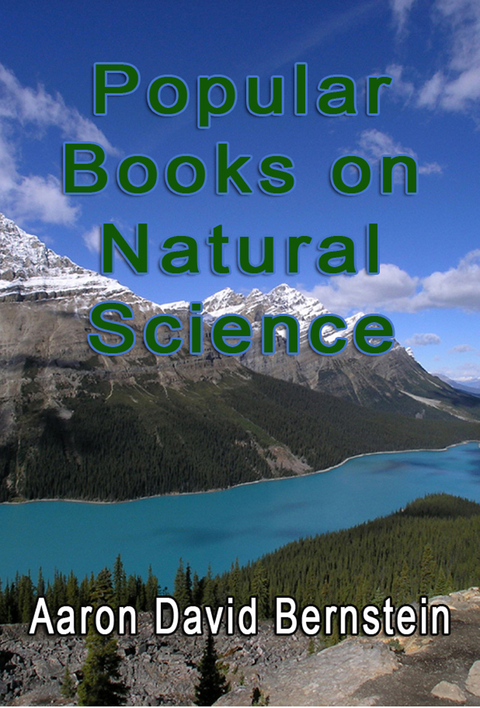
Popular Books on Natural Science (eBook)
149 Seiten
Publishdrive (Verlag)
978-1-300-37527-2 (ISBN)
Natural philosophers have considered and investigated subjects that often appear to the unscientific man beyond the reach of human intelligence. Among these subjects may be reckoned the question, 'How many pounds does the whole earth weigh?'
One would, indeed, believe that this is easy to answer. A person might assign almost any weight, and be perfectly certain that nobody would run after a scale, in order to examine, whether or not an ounce were wanting. Yet this question is by no means a joke, and the answer to it is by no means a guess; on the contrary, both are real scientific results. The question in itself is as important a one, as the answer, which we are able to give, is a correct one.
Knowing the size of our globe, one would think that there was no difficulty in determining its weight. To do this, it would be necessary only to make a little ball of earth that can be accurately weighed; then we could easily calculate how many times the earth is larger than this little ball; and by so doing, we might tell, at one's finger-ends, that-if we suppose the little earth-ball to weigh a hundred-weight-the whole globe, being so many times larger, must weigh so many hundred-weights.
Such a proceeding, however, would be very likely to mislead us. For all depends on the substance the little ball is made of. If made of loose earth, it will weigh little; if stones are taken with it, it will weigh more; while, if metals were put in, it would, according to the kind of metal you take, weigh still more.
If, then, we wish to determine the weight of our globe by the weight of that little ball, it is first necessary to know of what our globe consists; whether it contains stones, metals, or things entirely unknown; whether empty cavities, or whether, indeed, the whole earth is nothing but a hollow sphere, on the surface of which we live, and in whose inside there is possibly another world that might be reached by boring through the thick shell.
With the exercise of a little thought, it will readily be seen that the question, 'How much does our earth weigh?' in reality directs us to the investigation of the character of the earth's contents; this, however, is a question of a scientific nature.
Natural philosophers have considered and investigated subjects that often appear to the unscientific man beyond the reach of human intelligence. Among these subjects may be reckoned the question, "e;How many pounds does the whole earth weigh?"e;One would, indeed, believe that this is easy to answer. A person might assign almost any weight, and be perfectly certain that nobody would run after a scale, in order to examine, whether or not an ounce were wanting. Yet this question is by no means a joke, and the answer to it is by no means a guess; on the contrary, both are real scientific results. The question in itself is as important a one, as the answer, which we are able to give, is a correct one.Knowing the size of our globe, one would think that there was no difficulty in determining its weight. To do this, it would be necessary only to make a little ball of earth that can be accurately weighed; then we could easily calculate how many times the earth is larger than this little ball; and by so doing, we might tell, at one's finger-ends, that if we suppose the little earth-ball to weigh a hundred-weight the whole globe, being so many times larger, must weigh so many hundred-weights.Such a proceeding, however, would be very likely to mislead us. For all depends on the substance the little ball is made of. If made of loose earth, it will weigh little; if stones are taken with it, it will weigh more; while, if metals were put in, it would, according to the kind of metal you take, weigh still more.If, then, we wish to determine the weight of our globe by the weight of that little ball, it is first necessary to know of what our globe consists; whether it contains stones, metals, or things entirely unknown; whether empty cavities, or whether, indeed, the whole earth is nothing but a hollow sphere, on the surface of which we live, and in whose inside there is possibly another world that might be reached by boring through the thick shell.With the exercise of a little thought, it will readily be seen that the question, "e;How much does our earth weigh?"e; in reality directs us to the investigation of the character of the earth's contents; this, however, is a question of a scientific nature.
| Erscheint lt. Verlag | 22.12.2016 |
|---|---|
| Sprache | englisch |
| Themenwelt | Sachbuch/Ratgeber ► Natur / Technik ► Natur / Ökologie |
| Naturwissenschaften | |
| Technik | |
| Schlagworte | Natural science |
| ISBN-10 | 1-300-37527-2 / 1300375272 |
| ISBN-13 | 978-1-300-37527-2 / 9781300375272 |
| Informationen gemäß Produktsicherheitsverordnung (GPSR) | |
| Haben Sie eine Frage zum Produkt? |
 EPUB (Ohne DRM)
Digital Rights Management: ohne DRM
Dieses eBook enthält kein DRM oder Kopierschutz. Eine Weitergabe an Dritte ist jedoch rechtlich nicht zulässig, weil Sie beim Kauf nur die Rechte an der persönlichen Nutzung erwerben.
Dateiformat: EPUB (Electronic Publication)
EPUB ist ein offener Standard für eBooks und eignet sich besonders zur Darstellung von Belletristik und Sachbüchern. Der Fließtext wird dynamisch an die Display- und Schriftgröße angepasst. Auch für mobile Lesegeräte ist EPUB daher gut geeignet.
Systemvoraussetzungen:
PC/Mac: Mit einem PC oder Mac können Sie dieses eBook lesen. Sie benötigen dafür die kostenlose Software Adobe Digital Editions.
eReader: Dieses eBook kann mit (fast) allen eBook-Readern gelesen werden. Mit dem amazon-Kindle ist es aber nicht kompatibel.
Smartphone/Tablet: Egal ob Apple oder Android, dieses eBook können Sie lesen. Sie benötigen dafür eine kostenlose App.
Geräteliste und zusätzliche Hinweise
Buying eBooks from abroad
For tax law reasons we can sell eBooks just within Germany and Switzerland. Regrettably we cannot fulfill eBook-orders from other countries.
aus dem Bereich