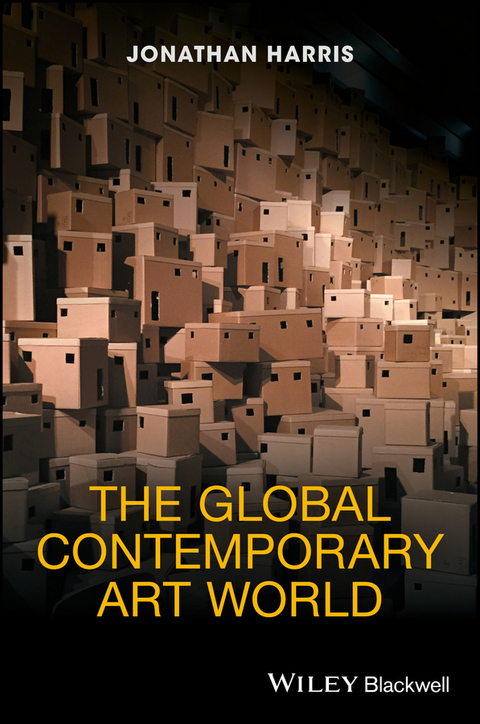
The Global Contemporary Art World (eBook)
John Wiley & Sons (Verlag)
978-1-118-33908-4 (ISBN)
The final installment in the critically-acclaimed trilogy on globalization and art explores the growing dominance of Asian centers of art
This book takes readers on a fascinating journey around five Asian centers of contemporary art and its myriad institutions, agents, forms, materials, and languages, while posing vital questions about the political economy of culture and the power of visual art in a multi-polar world. He analyzes the financial powerhouse of Art Basel Hong Kong, new media art in South Korea, the place of the Kochi Biennale within contemporary art in India, transnational art and art education in China, and the geo-politics of art patronage in Palestine, and he develops a highly original synthesis of theoretical perspectives and empirical research.
Drawing on detailed case studies and personal insights gained from his extensive experience of the contemporary art scene in Asia, Professor Harris examines the evolving relationship between the western centers of art practice, collection, and validation and the emerging 'peripheries' of Asian Tiger societies with burgeoning art centers. And he arrives at the somewhat controversial conclusion that dominance of the art world is rapidly slipping away from Europe and North America.
The Global Contemporary Art World is essential reading for undergraduates and postgraduate students in modern and contemporary art, art history, art theory and criticism, cultural studies, the sociology of culture, and globalization studies. It is also a vital resource for research students, academics, and professionals in the art world.
JONATHAN HARRIS is Head of Birmingham School of Art at Birmingham City University, UK. He has taught and lectured on modern and contemporary art at universities, museums and galleries worldwide for over thirty years. His The New Art History: A Critical Introduction (2001) remains a classic text, and he has published twenty books as editor, author and co-author, including Globalization and Contemporary Art and The Utopian Globalists (Wiley-Blackwell, 2011 and 2013).
JONATHAN HARRIS is Head of Birmingham School of Art at Birmingham City University, UK. He has taught and lectured on modern and contemporary art at universities, museums and galleries worldwide for over thirty years. His The New Art History: A Critical Introduction (2001) remains a classic text, and he has published twenty books as editor, author and co-author, including Globalization and Contemporary Art and The Utopian Globalists (Wiley-Blackwell, 2011 and 2013).
About the Author vii
Introduction: "Global," "Contemporary," "Art," "World" 1
Entering the Maze 1
Modernity, Contemporary Art and Globalization 7
Five Asian Centers Within the Global Contemporary Art World 15
Global Crash, Crises and the Art World 20
Contemporary Art in the Friezer 25
1 Doing the Business: Producing Consumption in the Hong Kong Art World 35
Hong Kong Gets the Art Basel Treatment 35
Offshore Art Business in the Global Neoliberal Capitalist Economy 39
Combined and Uneven Development in the Hong Kong Art World 45
Hong Kong's Art World Inside and Outside China 52
2 New Media Art and Cultural Globalism in South Korea 65
The Chic of Global "New Media Art" 65
Contemporary Art as Global Cultural Diplomacy 69
"Glocal Video": Conventions and Critiques 73
Culture, Contemporaneity and the Postcolonial Artwork 76
The "Real DMZ Project": Conflict Art in the Korean Peninsula 80
Contemporary Art Across Global Asia 85
3 Globalizing Indian Contemporary Art: The Biennial as Rhetorical Form 95
The Kochi Biennale Big Sell 96
Kochi as a Global Venue 99
Art at Kochi: Liberal Pluralism Versus Social Engagement with Globalization? 102
The Highs and Lows of Art, Media and Kochi Biennale Capital 108
Utopian Rhetoric in Contemporary Art at the Kochi Biennale 113
4 Social Reproduction of Contemporary Art in the People's Republic of China: Higher Education and the Branding of "Contemporary Chinese Art" 127
Art and Design Education as a Globalization Process 127
Changing Identifications in Art and Design Education in China 132
Contemporary Chinese Art Marketed for Global Consumption 136
Chinese Art and the World Art System 141
5 Contemporary Art and Post?-National Identities in the State of Palestine 155
"Palestine is Open for Business"! 155
Grounding the Culture Industry in Palestine 158
Palestinian Museums?-of?-art?-in?-waiting 162
The "NGO?-ization" of the Contemporary Art World in the State of Palestine 167
Concrete into Dust 172
6 Conclusion: Motifs of Global Fracture in the Art Of Bashir Makhoul and Wang Guofeng 181
Re?-Entering the Maze 181
In Girum Imus Nocte et Consumimur Igni 185
Utopian Photo?-Mythologies 188
Aesthetic and Social Implications of Digital Photography 191
Aesthetic and Social Implications of Digital Technology 194
Selected Bibliography 201
Index 217
1
Doing the Business: Producing Consumption in the Hong Kong Art World
My “premium economy” class flight to Hong Kong is delayed due to engine trouble and I spend a mostly sleepless “economy economy” night in a Helsinki airport hotel waiting for the jet’s repairs to be completed. I finally arrive at my budget hotel in Soho, near the western tip of Hong Kong island, only about eight hours later than scheduled, though it feels like I’ve lost a whole day…
Hong Kong Gets the Art Basel Treatment
On that first morning in Hong Kong I encountered a big demonstration in the downtown area protesting against the PRC’s plans to vet all candidates wishing to stand for election to the Hong Kong government in 2017. The privately owned, stock market‐listed South China Morning Post newspaper—once owned by Rupert Murdoch’s News International group—noted that this was the “biggest march for a decade,” held on the seventeenth anniversary of the British handover of Hong Kong to mainland Chinese rule in 1997. A local version of the global “Occupy” movement had emerged recently and taken a lead in the protests.1 I skimmed the pages of the A.M. Post, a free monthly magazine on Hong Kong contemporary visual arts. Many stories in the June 2014 number were concerned with the second “edition” of Art Basel Hong Kong held earlier and the numerous related art world events that had been arranged to take advantage of the potential buyers who had flown in for the fair. The global contemporary art world is, as many commentators note, predominantly “event driven.”2
A.M. Post reported, for instance, that a planned show of life‐size sculptures by Antony Gormley, intended to be sited at various high vantage points around Hong Kong, was cancelled due to the suicide of a bank employee who had jumped from the JP Morgan building offices… the French and Hong Kong governments had collaborated on the just‐opened exhibition “Paris Chinese Painting: Legacy of the Twentieth‐Century Chinese Masters” at the Hong Kong Museum of Art… Para/Site, a chic alternative exhibition and meeting space founded by artists in 1996, had paired up with the library, research and education agency Asia Art Archive, founded in 2000, to produce a show about the “colonial legacy” of “sexual conservatism” in the territory (“Sex in Hong Kong: Ten Million Years of Yearning”)… Ai Wei Wei’s Berlin show ‘Evidence’ had dealt with the artist’s recent imprisonment in the PRC ostensibly for tax evasion and the revelations of official corruption… a show at the newly opened government‐funded arts and “cultural engagement” center, enigmatically called “Oi!”—developed on the site of the former Hong Kong Yacht Club—included a nostalgic film installation by Kingsley Ng based on 1950s home movies of the colony’s Lunar Park fairground.3
This snapshot indicates something of the range of activities within Hong Kong’s contemporary art world in the first half of 2014, which was enlivened and considerably enlarged by the takeover of the Hong Kong Art Fair by Art Basel three years earlier. This move helped to encourage several globally active key New York/London dealing galleries to open venues in the city, confirming the centrality of Hong Kong in the Asian contemporary art market. A.M. Post’s editorial fairly sang Art Basel’s praises. The business in Hong Kong had initiated, it noted, some philanthropic as well as financial partnerships with, for instance, Art Basel’s support for the planned “visual culture” mega‐museum M+, Asia Art Archive, the Hong Kong Tourist Board, as well as “main sponsor” Deutsche Bank (Germany’s largest financial group, holding assets worth more than 1 trillion dollars), whose corporate art collection was foregrounded at Art Basel Hong Kong’s first edition in 2013. These organizations constitute something of the usual range of “bedfellows”—some combinations perhaps appearing unlikely—which cohabit or partner‐up in the global contemporary art world. Multinational banks come to rub their shoulders here with “anti‐colonial” and even explicitly dissident arts organizations. Sounding only mildly sarcastic, A.M. Post’s editors reflected in Warholian terms that it was perhaps “time for artists to […] enjoy the wealth and quality in life that business can bring, so that art can tread its path towards business—towards a better place.”4
Art Basel Hong Kong’s debut fair in 2013 consolidated the premium significance of the territory within Asia’s contemporary art world, although the focus of activity there is overwhelmingly on sales rather than on art production or museum and gallery shows. The SAR is geographically contiguous with mainland China—from which much art is brought to be sold to an effective world market—and relatively close to a number of other significant eastern Asian and southeast Asian contemporary art centers, including Taiwan, Japan and Singapore. Hong Kong’s key role is in the production and promotion of art consumption: in terms of art buying, selling and branding—these are the defining features of the global art fair business. Setting aside sales of artworks shown at the fair, Art Basel Hong Kong, along with several satellite fairs and auctions in the city, generates and stimulates economic, social and cultural activity at many interrelated levels and points within the system that comprises the Hong Kong art world. The glossy opening pages of the main catalogue published for Art Basel Hong Kong in 2013, a third‐tier world art fair now, alongside original Art Basel (first edition 1970) and Art Basel Miami Beach (first edition 2002), emphasize the continuum of “luxury” commodities associated with the art market. These include gold watches, Cuban cigars, vintage French champagne and residential properties in central London and Manhattan. The catalogue also showcased BMW high performance cars painted in the style (“brands”) of postmodern and contemporary artists, or their representatives, prepared to be linked to this wider luxury market: from “Andy Warhol BMW M1 1979” to “Jeff Koons BMW M3 GT2 2010.”5
Figure 3 BMW art car: Jeff Koons BMW M3 GT2 2010 (BMW car, painted in style of Jeff Koons, 2010).
Source: © Frank Stella. ARS, NY and DACS, London 2016.
The Art Basel businesses themselves are marketed as luxury goods, services and experiences—three complementary sets of products central now to the operation and character of the global contemporary art world. If the small city of Basel in Switzerland offered what is described as “limitless culture without going very far,” including access to what is claimed to be the “world’s oldest public art collection,” (the city’s municipal collection of art, founded in 1661), then the US city of Miami Beach boasted “premier international art and a high‐caliber audience.” Part of the unique service offered by Art Basel, then, is the delivery to participating gallery owners of a dense population of serious potential buyers. Meanwhile, the throng of mere onlookers, though vital to the spectacle of the fair, are kept at a distance from the VIPs.6
Time Out Hong Kong’s ‘Hong Kong Art Guide’ to the 2013 Art Basel fair in the SAR also began with multiple pages parading Western luxury brands and fashion models. Then it announced a Jean‐Michel Basquiat show at the new Gagosian gallery in town. A few pages later the Chinese performance artist duo Cai Yuan and Jian Jun Xi – based in Britain, famous mostly for jumping on Tracey Emin’s My Bed installation at Tate Modern in 1999—made an appearance advertising new works at the Shanghai Tang gallery venue in Hong Kong. Yuan and Xi’s “interventions,” the ad claimed, “reflect upon the phenomenon of globalization and the role of modern China in the 21st century.” Celebrity in the contemporary art world is an inevitable adjunct of this kind of marketing activity. The Art Newspaper International Edition, commemorating the first Art Basel Hong Kong, presented its own photo‐gallery of the most internationally famous Chinese artists: Zhang Peili—reputedly the creator of the first video artwork made in the PRC in 1988—Ding Yi, Cai Guo‐Qiang, Zeng Fanzhi, Yu Hong and Ai Weiwei (the latter named as the most influential player in the contemporary art world by Art Review magazine in 2011).7
Art Basel Hong Kong, following on from the Miami Beach operation, articulates the related worlds of business, city tourism and regeneration, luxury consumption and celebrity media culture. The art fair model has become a global template, encouraging both mutually beneficial and potentially competitive contemporary art world markets. For instance, the main catalogue contains an advert for the 2014 India Art Fair in Delhi, sponsored by “Yes Bank.” “Sponsoring,” “collaboration” and “partnership” activities have extended deeply into the productive activity of some globally successful artists who’ve become key players in the world...
| Erscheint lt. Verlag | 27.7.2017 |
|---|---|
| Sprache | englisch |
| Themenwelt | Kunst / Musik / Theater ► Kunstgeschichte / Kunststile |
| Kunst / Musik / Theater ► Malerei / Plastik | |
| Kunst / Musik / Theater ► Theater / Ballett | |
| Sachbuch/Ratgeber ► Sport ► Tanzen / Tanzsport | |
| Schlagworte | Art & Applied Arts • art basel hong kong • Art criticism • Art education • art education in asia • art education in the middle east • Art History • Art History & Criticism • art theory • Asian Art • asian arts world • asian dominance in the arts • contemporary Art • contemporary Asian art • global art theory • global capital and art • Globalization • globalization and art • Jonathan Harris • Kunstgeschichte • Kunstgeschichte u. -kritik • Kunst u. Angewandte Kunst • modern art • political economy of art • political economy of culture • post-modern asian art • the art of globalization • the art scene in asia • the asian art scene • Transnational art • transnational art criticism • visual arts in china • visual arts in india • visual arts in south korea • visual arts in the middle east • Zeitgenössische Kunst |
| ISBN-10 | 1-118-33908-8 / 1118339088 |
| ISBN-13 | 978-1-118-33908-4 / 9781118339084 |
| Informationen gemäß Produktsicherheitsverordnung (GPSR) | |
| Haben Sie eine Frage zum Produkt? |
 EPUB (Adobe DRM)
Kopierschutz: Adobe-DRM
Adobe-DRM ist ein Kopierschutz, der das eBook vor Mißbrauch schützen soll. Dabei wird das eBook bereits beim Download auf Ihre persönliche Adobe-ID autorisiert. Lesen können Sie das eBook dann nur auf den Geräten, welche ebenfalls auf Ihre Adobe-ID registriert sind.
Details zum Adobe-DRM
Dateiformat: EPUB (Electronic Publication)
EPUB ist ein offener Standard für eBooks und eignet sich besonders zur Darstellung von Belletristik und Sachbüchern. Der Fließtext wird dynamisch an die Display- und Schriftgröße angepasst. Auch für mobile Lesegeräte ist EPUB daher gut geeignet.
Systemvoraussetzungen:
PC/Mac: Mit einem PC oder Mac können Sie dieses eBook lesen. Sie benötigen eine
eReader: Dieses eBook kann mit (fast) allen eBook-Readern gelesen werden. Mit dem amazon-Kindle ist es aber nicht kompatibel.
Smartphone/Tablet: Egal ob Apple oder Android, dieses eBook können Sie lesen. Sie benötigen eine
Geräteliste und zusätzliche Hinweise
Buying eBooks from abroad
For tax law reasons we can sell eBooks just within Germany and Switzerland. Regrettably we cannot fulfill eBook-orders from other countries.
aus dem Bereich