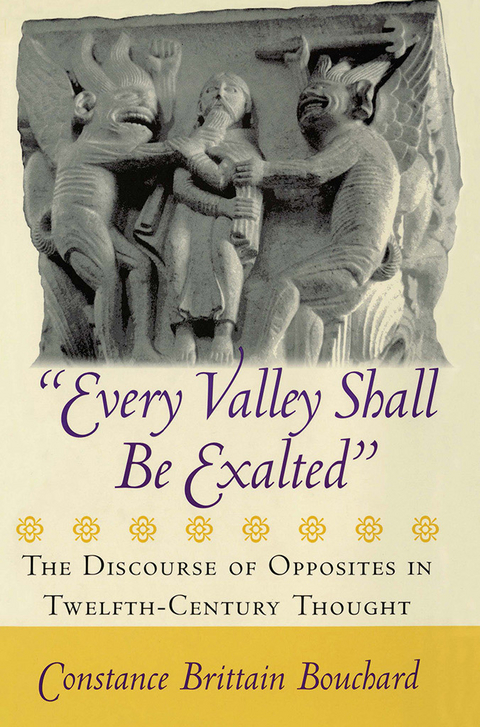
"Every Valley Shall Be Exalted" (eBook)
192 Seiten
Cornell University Press (Verlag)
978-1-5017-1664-5 (ISBN)
In high medieval France, men and women saw the world around them as the product of tensions between opposites. Imbued with a Christian culture in which a penniless preacher was also the King of Kings and the last were expected to be first...
In high medieval France, men and women saw the world around them as the product of tensions between opposites. Imbued with a Christian culture in which a penniless preacher was also the King of Kings and the last were expected to be first, twelfth-century thinkers brought order to their lives through the creation of opposing categories. In a highly original work, Constance Brittain Bouchard examines this poorly understood component of twelfth-century thought, one responsible, in her view, for the fundamental strangeness of that culture to modern thinking.Scholars have long recognized that dialectical reasoning was the basic approach to philosophical, legal, and theological matters in the high Middle Ages. Bouchard argues that this way of thinking and categorizing—which she terms a "discourse of opposites"—permeated all aspects of medieval thought. She rejects suggestions that it was the result of imprecision, and provides evidence that people of that era sought not to reconcile opposing categories but rather to maintain them. Bouchard scrutinizes the medieval use of opposites in five broad areas: scholasticism, romance, legal disputes, conversion, and the construction of gender. Drawing on research in a series of previously unedited charters and the earliest glossa manuscripts, she demonstrates that this method of constructing reality was a constitutive element of the thought of the period.
In high medieval France, men and women saw the world around them as the product of tensions between opposites. Imbued with a Christian culture in which a penniless preacher was also the King of Kings and the last were expected to be first, twelfth-century thinkers brought order to their lives through the creation of opposing categories. In a highly original work, Constance Brittain Bouchard examines this poorly understood component of twelfth-century thought, one responsible, in her view, for the fundamental strangeness of that culture to modern thinking.
Scholars have long recognized that dialectical reasoning was the basic approach to philosophical, legal, and theological matters in the high Middle Ages. Bouchard argues that this way of thinking and categorizing—which she terms a "discourse of opposites"—permeated all aspects of medieval thought. She rejects suggestions that it was the result of imprecision, and provides evidence that people of that era sought not to reconcile opposing categories but rather to maintain them.
Bouchard scrutinizes the medieval use of opposites in five broad areas: scholasticism, romance, legal disputes, conversion, and the construction of gender. Drawing on research in a series of previously unedited charters and the earliest glossa manuscripts, she demonstrates that this method of constructing reality was a constitutive element of the thought of the period.
Constance Brittain Bouchard is Distinguished Professor of Medieval History at the University of Akron. Among her many books are "Strong of Body, Brave and Noble," Holy Entrepreneurs, and Sword, Miter, and Cloister, all from Cornell.
Introduction1. Scholasticism: "The Last Shall Be First"2. Romance and Epic: "Honor Abandoned Because of Love"3. Conversion: "A Poor Man from a Rich Man"4. Conflict Resolution "He Humbly Delivered Himself to Justice"5. Gender: "Male and Female Created He Them"Conclusion
| Erscheint lt. Verlag | 31.5.2017 |
|---|---|
| Zusatzinfo | 4 halftones |
| Verlagsort | Ithaca |
| Sprache | englisch |
| Maße | 150 x 150 mm |
| Themenwelt | Sachbuch/Ratgeber ► Geschichte / Politik ► Mittelalter |
| Geschichte ► Allgemeine Geschichte ► Mittelalter | |
| Geisteswissenschaften ► Geschichte ► Regional- / Ländergeschichte | |
| Religion / Theologie ► Christentum ► Kirchengeschichte | |
| Geisteswissenschaften ► Sprach- / Literaturwissenschaft ► Anglistik / Amerikanistik | |
| Geisteswissenschaften ► Sprach- / Literaturwissenschaft ► Literaturwissenschaft | |
| Schlagworte | medieval thinkers, France, dialectical reasoning, medieval studies, interaction of religious thinkers, culture of the Middle Ages, high medieval thought |
| ISBN-10 | 1-5017-1664-6 / 1501716646 |
| ISBN-13 | 978-1-5017-1664-5 / 9781501716645 |
| Informationen gemäß Produktsicherheitsverordnung (GPSR) | |
| Haben Sie eine Frage zum Produkt? |
 EPUB (Adobe DRM)
Kopierschutz: Adobe-DRM
Adobe-DRM ist ein Kopierschutz, der das eBook vor Mißbrauch schützen soll. Dabei wird das eBook bereits beim Download auf Ihre persönliche Adobe-ID autorisiert. Lesen können Sie das eBook dann nur auf den Geräten, welche ebenfalls auf Ihre Adobe-ID registriert sind.
Details zum Adobe-DRM
Dateiformat: EPUB (Electronic Publication)
EPUB ist ein offener Standard für eBooks und eignet sich besonders zur Darstellung von Belletristik und Sachbüchern. Der Fließtext wird dynamisch an die Display- und Schriftgröße angepasst. Auch für mobile Lesegeräte ist EPUB daher gut geeignet.
Systemvoraussetzungen:
PC/Mac: Mit einem PC oder Mac können Sie dieses eBook lesen. Sie benötigen eine
eReader: Dieses eBook kann mit (fast) allen eBook-Readern gelesen werden. Mit dem amazon-Kindle ist es aber nicht kompatibel.
Smartphone/Tablet: Egal ob Apple oder Android, dieses eBook können Sie lesen. Sie benötigen eine
Geräteliste und zusätzliche Hinweise
Buying eBooks from abroad
For tax law reasons we can sell eBooks just within Germany and Switzerland. Regrettably we cannot fulfill eBook-orders from other countries.
aus dem Bereich